Monday, August 28, 2006

Disappearing Aircraft - Part 1 Stardust


There is, in UFO history, a number of reports of aircraft disappearing into the mists of time. In 1947 the Stardust, a passenger plane on its way to Santiago, Chile disappeared allegedly in sight of the airfield. The search, conducted over the next week found no sign of the wreckage.

In November 1953, an Air Force interceptor, sent to identify an object over Lake Superior disappeared from radar after its image was seen to merge with that of an intruder. The search, conducted over the next week found no sign of the wreckage.

In the mid-1950s, according to a retired Air Force brigadier general, four aircraft on a mission over Kentucky disappeared. According to the general, no sign of wreckage was ever found.

The first of these strange disappearances occurred on August 2, 1947, the Stardust, with eleven people on board took from Buenos Aires for Santiago. It was a routine flight for the British South American Airways plane. The weather was deteriorating and later would approach blizzard conditions, but it wasn’t so bad that the captain, Reginald Cook thought he needed to cancel the flight.

At 5:33 p.m. the radio operator Dennis Harmer sent a message to the Santiago Tower that they were slightly behind schedule but they believed they would arrive at the airfield in about twelve minutes. Then, at 5:41, Harmer made the last transmission. It said, "ETA Santiago, 17:45 hours. Stendec."

In the Santiago Tower, the operator didn’t understand the last word and asked that it be repeated. It was. Twice. Stendec. No one knew what that meant. It was also the last word ever heard from the aircraft. It had simply vanished from the face of the Earth.

Because of a snow storm, the search for the aircraft couldn’t begin until August 3. At first, given the position provided by the aircraft, the search centered near Santiago. When nothing was found there, the search was expanded but no trace of the aircraft was found. At least none was found in 1953.

Nearly forty-seven years later, in January, 2000, five mountaineers, climbing the rugged Mount Tupungato in Argentina, discovered the wreckage of an old aircraft. They also found the remains of three people. The Argentine Army sent an expedition into the area, which is so rugged that the soldiers had to hike the last few miles because even the burros were unable to make it. Using serial numbers from the engines and other bits of wreckage, they identified the aircraft as the long missing Stardust.

The aircraft, not fifty miles from Santiago as the pilots had believed and still over the Andes, was caught in the snow. The pilot, thinking he was approaching Santiago, but with no visual evidence outside the cockpit, began to descend. Unfortunately, their navigation was off and rather than being over the relatively flat ground near the Santiago airport, were still in the mountains. Tragically, they flew into the side of a mountain glacier. The show covered the wreckage during the night, concealing it from the aerial search along the flight route. Then, slowly the glacier swallowed all remnants of the aircraft. For fifty years that wreckage "flowed" downhill with the glacier. It finally flowed to the surface a couple of miles down the mountain. It was here, on a plateau, the wreckage was exposed and discovered.

The army expedition uncovered more wreckage, retrieved the remains of most of the victims some of whom were identified using DNA techniques, and confirmed the identity of the aircraft. The mystery of the Stardust had been solved... Well, most of it. No one has ever figured out what the strange word sent by Harmer meant. It is the only mystery about the crash that remains.

Friday, August 25, 2006

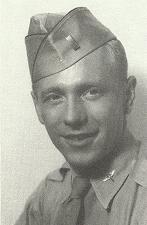
Russ Estes is Gone

Since I returned from Iraq in 2004, too many of my friends in the UFO field have died. The latest was Karl Pflock whose obituary can be accessed in the June 2006 Archives.

Philip Klass, who clashed with so many of us in the field died after a long fight with various diseases. Too many delighted that he was gone. While Philip and I disagreed on many aspects of the UFO field, I believe that we had a mutual respect for each other’s position. Yes, I’ve heard the stories of his nasty attacks on people, well aware that he was capable of doing anything he could to make life miserable for those on the other side of the fence. Some of his attacks were unfair, but certainly no worse than what those of us on our side have done to our own.

But the death that hit closest to home was Russ Estes. I had first met him in Albuquerque when he was working on a documentary about UFOs. He was at the MUFON Convention there, interviewing the speakers, the investigators, and anyone else who might have an interesting story to tell. I was one of those who sat down for his camera. I really remember little of what I said, other than providing information about my investigations into Roswell.

Months later, Don Ecker of UFO magazine, was arranging for UFO researchers to meet at Disney World to help promote the opening of a new "experience" with an alien theme. On my way to Florida I met Russ on the aircraft. I remembered him because he was a huge man.

While in Florida we spent quite a bit of time together talking about UFOs. Russ was as interested as I. We formed a friendship there that would last until his death.

After Florida I stayed in touch with Russ. He planned more documentaries and thought I could help him. I liked the idea of putting some of these ideas onto film, or more accurately, video tape.

Over the next decade we would meet many times. I traveled to California to visit him. I watched as he worked his magic with video tape and learned that the was an accomplished artist, had performed on a regular basis at the old Playboy Clubs, served in Vietnam with the Army Security Agency, and had lectured on a variety of topics.

Russ and I wrote a couple of books together. In two of them, he was more the illustrator than the writer, though he did contribute to the writing while I did little to contribute to the illustration. Together with Dr. William Cone, we wrote The Abduction Enigma about alien abductions. I was always a little disappointed that the book didn’t get a wider circulation because I thought it made some important points about abductions. Russ and Bill Cone had worked out much of the insight, though I believe I added to those insights.

In his last years, Russ had trouble with diabetes. At first it was an annoyance, meaning he had to eat on a fairly rigid schedule, but later it caused other troubles, as diabetes does. He might have suffered a fatal heart attack because of the diabetes, but given his location and circumstances, he was revived for a few more years. Think about that for a moment. He died of a heart attack, and was revived to live another few years. Not many can say that.

We’d had a tradition that I would call him just after midnight on New Year’s Day, asking how things were back in the past. I failed to make the call as 2004 slipped into 2005 because I hadn’t been back from Iraq all that long and I fell asleep. He tried to call me, but for some reason, I didn’t hear the telephone. I called him the next day. It was the last time we’d speak.

Russ had a fine mind and saw through much of the nonsense in the UFO field quickly. He’d ask the hard questions and that would, of course, annoy others. Exposing the flaws in a theory should make those proposing the theory reevaluate it but in the world of UFOs, it gets you labeled as a debunker and a government agent.

Russ was both these things... in some respects. Yes, he had once had ties to the intelligence community, but like me, those ties were of a non UFO nature and never really influenced what he thought and did. He had been a government agent just as anyone who served in the military, or worked for the IRS or the FBI or FEMA had been a government agent.

And he was a debunker in the best sense of the word. He took the bunk out of some aspects of the UFO field. You just have to watch the video of Harley Byrd going on and on about how he is the only real UFO researcher and he knows everything about UFOs. Russ didn’t really ask questions. He just let Byrd talk.

He produced an audio tape of music related to the UFO field with some wonderful songs on it. He sang, along with Bill Cone and Val Bankston, who also wrote much of the music. For a supposedly amateur tape, it was surprisingly professional. Such was Russ’s talent.

And now my friend is gone way too soon. I miss our sometimes esoteric chats, our delight at seeing the truth emerge when no one else wanted to hear it (I think of Gerald Anderson here as but a single example) and our realization that Don Schmitt had feet of clay.

What he wanted in the UFO field was to get at the truth. He talked to everyone and presented those findings to those who would listen. He didn’t have a big name, just a big heart.

Russ could be over powering, but only because he had so many talents in so many places. He was opinionated, but backed up his opinions with facts. Sometimes he was intractable, but more often he would listen to others, searching for weakness in their arguments. He did much for the field but few realize his contribution.

Russ was unique. He was intelligent, talented, insightful and sometimes a control freak, but he was always a friend. He is impossible to replace and I certainly miss him.

Thursday, August 24, 2006

Carl Hart and the Lubbock Lights


It seems that every time I sit down to add to this blog, I’m exposing another myth or solving another mystery. It begins to look as if I’m really a debunker in disguise. The truth is that I believe that we must publish, as quickly as we can, the solutions to mysteries that have baffled us for years. I’m fascinated by answers to long held mysteries which is why I often jump at the chance to expose them. Coming up in later blogs will be the solution to the disappearance of the Stardust and a possible solution to the disappearance of an Air Force interceptor in 1953.

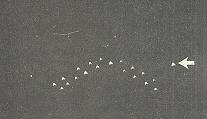
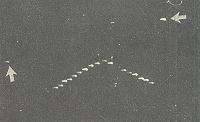
There are mysteries out there that remain intriguing. In August 1951 four college professors saw strange lights fly overhead in Lubbock, Texas, and the Lubbock Lights mystery was born. Many of those sightings have since been solved, and the solutions offered make sense. There is, however, one part of the case that remains as mysterious today as it did more than fifty years ago and that is the photographs taken by Carl Hart, Jr.

On February 1, 1993, I had the opportunity to interview Carl Hart about the photographs. What follows is that interview. (For those interested in more about the Lubbock Lights, I suggest a look at my 1997 book, Conspiracy of Silence.) I offer the notes of the interview without commentary (well, not much).

After learning that the man I was talking with had taken the famous pictures, I asked, "Were you looking for the lights when you saw them?"

He said, "Oh, no. Of course this was summer time and very hot. We didn’t have anything like central air conditioning. I slept with the windows open and I liked to sleep with my head stuck out the window and there they were."

"You saw them fly over one time?"

"Oh, I think if I remember there were like three formations... of course they had been in the news here for a week or two before I happened to see them and they usually showed up in several flights when they would so... when I saw them I went on outside with my camera..."

"Did you get a feel for the size of the objects or how high above you they were?"

"Not really... the only thing I saw was lights. Wasn’t any other objects associated with them. Wasn’t any noise..."

"Now you were questioned quite closely by the Air Force..."

"The Air Force and everybody else."

"Did the Air Force give you a final conclusion of what they thought you had photographed?"
"No, no they didn’t. I never did hear an official version. I heard some unofficial things that came out later... about how they thought I had faked them somehow or another." (Attempts to duplicate the pictures by a professional photographer failed... and because of that, this part of the mystery remains unsolved.)

"Of course you hadn’t faked them..."

"No."

"You have no idea what they were?"

"I really don’t. I’m not even sure who it was. There was someone tried to duplicate the light in a laboratory by reflecting light off a pan of water where they could cause a ripple run down the water and they could cause them to move and his theory was that it was a cold air inversion and that it had waves in it like the ocean and the sensation of them moving across the sky so I don’t know if that’s what happened or not." (This was Dr. Donald Menzel whose results were published in 1952. Later Menzel decided, without evidence, that Hart had faked the pictures. Menzel, it seems, could not admit that some aspects of the UFO phenomenon were inexplicable.)

"You really have no clue about what you saw..."

"I really don’t. Nothing’s ever come forward to explain those and there wasn’t anything for me to judge them by other than just the lights on the bottom of just one object or group of individual lights... They were lights either on something or individually."

Did you know the professors who had seen the things the first night?"

"Later on I did. I didn’t know them at the time."

"Were they aware you had taken the pictures?"

"Oh, yeah. I think there were some of the ones felt like I had stolen their glory... They weren’t too receptive of what I had done as best I could recall."

"Have you made any money off this thing?"

"I might have made three or four hundred dollars total over the years."

"The pictures appear in books and magazines all the time."

"I wasn’t aware enough of what was going on to copyright them. If anyone paid my anything it was to save themselves from possible legal problems later on... for several years people would ask before they would use them... My advice from a friend and professional journalist at the time was that if you copyright them somebody’s going to think you faked tem and are trying to make money out of them"

Hart did tell me that he doesn’t particularly disbelieve in flying saucers. He said, "I’m kind of open minded on that. If one would show up some place else here, I think I’d accept."

I asked him one last time if he knew what he had photographed.

"I really don’t."

(I have found that those faking UFO pictures eventually come clean, admitting the hoax, sometimes decades later. With Hart, although no one would really care at this late date if he had faked them, he maintained he didn’t know what he had photographed. Because of that, the photographic part of the Lubbock Lights remains unsolved.)

How Many Planets? Part 3

The International Astronomical Union had met and voted, and the correct answer to that question is now... Eight.

After what some have described as a hotly debated issue, a definition of a planet was produced that included three criteria. It had to be large enough to have a gravitational field strong enough to make it a round object, it had to orbit the sun, and finally it had to have "swept" that orbit of debris (or as the IAU put it, "cleared the neighborhood around its orbit"). Pluto failed because it crossed the orbit of Neptune.

Pluto is demoted to "dwarf" planet, which means the other objects, out in the Kuiper Belt and beyond would also be dwarf planets. Ceres, which held planetary status in the 19th Century, was demoted and then considered for promotion, would be a dwarf planet. Charon would remain a moon of Pluto.

Personally, I find this a little disappointing. I had hoped we were going to expand the Solar System (though I guess we have) and increase the number of planets. In writing science fiction when I have found it necessary to create solar systems in the far reaches of space, they always had more than nine planets (or as is now the case, eight).

The only positive in this is that here, in 2006, we actually debated the issue. I suspect, as our knowledge of the Solar System increases, we may find ourselves in this debate once again. In the Discover magazine article, they suggested that one of the objects out beyond Pluto was the size of Mars. That, it seems to me, would qualify it as a planet (if the size is confirmed), though it might not have the "clean" orbit now claimed as the third part of the definition.

So, now we have answer to the question. How many planets in the Solar System? Eight.

Saturday, August 19, 2006

How Many Planets - Part Two


About a year ago I wrote a column asking how many planets there were in the Solar System. The only real conclusion I drew was that the true number wasn’t nine. If Pluto was demoted, the answer was eight, and if not, the answer was twelve. Either way, changes were coming to our definitions.

Now the International Astronomical Union has suggested the correct answer is... twelve. I was right. But I picked the wrong objects.

According to the IAU, 1 Ceres, once thought to be a planet, demoted to asteroid, would once again reach planetary status. Charon (which for some reason I called Clarion) would be named a planet, orbiting a central point with Pluto and both orbiting the Sun (See photo of Pluto, Charon and their two moons, photo courtesy of NASA). Kind of a strange relation between the two.

And 2003 UB313 (aka Xena) would also be called a planet. These three objects along with 1 Ceres would be known as Plutons, a sort of small planet. All would be out with Pluto or beyond with the obvious exception of 1 Ceres.

But if this is voted on by the membership of the IAU, then it opens the door for a number of other objects far out into space, one of them about half the way to Alpha Centuri.

Discover magazine, in November 2004, carried a story about these new objects, suggesting that Sedna (aka 2003 VB12) should be considered as a planet. According to the figures published them, it is larger than 1 Ceres, and could be twice as large.

According to the magazine, in addition of Sedna, there were an additional seven objects that ranged in size from about five hundred miles in diameter up to about a thousand miles (2004 DW).

The IAU’s seven member Planet Definition Committee recommended that 1 Ceres, Charon and Xena all be awarded planetary status. They created two criteria for this. The object had to be large enough so that its gravity would pull it into a nearly spherical shape and it must orbit the Sun. That second criterion eliminates the largest of the moons in the Solar System. Many of those objects out beyond Pluto, in the Kuiper Belt, just barely make it, but the latest information makes them large enough.

So, at the moment, there are nine planets in the Solar System, but after the membership of the IAU votes, the answer will probably change with three additions, which makes twelve. In the years to come, if the information we have holds up, the answer will rise to, at a minimum of nineteen with some astronomers believing that thirty is a more likely answer.

As I said before, this is an exciting time to study astronomy. Maybe 19 planets in our Solar System, more than 200 planets discovered around other stars, and much more to be found.

Spitzbergen UFO Crash


For the last ten years or so, there has been a list of UFO whistle blowers circulating. There are many names on the list but few of them have anything spectacular to tell. Most of the stories are of seeing UFOs and reporting them up the chain of command. Some of these witnesses tell of seeing classified documents relating to UFOs and UFO crashes.

One such witness is former Air Force Lieutenant Colonel Dwayne Arneson. Now, don’t get me wrong here. I believe that Lt. Col. Arneson served in the Air Force just as he claimed. I believe that a check of his record will corroborate what he says about his military career. In fact, I was in email communication with Lt. Col. Arneson at one time but haven’t heard from him in months (I suspect it was because I suggested that the Spitzbergen crash was a hoax, but I get ahead of myself here).

According to Dr. Stephen Greer’s Disclosure documents, Lt. Col. Arneson said, "I was a top secret control officer. I happened to see a classified message go through my com [communications] center which said, ‘A UFO has crashed on the Island of Spitzbergen, Norway, and a team of scientists are coming to investigate it."

I believe this to be true as well. In fact, I shouldn’t say that I believe it. I know it’s true. Classified communications among various Air Force locations about a crash in Spitzbergen did take place. I too have seen the documents. I have copies of them. Lt. Col. Arneson is correct.

But, that isn’t the whole story. In a classified document available in the Project Blue Book files, we read, "Info derived from foreign broadcasts to effect that German newspaper CMA [meaning comma, used rather than punctuation] carried article stating that a flying saucer-like flying object crashed Spitzbergen 9 July and that NAF [Norwegian Air Force] recovered it [usually, when using CMA for comma, they use PD for period but here they didn’t]. Claim diameter of 47 meters CMA constructed of steel of unknown alloy and that operating instructions written in Russian. Info apparently has had big play in German press running continuously since shortly after 9 July. Request validity of this info..."

Most UFO researchers now consider the case a hoax, but the late Frank Edwards, in his book, Flying Saucers - Serious Business, carries the report, attributing it to Stuttgarter Tageblatt which quotes a Colonel who provides additional details. He suggests the case is authentic. Ryan Woods, in his book, Majic Eyes Only, recounts the case, mentions that some think it a hoax, but rates it as one requiring further study. In my own, History of UFO Crashes, I suggest it’s a hoax.

Here, however, this doesn’t matter. What we have is a claim by a Disclosure Project witness about classified documentation that he saw while working with the Air Force. His story is true. He did see what he claimed. The only question left is if the report was of a real event or a hoax. Take your pick.

Wednesday, August 16, 2006

MJ-12 Revisited

I have, for a long time, thought there is no real government conspiracy to hide UFO information from us. I thought that we are so inept, that we accept so much as true with little or no proof, and that there are so many frauds, charlatans, fakers and liars out there that the government doesn’t need any program to discredit UFO reports. We do it to ourselves all the time.

But then I got to thinking about this MJ-12 stuff. I believed that it was created by certain members of the UFO community to propel themselves into the spotlight. It was a hoax from inside the community that wasn’t necessarily designed to mislead, but had another agenda behind it. This might have been a creation designed to shake information loose with the added benefit of media attention.

But then I began to reevaluate these thoughts.

And I began to look at those who were the initial reporters of MJ-12.

And I remembered something that Stan Friedman had told me a long time ago.

And I began to wonder if it wasn’t possible that MJ-12 was more of a government project that I had suspected.

Let me backtrack a little bit and mention William J. Moore who might be considered the father of MJ-12, who has been around the UFO field for a long time, and who admitted to ties to the intelligence community long ago. Moore had also once been on the Board of Directors of the Coral and Jim Lorenzen’s Aerial Phenomena Research Organization. Moore confessed that he was spying on UFO researchers for the government at that time.

I thought he was just making that up for some reason. He did accuse me of the same thing and since I knew that I wasn’t spying on anyone for any reason, I suppose that led me to my conclusion. Of course, he might have accused me as a justification for his own spying.

Friedman also told me that Moore had told him that he, Moore, was thinking about creating a Roswell type document because it might shake things loose. But what if the idea for this wasn’t Moore’s? What if it came from somewhere else?

Moore was also associated with Richard Doty, a former member of AFOSI who had lost his status as a member of AFOSI and finished his Air Force career in food service. This means, simply, that he was in charge of a Dining Facility or what we used to call a Mess Hall in the Army (now they’re DFACs which stands for Dining FACility).

Moore also said that he was responsible for some of the disinformation that was leaked to Paul Bennewitz. Moore said that he played along with this, even to the point of rearranging Bennewitz’s furniture to frighten him. Moore said he did it in the misguided belief that it would take him into the inner ring of the anti-UFO government programs so that he might be able to learn more about them and then expose them.

I thought at the time it was a load of crap, but probably because I was still being accused of being a government agent (this time by Don Schmitt who was supposedly my friend) and I knew this wasn’t true. But what if the government wanted to discredit UFO research. What if the plan was to throw out so many different ideas, so many tangents, that anyone who stumbled onto the right one might be dragged onto another. Or, if that didn’t work, just discredit all of UFO research by discrediting one small aspect of it.

For about twenty years we have been arguing the reality of MJ-12. Great amounts of effort, research and money have been dumped into the chase of MJ-12 and that is effort, research and money that was not available for other, possibly more productive lines of inquiry. And in that time, we haven’t uncovered anything that advances our knowledge of UFOs in any helpful way. We have not found the smoking gun documents but have found dozens, if not hundreds that are faked. In fact, some of the evidence suggests there were all faked. It even tells us who did it and why, but still the debate continues.

So, where does that leave us today? Well, Bill Moore did claim to be a government agent, he did admit to the harassment of Bennewitz for the government and he did admit to spying on researchers for the Air Force. Moore was the first to tell us of MJ-12 and it was Moore who worked to prove that MJ-12 was real. Maybe there is a connection here between the government and Moore that has accomplished the mission. Twenty years later and we’re still arguing about MJ-12 and when we divert our attention to MJ-12 we can’t focus it in other directions, and maybe that is the whole point.

Sunday, June 11, 2006

Karl Pflock Dies at 63

Karl Pflock, a long time researcher into UFOs and other related phenomena died June 5 from complications of ALS. He was 63.

I met Karl about fifteen years ago when he was associated with the Fund for UFO Research and I was beginning an investigation into the Roswell UFO crash. Karl convinced the Fund that another investigation should be initiated. Not long after that, Karl and his wife, Mary moved to New Mexico, which made it easier for him to investigate events in New Mexico.

Karl came to a different conclusion about the Roswell crash than I. Eventually; he was convinced that a balloon array launched in conjunction with the then top-secret Project Mogul was the best explanation. He found some of the eyewitness statements to be weak and without sufficient corroboration. He thought that the explanation offered by Charles Moore, one of the members of Project Mogul, to be persuasive. I did not.

He entered into a exclusive relationship with Glenn Dennis, the Roswell mortician who told the marvelous story of a nurse he had know out at the base, who told him about alien creatures and who soon disappeared. Karl didn’t know that Dennis already had an exclusive relationship with Mark Wolf.

Karl interviewed Frank Kaufmann, who I believed was telling the truth. Karl did not. He thought Kaufmann was spinning tales and based that on his interviews with Kaufmann. Kaufmann explained it away, but in the end, Karl was right about Kaufmann and I was wrong.

After a couple of years, neither of us believed much of what Glenn Dennis said. We’d seen too many of his tales collapse under investigation. So we agreed on that.

In fact, it turned out that we agreed on far more of the UFO field than we disagreed. We talked about Barney Barnett and how we found his tale of seeing the crashed Roswell saucer to be less than credible. We eventually wrote an article about it together, wondering what the UFO community would make of the collaboration. Karl, it turned out, had to do most of the final work because I found myself called to active duty in Iraq.

In the beginning, I think, we agreed on little and clashed more often than not. We debated the Mogul explanation at the 1997 Roswell Fiftieth Anniversary. We managed to fill the house but I think neither of us persuaded many in the audience. Those who believed in the aliens continued to do so and those who believed in Mogul continued to do so. If there was a winner, it was based solely on the beliefs of those who attended and not the merits of the arguments offered.

I believe he was a good researcher and he aspired to be a good writer as many of us do. Once I got away from the shadow of Don Schmitt, my relation with Karl became much more cordial. (I found that to be true with a number of other researchers with the exception of Tom Carey).

Karl, I think, had a bit of the flair for the dramatic, which explains to some extent, the Kurt Peters episode. Karl had told writers investigating a wave of cattle mutilations that his name was Kurt Peters rather than Karl Pflock. I was never convinced by his explanation for it, but heck, we've all done dumb stuff at younger ages. I had meant to ask him about it on a number of occasions but just never got that done.

I'm reminded too of a trip that he and I took in a limousine in LA nine years ago. We were going to do the Sci Fi Channel's SF Vortex and argue about Roswell and UFOs. Also in the car was Russ Estes and I realized that all three of us had been part of the intelligence community at some point. I wondered then what the conspiracy theorists would make of that... but now, two of those people are gone and given our ages, I wouldn't have expected it quite that quickly.

Just another note here. Karl had worked for the CIA but I never really knew what he had done for them. I suspect it wasn’t real exciting, in a covert way, but something necessary. I believe based on what he had said in the past that he had served in the Marines as well. He’d even been a Deputy Assistant Secretary of Defense. Those inside the UFO community like to suggest he was a "spook," but then, they like to say that about nearly everyone. Of course, his connection to the CIA didn’t help.

Karl liked to twist the tail of those in the UFO community, and sometimes we need it. I believe he was honest in most of what he did and said just as most of us are honest... I keep thinking of things to put here... things that many of us hold as self evident truths but that might not be quite as solid as we'd like them to be.

There were those in the UFO community who don’t see it this way and had their own arguments with Karl. It is impossible to do research and publish those results without offending some. It is also impossible to deal with people daily without offending some. Maybe there is good reason for that offense, but for me, Karl was fair and honest, and I believe we became friends.

We had planned to write a book together, though in the last couple of years, I think that was more of a dream for Karl. We exchanged ideas and thoughts, and had decided on a case to review at length. Then Karl suggested that he would gather the data and maybe I should do the writing. This was, of course, a result of ALS. I knew this and while I don’t really like these projects where I end up doing the writing, here it wasn’t Karl’s fault. Besides, he would do the editing and that is always a big problem. Finally, Karl had to bow out because he was afraid that he would be unable to finish his share of the work.

Anyway, I always enjoyed the exchanges with Karl, learned things during them, and kept in touch with him during my service in Iraq. I'm sorry that he was taken from us at this point because I think he could have added something to our research. He was much too young to be gone already.

Thursday, May 04, 2006

New Thoughts On the Autopsy Fake


When Ray Santilli admitted recently that he had faked the footage of the alien autopsy film there were those who were didn’t believe this new revelation. They began to suggest reasons why they didn’t believe Santilli was telling the truth. And they asked a very interesting question of the rest of us. If we didn’t believe Santilli in the beginning, when he first released the film, why did we believe him now?

The answer is simple. Evidence.

When Santilli appeared on the scene in the mid-1990s, he came with what seemed to be hard evidence. He had the statement from the cameraman who took the film and he had the film itself. At the time he first appeared he made a number of statements such as claiming that President Truman could be seen on the debris field and that trucks and cranes were there, all things hard if not impossible to fake. There were supposed to be nearly two hours of film including the in the field, preliminary autopsy and then another conducted in a morgue. At one point Santilli produced some classification sheets that he said were on the film canisters but which were more consistent with something from Hollywood than they were with military orders. After they were criticized, he quickly withdrew them.

Here are a few of the original problems. Take the film. This is a piece of physical evidence. We can examine what is on the film and see if it conforms to the standards of other such films shot at the time. First, it didn’t conform. Autopsy footage, according to former military cameramen, was always shot in color. There were normally three cameras, one fixed motion picture, one motion picture camera operated by a human operator, and one still camera operator. Santilli’s footage was in black and white with a single movie camera. Although the alien autopsy would have been a unique event, there was no reason to violate the norms of the time.

The film could be tested for age. Kodak said they would do it, but they wanted a frame of the film with the alien on it. Santilli never would allow that to happen providing a variety of excuses. If the film was dated to the proper time, 1947, while not proving the footage real, it certainly would go a long way in that direction. Refusal, however, suggested that there was either no film at all (meaning the thing was only on videotape) or that Santilli knew that Kodak would learn the truth about the age and that would uncut its value.

Kodak did say that all its film stock was marked with a code so that the year of manufacture could be determined. The problem was that they recycled the codes. So, while Santilli’s film had the code for 1947, the proper year, it could also have been 1967 or 1987. This proved nothing.

The real trouble was the lack of provenance for the film. Santilli said that it came from an U.S. Army cameraman who had inadvertently ended up with some canisters of classified film. He hadn’t known what to do with it or how to return it to the Army. But, Santilli would never identify the cameraman. Instead, he produced a transcript of an interview with the cameraman. It was filled with British colloquialisms. When challenged, Santilli said his British secretary had typed it, though that didn’t explain why an American was using British terminology. A new version was released without the British accent.

Then, while viewing footage of the wreckage on display in a tent, there was a metallic I-beam with some kind of strange symbols on it. Well, not so strange. The symbols spelled out video. What were the odds that alien symbols would spell out an English word when we had so few samples of the alien writing? That seemed to tell many of us that this was a video joke.

These, among other things, raised red flags for many of us. These were questions that were asked but were never satisfactorily answered. Instead, we were told that no one had come forward admitting this film was a hoax. It couldn’t have been carried out by one man, so where were all the others claiming they had participated in its creation?

Then, several years ago Phillip Mantle released a statement that the tent footage had been faked. This was of the first, preliminary autopsy, allegedly conducted in a tent on the crash site. Santilli, the story went, was disappointed by the quality of the tent footage, so he had recreated it in hopes of having something a little better to show and to make a little more money. Santilli was admitting that the tent footage was a hoax. He and friends had created it. The reason for it was irrelevant. The point was that it had been faked.

Now, several years later, Santilli was telling us all the footage was a recreation. He even identified the man who made the alien body and that man had expertise that allowed him to create it. Not only that, the man was proud of his work and confirmed that he had made the alien creature.

So, why do we believe Santilli now when we didn’t so long ago? Because all the evidence supports the admission and there is corroborating testimony from a man who has been identified as one of the participants in the hoax. There is no cameraman, and if there is film (as opposed to only videotape) of the autopsy, it was film Santilli and his friends created. There is no evidence to suggest that the alien autopsy is real and there never was.

But what astonishes me, as it has in the past, is that the man responsible has admitted the hoax and there are people who refuse to believe him. He told us how it was done, identified the other participants, and gave us a good reason for why it was done. And still people want to believe that the footage is real.

Well, it’s not. It’s a fake and I would hope that we never have to deal with it again. This is, however, UFO research and no matter what the outcome of a case, no matter how thoroughly it has been researched and then explained, it will resurface as people with little critical thinking skills tell us why it was real.

Friday, April 07, 2006

The End of the Alien Autopsy


I first saw the Alien Autopsy film when working on a documentary with a British film producer for a show to highlight the film. He sought comments from those of us who had spent time and money investigating the Roswell UFO crash. I studied the film, saw that it bore no resemblance to the descriptions of the aliens provided to us, noticed many other things wrong with the film, and thought that the autopsy as portrayed seemed to be rather superficial if not a bit cavalier.

We learned later that one part of the autopsy had been faked. Philip Mantle, a British UFO researcher had learned that the tent footage, a rather poorly lit, hard to see segment of the film had been "recreated" because the original footage was too poor to use on television. The tent autopsy wasn’t used because it was nearly blacked out and the body on the table could have been almost anything. In other words, the tent footage had been faked, though for the best of reasons, according to Ray Santilli, the man responsible for the whole Alien Autopsy mess. He had recreated it.

Now, comes more interesting news. Mantle, in a letter posted to various places on the Internet, tells us:

Tonight showed the SKY ONE TV show 'Eamon Investigates - Alien Autopsy’. The show starts of with Santilli still claiming that he saw real film of aliens and that he purchased it from a former US military cameraman. However, there is now a change in the story. Santilli & his colleague Gary Shoefield claim that it took 2 years to buy the film & that when it finally arrived in London 95% of it had 'oxidised' and the remaining 5% was in very poor condition.

They therefore decided to 'reconstruct' it based on Santilli's recollection and a few frames that were left. To do this they hired UK sculptor John Humphreys. Humphreys tells of how he used sheep’s brain for the brain and a lamb’s leg for the leg joint.

The cameraman's interview film is also a fake. The man in the film is someone they literally brought in off the street and gave him a prepared script to read from.

Santilli and Shoefield continually try to insist that the AA film as we know it is a restoration, but in fact it was made by John Humphreys.

To try and justify they claim that some of the surviving original frames are seen mixed in with the reconstruction/restoration. Interestingly neither Santilli, Shoefield or Humphreys could point out where and which are these frames when viewing the AA film.

Santilli admitted that the six-fingered panels in the debris film were the result of 'artistic license' and he even produced one of the I-beams from the boot of his car. The debris film was also made by John Humphreys.

In fact, Humphreys is the surgeon in the film, and a former employee of Shoefield's in behind the window. He's Gareth Watson, a man I met several times in Ray's office.

Nick Pope and myself appear briefly in this show and I dare say Nick will have his own comments to make.

For anyone interested in the AA film I do recommend watching this if you can. I've taken part in another show for Channel Five in the UK the content of which I am not permitted to disclose.

After watching this tonight I can honestly say that I do not believe one word of either Santilli or Shoefield and I have no doubt that the film is nothing more than a complete fake.

There is and never was any original film and there is and never was any US military cameraman. Santilli & Shoefield had little credibility as it was but now they have none.

The alien autopsy film is dead and I hope to put it to rest, once and for all, soon. Watch this space.

Philip Mantle

I could review the many reasons that I believed the film to be a fake, but those who are interested can find the opinions in my 1997 book, The Randle Report: UFOs in the ‘90s. You can also look at the Alien Autopsy wetsite hosted by v j enterprises at:

This also sets up a number of interesting questions. As some have pointed out, there are those who claimed to have seen the footage elsewhere. It was those witnesses, and Cliff Stone comes to mind here, who said they saw the footage long before Santilli released it into the public arena. Interestingly, none of those people are on record about such a film prior to the announcements made in 1995. Even more interestingly, with Santilli’s admission, none of those people ever said that the film didn’t look quite right. They just claimed to have seen it all before.

Yes, I know what the fall back position will be. Santilli said the film was so poor that they could use very little of it, so they recreated it. A very small part of the footage is real and the rest reconstructed. So, those claiming to have seen the film can now say, well, yes, it’s a reconstruction of what I saw long ago. I just couldn’t compare the original to what I saw but it looked like the same thing.

Crap.

Mantle said it all when he said the Alien Autopsy is dead. That’s where it should be, but there will be those who will claim that the government (whose… US or UK) got to Santilli and forced him to say the film was a recreation. There will be those who claim that the sheep’s brain or the lamb’s leg don’t make sense and this is proof of government pressure to discredit the film. There will be those who will see conspiracy everywhere in the confession, but will never acknowledge the real conspiracy is the one created by Santilli and friends to make money.

So, I agree with Mantle. The Alien Autopsy is dead. Let’s leave it there and move on.

Saturday, February 25, 2006

UNSOLVED HISTORIES SOLVED


I happened to catch the Unsolved Histories that dealt with UFOs. I now understand something about that program that I didn’t know for certain before. The experiments conducted are so much eyewash and have nothing to do with reality. All three of the experiments that were performed on that program were badly flawed and the results, while interesting, were virtually useless.

Taken in reverse order, I’ll look at the Mantell case, where a National Guard pilot died chasing a UFO, the Roswell case, which is, of course, the alleged crash of an alien ship, and finally the Arnold sighting which is credited with launching the modern UFO era.

For those interested in a complete examination of the circumstances surrounding the crash of Captain Thomas Mantell, all the relevant material is in a paper at www.virtuallystrange.net/ufo/updates/. For the Unsolved Histories experiment to be relevant, the producers should have reviewed everything that had been written about the case since January 1948. They avoided the eyewitness testimony of those on the ground, including the crew in the Godman Army Airfield Tower near Ft. Knox, Kentucky, the other pilots in the flight with Mantell, and dozens of others who reported the object in the afternoon sky.

For the experiment, and making it sound as if they were doing a scientific study, they used the services of a professional astronomer who would calculate the position of the sun in the sky to duplicate the condition from 1947. They also used information about a new type of balloon in 1947, known as a Skyhook, so they could create a model of the balloon with lighting that would be similar to that Mantell saw. They found one of the few working F-51 Mustangs, the type of fighter that Mantell have been flying. They were now ready for their experiment.

I would have believed the experiment relevant, except they were in California rather than Kentucky, they were in the middle of summer rather than winter, they were flying in the early morning rather than the middle of the afternoon, the Mustang they used was configured with a jump seat for a passenger when Mantell’s was not, and the sky was clear while the evidence shows that the sky was slightly obscured in 1948. And, of course, there was nothing in the sky for them to photograph. They had to add that to the tape later, to show us what Mantell might have seen.

While I thought it impressive that they reconstructed the Skyhook balloon on a small scale and duplicated the lighting conditions as best they could, all of this didn’t have to be done. If they had read the eyewitness statements, available in the Project Blue Book files, on-line at the NICAP web site, or on microfilm from the National Archives (Marked as RG 341, Records of the United States Air Force, Project Blue Book T-1206, Roll 2), they would have read descriptions that make it clear that the object was a balloon. It hung in the sky for hours, giving the witnesses a chance to study it, some of them using binoculars. When you read the descriptions, it’s quite clear that what Mantell saw was a balloon, probably 60,000 feet above him, made of a material that had a metallic sheen. A type of balloon that Mantell had never seen, and which fooled him. Nearly everyone who has studied the case now understands that Mantell chased a balloon. It was a conclusion reached without an elaborate looking experiment that was of little real value but that made good television.


Next they went after Roswell; suggesting that human memory is fallible and that people add and subtract from their memory over time. They suggested that memory might not be accurate, though the person relating the memory might believe that he or she is telling it exactly as it happened. So, is there something new in that?

Their experiment was to bring in some volunteers who would believe that they were going on a nature hike, but along the route, they would pass a crash site where there would be metallic debris and armed guards. Later, weeks later, they would be asked what they had seen and it would be compared to the videotape made from their helmet cameras.

Once again, there are problems with the experiment. First, the witnesses whose Roswell testimony is considered reliable all spent hours on the field and handled the debris. Second, armed men did not intimidate many of them, because they too, were soldiers. And finally, the implication of the experiment was that all memories are untrustworthy and that all people suffer from the same memory problems and that just isn’t true.

Their experiment was unnecessary if they were attempting to show that memories can, and the key word here is can, be altered over time. Psychologist Ulric Neisser conducted an experiment when the Challenger was destroyed in 1986. The day after the disaster he had the students in his freshman psychology class answer a short questionnaire about the explosion. These were simple questions about where they were when they heard and how they had learned about the disaster. He then filed those questionnaires away until the students were seniors. He then gave them all the same test with one additional question. He wanted to know how accurate they believed their memories to be.

According to the results, a quarter of the students didn’t have one memory that was accurate. In one case, for example, the student reported he had been home with his parents, but the truth was, he had been at college.

At the other end of the scale were those whose memories were completely accurate and that didn’t seem to be colored by the passage of time. So, what have we learned? That some people have memories that have been altered over time and others don’t. Some people remember an event accurately and some don’t. And that the experiment performed by the Unsolved Histories, while interesting, has nothing to do with the Roswell case, other than suggest that some witnesses, while honestly reporting what they remembered, might be in error. But there is no reason to believe that those talking with us today, or who have been interviewed in the past, were relating memories that have been altered, especially when those witnesses have their testimony corroborated by other witnesses and documentation.

Instead, Unsolved Histories trotted out the anthropomorphic dummies that the Air Force had used in ejection system tests in the 1950s and suggested that the Roswell witnesses might have been confused by the wreckage and dummies left by those experiments. They failed to mention that those experiments took place ten years later, only one experiment fell near Roswell, and that there is no evidence that a witness relating his or her experience about the alien craft had even been in a position to see the Air Force experiment. In fact, without being able to produce that evidence, this anthropomorphic dummy theory fails.

The Unsolved Histories crew again, should have reviewed the available literature. Maybe they would have then questioned some of the Air Force assertions. For example, Colonel Richard Weaver interviewed retired Lieutenant Colonel Sheridan Cavitt. In 1947, Cavitt was in the Army’s Counter-Intelligence Corps and was stationed in Roswell. Major Jesse Marcel said that Cavitt accompanied him out to the ranch where the debris had fallen. Marcel, of course, described metal that could not be dented with a sledge hammer, some parchment like material that could not be set on fire, and had loaded his car with debris to be taken to the Roswell Army Airfield. In later interviews he would explain that the material was something that had fallen to earth but that was something that had not been made on Earth.

When I interviewed Cavitt in the early 1990s, he told me that he had never been involved in the recovery of any balloon material which, unfortunately contradicts what he told the Air Force five or six years later. He was too busy in 1947 to worry about balloons. But when Weaver interviewed him, the story was different. Weaver asked, after Cavitt had described the scene that he and Marcel have found, "What did you think it was when you recovered it?"

Cavitt said, "I thought it was a weather balloon."

The next logical question, at least to my way of thinking, should have been, "Did you communicate this rather important bit of information to Marcel?"

Instead, Weaver asked, "Were you familiar with weather balloons at the time?"

Unsolved Histories didn’t bother with the testimony of Lewis Rickett, who worked with Cavitt in Roswell and whose story is completely at odds with him. Nor did they search for any of the documented and video taped interviews with Jesse Marcel, nor did they worry about finding any of those who had handled the debris to describe it. Instead they performed an experiment that was irrelevant but which looked good to those who don’t understand true scientific testing.


Finally, let’s look at the Kenneth Arnold sighting. Unsolved Histories found an aircraft like that flown by Arnold and they traced his course as he flew across Washington State in June 1947. Arnold said he saw a group of objects traveling at what he believed to be about the same altitude as he was flying and judged them to be about fifty miles away. He timed their flight between two points and calculated they were flying about 1800 miles an hour, or much faster than anything of that era.

During the experiment, Unsolved Histories determined, to their satisfaction, that Arnold couldn’t have made the observations as he claimed. The objects wouldn’t have been visible to him. They were suggesting that he had made a mistake and therefore there could be an explanation for his sighting. They came up with a reflection on the cockpit windows and the possibility of geese.

But here are the problems. If they had bothered with reading any of the material about Arnold, they would have known that he thought of reflections of some kind, and turned the aircraft to find out if that solution worked. He also thought of water on the windows and opened one to make sure that he wasn’t being fooled in that way.

As for the birds, if they were closer than he estimated, then they would have been flying slower. The problem is if they had been much closer he would have recognized them as birds. If they were farther away, then they would have been flying even faster, if he could have even see them.

And, they didn’t account for the sighting of Fred Johnson who told the Air Force that he had seen the objects about the same time as Arnold. Johnson even wrote that he had seen the objects through a telescope. So, there is independent corroboration for Arnold’s sighting, if Johnson is to be believed.

What we have in Unsolved Histories are producers who have the answers before they perform their experiments and experiments that are full of design flaws. Only the Arnold experiment adds anything to our knowledge of the case. In both the Roswell case and the Mantell tragedy, we have badly flawed experiments. A little on-line research could have saved them all some trouble, but then that wouldn’t have had the cloak of scientific investigation. And this ignores that the first step is to review the available literature so that you don’t duplicate the earlier investigation unless, of course, you are attempting to corroborate those results.

In the end, they solved nothing, though they drew conclusions. Had they bothered with the latest UFO research, they would have known that the Mantell sighting was solved long ago, that their information about the Roswell case was out of date, and that the Arnold sighting was not stand alone. They could have saved themselves some time and they could have attacked other sightings, maybe adding something to the research. In the end, they offered entertainment but not science.

Thursday, February 23, 2006

Lovekin is a General... But...

Well, the answer is finally in. After writing to many people requesting information, after actually calling Stephen Lovekin at home (and learning to my horror that he was just out of the hospital), after emailing a relative who was defending him, I have learned the truth about Lovekin. It turns out that I was right… He was not a brigadier general on active duty with the Army, he was not a member and brigadier general in the North Carolina National Guard and he was not a brigadier general in the Army Reserve. He is, as I speculated, a brigadier general in the State Guard of North Carolina Association, a volunteer, civilian organization. For those wishing to the Disclosure Project evidence, click on the comments after the other Lovekin article for the links.

Yes, this seems to be splitting a fine hair here, but it is not. As I wrote, during World War II, when the National Guard in all states was activated, the states responded by creating the State Guard. It was an organization that took on the role of the National Guard while those soldiers were deployed. When the war ended and the National Guard soldiers were demobilized, these state guards were disbanded or allowed to disintegrate. Their charters, in many cases expired. In the 1990s, many of these organizations were revitalized, but often without the state recognition they once held.

With the information, supplied by Dr. Stephen Greer of the Disclosure Project, I learned about Lovekin’s military connection. I used Google to find the State Guard of North Carolina. It has a one page web site that explains in their mission statement, "The NCSGA (North Carolina State Guard Association) is deicated (sic) to provide an organized trained group of volunteers to help in times of emergency and as a manpower multiplier force for the CERT program in the State of North Carolina."

They also note, "We train to assist our local law enforcement, fire, and medicial (sic) teams. We have training with the Red Cross Emergency System, Mass Care, Housing, Comm First Aid, etc. We have volunteered and helped on the NC coast with hurricanes, in the mountains with floods and in our communities with search and rescue."

There is a link to another, more comprehensive web site for that organization. For those interested in more information Contact: Tom Griffith (Chief of Staff) 225 Edgeland Dr.PO Box 17171, Charlotte, NC 28277 Matthews, NC 28105 Phone: (704) 847-4855 Fax: Website: http://www.ncstateguard.org USAFreedom Corps: Citizen Corps.

This organization is somewhat similar to the Air Force’s Civil Air Patrol (CAP). All CAP members wear the Air Force uniform, but they are not members of the Air Force. The CAP is the official auxiliary and they perform a great service in search and rescue. But they are civilian volunteers who serve without pay and often with little recognition.

And so it is with the North Carolina State Guard Association. They perform service and are a benefit to the community, but they are an organization of civilian volunteers in a paramilitary organization who serve without pay.

So, the answer to the question in the original article, "Is Lovekin a Brigadier General," is yes. But it is a qualified yes, meaning that he holds a commission as a Brigadier General in an organization that has no official recognition.

If I was to complain about the way he is listed in the various articles and on various web sites, it would be about the claim of National Guard Reserve. As I have said, there is no such thing though both the National Guard and the Army Reserve are parts of the Reserve Component. In all official planning for the force structure the National Guard and the Army Reserve are featured. The North Carolina State Guard Association is not.

To correct the problem, all that needs to be done is to change the listing from National Guard Reserve to North Carolina State Guard Association. Those who wish to understand the significance of Lovekin’s commission can then find their way to the web sites. They will have the information necessary to understand what is going on.
But let’s go just a little bit further. I now understand why my search failed to find any reference to an officer named Lovekin in the Army Registry. When Lovekin said that he was assigned to the White House Signal Agency, he was not an officer. He was a specialist, meaning he was a low-ranking enlisted man. Given the timing, and Lovekin’s biography, it means he entered the Army shortly after he finished high school, served for a limited time, and then went to college. I wouldn’t be surprised to learn that he joined the Army for the GI Bill which would have helped pay for college.

Lest anyone think I am disparaging Lovekin’s course, let me point out that I served as a private on active duty, later as a specialist (E-5) before finishing flight school and receiving a promotion to Warrant Officer. One of my goals was to obtain the GI Bill to help pay for college. In fact, there are many who served in the military with the idea of receiving money for college. As I mentioned before, I have nothing against teenagers in the Army. I was one myself.

Where does that leave us? Well, Lovekin was a member of the White House Army Signal Agency, but as an enlisted man. He serves, or served, as a Brigadier General in North Carolina State Guard Association but has not held that rank in the Armed Forces of the United States. What this does is clarify his position and helps us understand and assign credibility to his claims of what he heard at the Eisenhower White House.

I’ll make one more quick comment. I laid out the information I have carefully. I showed that there were no official documents that showed Lovekin served as a general in any of the officially sanctioned military services. I suggested then that he might have been appointed a general in this loosely organized State Guard, which is the case. I had asked for help from those supporting Lovekin such as Dr. Michael Salla, who said he would find out and let me know. I wrote to Lovekin’s cousin, twice, asking for documentation and said I would post it immediately (I find that I don't have to do that because of the emails in the comments section... There are links there to the documentation). I received nothing. Instead, I’m attacked for wanting to get to the truth. This I knew would happen.

So, for those who want to believe, Lovekin is a general. For those who want the truth, the source of his commission is important. If the media were to check on this, what conclusion do you think they would draw? And it is those people who are disinterested that should drive the train, not the true believers or the hardcore debunkers.

Thursday, January 05, 2006

IS LOVEKIN A GENERAL - Revised

Over the last week or so there has been a raging controversy over my posting of the information about Stephen Lovekin, his status as a brigadier general, his work as part of the White House Army Signal Agency, and his claims of information about UFOs from President Dwight Eisenhower. I have received many nasty emails, several that were critical, but made their points without resorting to personal attacks, and I have even received a few that were supportive.

But the real point here is that the complaint I have is not with Lovekin, but with how he was presented to the world as a UFO whistle blower. I could have handled this in a more professional manner and basically left him out of it. As near as I can tell, he was careful in what he said about his military service and that the source of his commission was never fully explored. In other words, and as you can read in the preceding article, he is a brigadier general in the North Carolina State Guard Association. These state guards are strange beasts and there is no universal protocol for them. A few, California and Ohio spring to mind, have some sort of state recognition while others seem to be little more than clubs for those interested in the military. A few, maybe most, do serve a purpose as a source of volunteers during natural disasters. To some, these distinctions are unimportant and to others they are.

In the article that this replaces, I detailed my investigation into the source of Lovekin’s commission and then speculated that it might be in one of these state guards. In that respect I was correct and I should have left it right there. However, I was working under the impression that Lovekin had suggested he was an officer at his time with the White House Army Signal Agency and this turns out to be incorrect. Because of this, I wrote, in part, "Once again, if we read Lovekin’s law biography carefully, we find no time for him to have been trained and then serve as an Army officer, complete his under graduate training and then attend law school. He received his law degree in 1964. He would have had to graduate from high school in 1957 or 1958, complete OCS which, in that time frame lasted six months, serve his military term, attend college and then go on to law school, all in six or seven years."

What is really embarrassing here is my suggestion that we read his law biography carefully and then I go on to make an elemental mistake. HAD I read it carefully, I would have noted that he received his law degree in 1967, not 1964. As an officer in the White House, it would have been tough. For an enlisted man, not. Clearly he was able to complete his Army training, be detailed to the White House, finish his tour and then enter college. Three years after graduation from college, he received his law degree. Oh, if I have only taken my own advice and read it carefully.

There is a second paragraph in the article that this replaces that I shouldn’t have written. Or rather, a sentence that should have been modified. I wrote, "This all suggests to me that the ‘whistle blower’ testimony offered by Stephen L. Lovekin is of little use in developing any policies related to UFOs or extraterrestrial visitation…"

Which those of a skeptical bent would take given the nature of the testimony meaing, simply, if UFOs are not extraterrestrial, then the testimony of Lovekin can be ignored because the suggestions of extraterrestrial involvement are clearly in error. It’s a sort of circular argument. UFOs aren’t extraterrestrial and therefore any information suggesting they are is somehow in error.

I’m not saying this, that there is no extraterrestrial visitation, and my conclusion about Lovekin’s value was based on the source of Lovekin’s commission. The best I can say about it is that I might have overstated the case. Or for those who support Lovekin and his testimony, I was wildly overstating the case.

I also wrote, "There is no corroboration of his many claims of military service as a high-ranking officer," which is true, but I should have written that the many claims, rather than his claims… Well, he did say he was a general and that implies high-ranking military service. We can argue if his commission in the North Carolina State Guard Association qualifies. At this point, I think I’ll just leave that alone and let everyon conduct his or her own research into the value of these state guard associations.

Then I drift off into the real speculation and write, "[N]o verification of his positions in the White House…" While it is true when I wrote that I had no verification, the statement is a conclusion not based on fact. Clearly Lovekin did work in the White House Army Signal Agency, and there is no way to spin this mistake. I should not have written it. I guess I was blinded by the lack of success in finding any record in the Army, National Guard or Army Reserve of an officer named Lovekin. Had I searched a little harder, I might have learned that it was a claim that others made for him, but not one he made himself.

Finally, I wrote, "[A]nd little reason to believe he was witness to the things he claims." Well, again, that question is open because we seem to lack corroboration for his claims. But then, it could be that others who witnessed the same thing have decided not to talk about it, or didn’t hear the same things, or interpreted them in a different fashion.

I suppose I could say that those making the extraordinary claims should be prepared to provide evidence for them, but then, is this Lovekin’s fault? Has his comments been taken out of context or embellished by the enthusiasts for his information? Certainly possible.

The best conclusion, based on what we know now, having seen some documentation, having explored the source of his commission, and having reviewed some of the transcripts of his testimony (some of that offered by Grant Cameron and Dave Rudiak) is that the question is still open.

Although I have replaced the original column, I have left the comments attached to it intact because they link to a site that provides documentation for those who would like to see it.

(NOTE: I came to the realization that unlike a mistake in a book, magazine or newspaper, I did not have to live with it. I could fix the situation simply by taking down the article. I also felt that an explanation was required, so I replaced it with this. I could say that the original article served its purpose by shaking everything loose and we now have a more accurate picture, but the reality is that I simply drew too many conclusions from the information I had. I should have been careful and I should have left Lovekin out of it.)

Tuesday, December 20, 2005

Walter Haut Dead at 83

Walter Haut, the man who issued the press release that claimed the Army had recovered a flying saucer died Thursday, December 15, 2005. He was 83 according to published reports.

Haut, it might be said, was the father of the Roswell UFO crash story. He was the man who gave the interviews, provided leads, and always seemed to have a new idea when the old began to fade. He was the link to Glenn Dennis, the mortician who reported bodies at a Roswell funeral home; to Frank Kaufmann, who claimed to have been an intelligence agent in Roswell and one of the creators of the cover up; and the man who conceived the International UFO Museum and Research Center for Roswell.

Haut will be best remembered as the man told the world about the Roswell flying saucer. In later years he would confess that he no longer remembered if Colonel William Blanchard, the commander of the bomb group in Roswell, had called him with the specifics of the crash, had called with an already completed press release, or if Blanchard had ordered him to report in person. No matter which it was, Haut took the completed press release to the four media outlets in Roswell, the two daily newspapers and the two radio stations, and then went home. He told Russ Estes that he mowed the lawn.

There was, for several hours, a firestorm around Roswell. Haut said that he got telephone calls from around the world, and at one time had a stack of envelopes and stamps from nearly every foreign nation. Although he had reported the debris found was from a flying saucer, the Army later said that it was from a secret balloon project. As that story took over, the phone calls dwindled.

Haut told most researchers that his only involvement had been to write the press release. He hadn’t seen anything else personally, but he believed that the debris came from an alien spacecraft.

Although the details he provided were sometimes confused, the overall story he told remained the same for nearly twenty years. The Army had recovered one of the flying saucers, sent it on to higher headquarters, and then those in Roswell had gone back to work.

In the mid-1990s, Haut began to hint that he might have seen more than he had said originally. He had told me, repeatedly, that his only role was as author of the press release. He had attended staff meetings. In one of them Colonel Blanchard made it clear that they had found a weather balloon and no one was to talk about it again.

Stories began to circulate that Haut was closer to the inside than he had let on. In a video-taped interview conducted by New Mexico UFO researchers, Haut said he had seen the craft and the bodies. That information was not to be released until his death.

Haut, with friends Glenn Dennis and Max Littell, started the International UFO Museum in 1991. He was president until 1996. Littell died several years ago. Of those three, only Dennis remains.

Haut was born June 3, 1922, in Chicago. He had trained during World War II as both a navigator and a bombardier. He served in the Pacific during the war and later, in 1946, participated in Operation Crossroads, the atomic tests at Bikini. He had been assigned to the 509th Bomb Group on temporary duty for the atomic tests, but that duty was expanded into a permanent assignment. In July 1947, he was a first lieutenant and worked as the Public Information Officer for the bomb group. He left the service the next year and remained in Roswell for the rest of his life.

Haut was one of the main reasons that the Roswell case achieved international attention. He was well spoken, sometimes funny and always articulate. He provided information to all who asked for it, was courteous to the hundreds of people who showed up at his front door over the last two and a half decades, and who enjoyed his role as "Mr. UFO." With his passing, one of the pillars of the Roswell UFO crash has been lost.

Sunday, November 27, 2005

A Reply to Dr. Kevin Randle's Critique of Exopolitics

In the interest of fairness, and because witness testimony is an important part of UFO research, I invited Dr. Michael Salla to respond to my comments on Exopolitics. Following is the unedited letter that Dr. Salla supplied. KDR
Dr Kevin Randle, has produced a thoughtful critique of my reliance on whistleblower testimonies as a basis for getting to the truth about the UFO cover up and the extraterrestrial hypothesis (see “Exopolitics”, 18 November 2006, http://www.kevinrandle.blogspot.com/ ). Dr Randle (also a Major in the Iowa National Guard) is on the record that the Roswell crash happened and that a political cover up of UFO and extraterrestrial related evidence exists. However, he believes that other than the Roswell case where whistleblower testimonies have been exhaustively vetted, and supporting evidence analyzed, that there is not sufficient credible evidence to support other whistleblower claims of UFO crashes and cover up of extraterrestrial technologies and entities. So Dr Randle cannot be dismissed as unsympathetic to the claims of a Cosmic Watergate and the veracity of whistleblower testimonies, it's just that in his view these need to be independently verified by hard evidence and documentation as the basis for reliable research. So he has consistently attempted to establish a very high evidentiary benchmark where all claims and background details of a whistleblower need to check out in order for the testimony to be accepted as reliable. If it is found, for example, that a whistleblower has embellished a part of their service record or testimony, then their entire testimony concerning UFO crashes, extraterrestrial entities or technologies, becomes unreliable.In his critique where he specifically focuses on my approach to exopolitics research, Dr Randle identifies four whistleblowers that I use as the principal anchors in my research and analyses: Master Sgt Clifford Stone, Command Sgt Major Robert Dean, Lt Col Philip Corso and Bob Lazar. In picking these whistleblowers, all of whom I believe to be credible, Dr Randle wishes to demonstrate the danger of using testimonies that are in his view unreliable and analyzing the political implications of these testimonies in a new discipline called exopolitics. He believes that using unreliable testimonies in this way leads to a highly distorted conceptual framework for understanding the UFO phenomenon and the extraterrestrial hypothesis. He concludes his critique with the following statement: "In other words, isn’t it time for the proponents of exopolitics to properly vet the backgrounds and the tales of the whistleblowers rather than simply defend them? Isn’t time for us to stop embracing every tale we are told that appeals to us simply because it appeals to us? Shouldn’t we instead search to find the truth in a field with the voices of the charlatans seem to drown out the voices of reason."I think Dr Randle is quite correct in his statement that the backgrounds and stories of whistleblowers have to be vetted rather than simply defended. However, this straight forward request takes us into three very difficult process issues when it comes to vetting whistleblower testimonies. First, what threshold standards need to be established in vetting whistleblower testimonies? Second, what investigatory standards should be expected of those vetting whistleblower testimonies? Finally, what national security processes contextualize the vetting of whistleblower testimonies?

As far as the first process question is concerned, Dr Randle advocates as a very detailed and exhaustive study of whistleblower claims, evidence and background to check for consistency and accuracy. If the whistleblower fails to be consistent and accurate, then the testimony is considered unreliable and either dismissed or put into the proverbial gray box. I will describe Dr Randle's method as the “parsimonious vetting approach”. On the other hand, there is a more 'nuanced' or 'whistleblower friendly' approach to vetting whistleblower testimonies where as long as certain threshold criteria are met then whistleblower testimony can be accepted as credible even if a few inconsistencies or inaccuracies are found.

The second process question is more difficult since Dr Randle assumes that this is simply a matter of independent investigators coming in with a parsimonious vetting approach and imposing this on whistleblower testimonies. In contrast, I argue that investigators need to be sensitive to the national security implications of whistleblowers coming forward to make unauthorized disclosures of classified information. This means asking questions that are sufficiently nuanced and sensitive to the possible penalties faced by whistleblowers in revealing classified information. This means that those taking a parsimonious vetting approach may be asking the wrong questions of whistleblowers, and therefore get unsatisfactory answers or an incomplete picture of what is occurring. I have described in a short paper, ten examples of the wrong questions asked by investigators when interviewing whistleblowers disclosing classified information (see: http://www.exopolitics.org/Exo-Comment-30.htm ). Of course, researchers are free to agree or disagree with my list of ten questions to ask/not to ask whistleblowers. The important issue is that there is a difficult process issue involved here since there are severe penalties for disclosing unauthorized information that need to be considered when it comes to the vetting of whistleblowers.

Finally, this takes me to the third and most controversial process issue: the national security processes that contextualize whistleblower testimonies. There is generally agreement among most UFO investigators including Dr Randle that a Cosmic Watergate exists. There is great disagreement, however, over the extent to which this Cosmic Watergate contextualizes the data collection process and the vetting of whistleblower testimonies. Some such as Dr Randle would argue that Cosmic Watergate involves merely the withholding of classified information; and that claims of evidence tampering, destruction and fabrication, are not supported by the evidence. On the other hand, some researchers (including myself) argue that evidence tampering, etc., is an important part of the national security system associated with Cosmic Watergate. I include this on a list of ten ways in which the national security system is designed to prevent unauthorized disclosure of highly classified information concerning the extraterrestrial hypothesis and UFOs (see http://www.exopolitics.org/Exo-Comment-32.htm ).

Each of the three process issues I've identified impact on the vetting standards that should be used for alleged whistleblowers disclosing classified information concerning extraterrestrial technologies or extraterrestrial biological entities. I certainly don't agree with the vetting standard advocated by Dr Randle which in my view is too parsimonious, and fail to adequately take into account the national security implications of whistleblowers disclosing unauthorized information. At the same time, there is a need not to accept whistleblower testimony at face value and so some vetting is required in order to exclude charlatans and frauds as Dr Randle is rightly concerned about. Finding the right vetting standards in my view requires considering all three process questions when it comes to vetting and certainly requires those doing the vetting being sensitized to the national security implications for each whistleblower being investigated. I believe that the vetting standards I have used satisfy the minimum threshold in terms of the whistleblower being extensively interviewed by competent researchers, their military service or corporate service record being corroborated, independent witnesses interviewed, internal consistency of their claims, all circumstantial evidence checked, etc.

I will now briefly respond to the inconsistencies or inaccuracies in the testimonies pointed out by Dr Randle in his critique of the four whistleblowers he cites: Stone, Dean, Corso and Lazar. I think that Dr Randle has pointed to several inconsistencies or inaccuracies in the testimonies of these whistleblowers that in his view exclude the reliability of their testimonies. I have had a debate with Dr Randle on these whistleblowers on previous occasions where we have gone into more details in arguments both for and against their credibility (see http://groups.yahoo.com/group/exopolitics/message/158 )

In the case of Clifford Stone for example, he points to Sgt Stone's 22 year military service record as not supporting Stone's claim of having been covertly trained for elite UFO retrieval teams, and that he only was trained as an administrative typist. Stone claims that his service record never included his covert training and even his regular commanding officers were not made aware of his covert service that he was secretly summoned to do. I consider Stone's claims to be very plausible and in fact reflect what I consider a very logical way of setting up a covert UFO retrieval system within the regular military system where operational security is maintained by restricting access to only those doing the covert service. A system where Stone's regular commanding officer is not in the loop is consistent with numerous testimonies where senior military and political officials are not informed. This is certainly a logical corollary of a Cosmic Watergate so I consider Stone's views plausible; and his sincerity, consistency and commitment to detail in interviews with myself and other investigators leads to my conclusion that he is credible. A number of competent researchers have extensively interviewed Stone and find him to be credible. For more on the other points discussed by Dr Randle and myself, please go to: http://groups.yahoo.com/group/exopolitics/message/218

In the case of Robert Dean, Dr Randle points to the cavalier way in which Sgt Dean was given the alleged Assessment detailing UFO/extraterrestrial visitations and the threat they posed to NATO. He argues against the plausibility of a such a top secret document being handled in that way, and the subsequent difficulty in proving the existence of such a document by Timothy Good. Nevertheless, it is a matter of the public record that Dean did serve in the Supreme Headquarter of the Allied Powers in Europe (SHAPE) and served in the Supreme Headquarters Operations Center (SHOC). So Dean served in the apex of the military command system for NATO in Europe and was in a position to view such a document if it existed. Given the extensive data supporting a UFO presence, it is quite logical to assume that NATO did authorize a top secret study of the possible threat posed by UFOs and any visiting extraterrestrials. If such a study was commissioned, then one or more copies would have been in the SHOC as Dean described. Given his distinguished 27 year military service and government employment, there is no reason to believe that Dean would fabricate such a story. He was in the right place and time where such a classified NATO study would have been authorized and analyzed by senior NATO military officers. He would be an example of someone who meets the minimum threshold criteria for whistleblower credibility.

This take me to the case of Col Corso who continues to be dismissed by UFO researchers for allegedly embellishing his service record by claiming to work in the National Security Council as opposed to the less prestigious Operations Coordinating Board that reported to the NSC. Further, he has been criticized for claiming to be the head of the Foreign Technology Desk at Army Research and Development for two years, when his service record states he was only in this position for three months. In Dr Randle's views, these embellishments make Corso's testimony unreliable. I have argued elsewhere that an independent FBI report stated that Corso served in the Operations Coordination Board National Security Council thereby answering critics such as Brad Sparks who claim that the OCB was not part of the NSC prior to 1957 and Corso deliberately embellished his background. As for his military record stating he was head of the Foreign Technology Desk for three months rather than the two years he claimed, there are a number of plausible explanations for this discrepancy such as the slow moving nature of the Army bureaucracy, but no reason to deny that Corso was a trusted aide of Lt General Arthur Trudeau who gave Corso the special assignment he claimed and expedited the process whereby Corso could begin the covert duties assigned to him regardless. The recent testimony by Paul Hellyer, former Canadian Defense Minister, where he claims an anonymous retired USAF General confirmed Corso's claims, suggests that these minor inconsistencies do not in any way impact on the veracity of Corso's central claims concerning the dissemination of ET technology into the civilian sector. Again, I would argue he meets the threshold criteria for whistleblower credibility.

This takes me finally to Bob Lazar who has been vilified by many UFO researchers for his claims to have worked at S4 on the reverse engineering of extraterrestrial vehicles. There are a number of inconsistencies pointed out by researchers such as Stan Friedman concerning Lazar's testimony, but there continues to be strong support for Lazar from credible investigators such as George Knapp. Knapp and his investigatory team have been able to, for example, confirm that the W2 supplied by Lazar was authentic and that he did indeed work at the Meson facility at Los Alamos, and that other Los Alamos personnel were given threats not to discuss Lazar's employment. Most criticism of Lazar rests on the absence of evidence of him completing two masters degrees, yet it is highly unlikely that someone would work at a prestigious facility at such as Meson Particle Facility without having at least completed a Bachelor's degree. It is very likely that, as I and others have argued, his educational and employment records were removed as part of the security procedures in place for him working at S4 and/or for minimizing the impact of his disclosure once he became a whistleblower. In conclusion, each of the four whistleblowers have been extensively investigated and there continues to be strong support for their credibility by a number of competent researchers. If one attempts a vetting process that is based on the three process issues I have described above, I believe that each of the four whistleblowers would pass a satisfactory threshold of credibility to exclude possible charlatans and ensuring whistleblowers with high credibility emerge. As a result of accepting the testimonies of these whistleblowers, considerable headway can be made in understanding the nature of the national security system that has been created to maintain Cosmic Watergate. That is the basis of the exopolitical model I use in doing my own research on the political implications of the extraterrestrial presence.

I consider a parsimonious vetting approach to whistleblower testimonies plays into the hands of those wanting to perpetuate Cosmic Watergate by interfering with the evidence and documentation that is cited by whistleblowers or used to determine their credibility. This often leads to the criticism that whistleblowers who claim that hard evidence and documentation has been removed that would substantiate their claims are making claims that can't be falsified (as in Karl Popper's 'falsifiablitiy thesis) and therefore one moves out of the scientific arena into the arena of faith. In contrast, this criticism can be turned on its head since it is a matter of faith to believe that a purely objective scientific process can be used in a field distorted by national security processes where hard evidence and documentation is removed or altered. This is an important process issue that whistleblower testimonies force researchers to confront, albeit with great reluctance as evidenced by Dr Randle’s critique. I nevertheless thank Dr Randle for providing his critique and giving me an opportunity to reply, and explain the appropriateness of my exopolitical approach to whistleblower testimony.

In peace

Michael Salla