Showing posts with label Captain Edward Ruppelt. Show all posts

Tuesday, November 19, 2024

Maury Island and National Geographic

The other night I was doing what I call a “video lap.” This is sitting with the remote in one hand and checking out the programming on the stations. I found, on the National Geographic channel a documentary on “Mysterious Islands,” which might or might not by the precise title. It was a bout islands that have something mysterious having happened there.

What caught my attention was a mention of Maury Island. As we all know, meaning those of us have been around the UFO field for a long time, the Maury Island sighting was described by Captain Edward Ruppelt, one-time chief of Project Blue Book, as “the dirtiest hoax in UFO history,” or something like that.

Captain Edward Ruppelt


Naturally, I stopped on that channel, fearing what I was going to see. Now, I understand that those reporting on these sightings, often don’t have the time to take a long, hard look at a case and can’t get beyond the surface. Or, they find what they want to find based on the bias of the documentary and quit their research.

Yes, they provided a look at the surface, suggested that this was an important UFO case that resulted in the recovery of metallic debris from a damaged UFO, and ultimately ended with the death of two Army Air Forces officers. Only mentioned briefly was the fact that one of the participants later said that it was a hoax. It was clear from the context that we could dismiss this claim.

Rather than go through all this again, I have written about it at length in Crash: When UFOs Fall from the Sky. I had the time to do complete research, had the chance to talk with those who had investigated the case in the past, and reviewed many documents relating to the sighting. What that means, simply, is that I did the sort of deep research that those now reporting on Maury Island, didn’t do. I did post a long article on this blog and you can read it here:

http://kevinrandle.blogspot.com/2010/07/maury-island-ufo-crash.html

Yes, I periodically review cases such as this to learn if there is anything new to learn about it. I have found nothing today that would change my mind. I still believe it to be a hoax. To me, that seems to underline the truth. But we still must deal with new documentaries that don’t provide a complete picture. This is one of those cases that should be reduced to nothing more than a footnote. 

Friday, January 07, 2022

ATTIP, Philip Corso, and the Roswell Crash


This week I was flying solo because there were a number of things that I wanted to talk about to wrap up the last year. Don Schmitt and I did some of that in the shows we completed just before Christmas, but we didn’t get to everything. So, I talked about AATIP and Disclosure, but I also wanted to address some of the hoaxes and charlatans that dot the UFO landscape… and yes, I said UFO instead of UAP. I’m not changing this because some bureaucrat decided to obscure the issue by creating still another new acronym for flying saucer. You can listen to the show here:

https://www.spreaker.com/episode/48188703

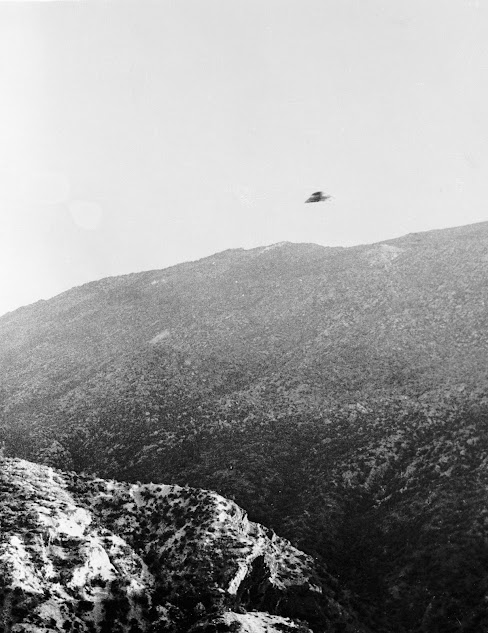
Over the last several days, I have been exchanging emails, well, comments over on Rich Reynold’s UFO Conjectures blog. This had to do with Philip Corso. I suggested that Corso’s tales should be rejected because his book was filled with speculation and half-truths. I have addressed these things before but this time I suggested that one of the pictures in his book, that he captioned, “Lt. Col. Corso was never able to confirm the veracity of the following purported UFO surveillance photos, which were in Army Intelligence files as support material for the R&D project to harvest the Roswell alien technology for military purpose,” was in error.

The admitted fake that Corso thought might be the real thing.

Well, he might well have seen the picture in Army intelligence files, but it was also found in the Blue Book files, at least according to Ed Ruppelt and is an admitted hoax. In fact, the picture was printed in the 1966 Look special on UFOs with the admission by the photographer, Guy B. Marquand, Jr. He said, “I was twenty-one years old at the time and just having fun.” Although he admitted he had faked it, the picture is still accepted as authentic by some. It just seemed to me that Corso, if he was who he claimed to be, would have known this.

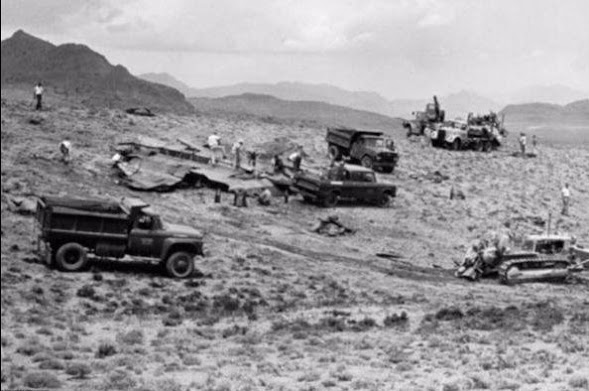
But what really brought all this to mind were two pictures sent to me in the last month or so. These were pictures of a wrecked craft that was claimed, by some on the Internet, to be the Roswell wreckage. One of the pictures seemed to show a jet engine and at no time has anyone I talked to mentioned a propulsion system that looked like a jet engine. The picture was obviously of an aircraft accident.

The alleged Roswell craft with a very terrestrial looking jet engine.

The second picture, which to me looked like a diorama that had been photographed, but was probably the same wreckage, wasn’t on the terrain that I’ve seen in that area of New Mexico. Sure, there are mountains and hills and canyons, but these particular hills didn’t have the flavor of the New Mexico landscape where the crash took place. Don Schmitt, Tom Carey and I, among many others, have been all over that area of New Mexico, and it simply doesn’t look like this.

The retrieval operation that looks to me like a diorama, but is probably from the
same aircraft accident.

I was reminded of the “Tomato Man” pictures that were circulated a couple of decades ago that were supposed to show one of the bodies of the alien flight crew. This picture was exposed as that of a human aviator killed in an aircraft accident. The body had been burned in the crash which gave it the alien look. This seemed to be the unnecessary exploitation of a man who had no connection to UFOs.

Anyway, I just wanted to clear up these points and to provide some evidence about what I had said.

Thursday, December 05, 2019

Cape Girardeau UFO Crash, 1941


Charlette Mann wrote to Ray Fowler, a long time and well-trusted UFO researcher, who sent the letter on to Len Stringfield because Fowler thought Stringfield would be interested. Mann wrote that her grandfather, a minister, received a telephone call asking him to go to the scene of an aircraft accident. Stringfield, quite naturally, called her to ask for more detail and convinced her to rewrite her letter into a more structured report which he published in his UFO Crash/Retrievals: The Inner Sanctum and which is dated July 1991. He shared his report with many of his fellow UFO researchers, especially those interested in crash retrievals.

According to Mann’s letter, her grandfather, Reverend William Huffman was “born in August, 1888 and he grew up in Missouri. He attended college in Bolivar and after graduation, he went to a seminary. He was an ordained Baptist minister... he was a quiet man who was well respected.”

Alleged crash site. Photo copyright by
Michael Huntington.
Which, of course, means that his credentials are just fine. He was a well-educated man for the times and he was a minister which suggests he was also an honest man... again for the times. But he died before telling Mann about the case. This information came from her grandmother, known as Floy and I don’t believe I need to point out that it is, therefore, second hand and as related by Mann, third hand.

In her May 6, 1991 letter to Stringfield, she provided all the details that she had heard from her grandmother. She wrote:

It happened in the Spring of 1941. About 9 to 9:30 one evening, granddad got a telephone call from the police department, saying they had received reports that a plane had crashed outside of town and would he go in case someone needed him. Of course he said yes. A car was sent to get him, but my grandmother said it wasn’t a police car.
After grandfather returned that night, he explained what he had seen to grandmother, my father, Guy, and Uncle Wayne, but that they were never to speak of it again...
He said they drove out of town 13 - 15 miles or so, then parked the cars on the side of the road and had to walk 1/4 of a mile or so into a field where he could see fire burning.
Grandfather said it wasn’t an airplane or like any craft he’d ever seen. It was broken and scattered all around, but one large piece was still together and it appeared to have a rounded shape with no edges or seams. It had a very shiny metallic finish. You could see inside one section and see what looked like a metal chair with a panel with many dials and gauges – – none familiar looking to him. He said that when he got there, men were already sifting through things. There were some police officers, plain clothes people and military men. There were three bodies not human, that had been taken from the wreckage and laid on the ground. Grandfather said prayers over them so he got a close look but didn’t touch them. He didn’t know what had killed them because they didn’t appear to have any injuries and they weren’t burnt. It was hard for him to tell if they had on suits or if it was their skin but they were covered head to foot in what looked like wrinkled aluminum foil. He could see no hair on the bodies and they had no ears. They were small framed like a child about 4 feet tall, but had larger heads and longer arms. They had very large oval shaped eyes, no noses just holes and no lips just small slits for mouths. There were several people with cameras taking pictures of everything. Two of the plain clothes men picked up one of the little men, held it under its arms. A picture was taken. That was the picture I later saw. Then, one of the military officers talked to granddad and told him he was not to talk about or repeat anything that had taken place for security reasons and so as not to alarm people. Granddad returned home, told his family. That was all. About two weeks after it happened, he came home with a picture of the two men holding the little man.
After my grandfather died, my Dad kept the picture and was very interested in UFO info. Then when I was 10 or 11, a close friend of my Dad’s asked if he could borrow it to show to his folks so Dad let him have it and never got it back.
Stringfield was concerned about that picture. First, as has happened in all similar stories, the picture has disappeared, so we don’t have that bit of physical evidence. Of course, you have to wonder if there was actual security on the field, why were there people taking pictures… unless in an official capacity. Then you have to ask why Huffman was given one.

But Stringfield was also worried because he had seen, as I have seen, a picture that sounds similar and has been published around the UFO field for many years. In it are two military men holding the long arms of what is supposed to be an alien creature but what is clearly a monkey. It is an obvious but not a particularly well-known hoax.

Mann, in her May 6, 1991, provided a lengthy description of that photograph. She wrote:

My recollection from what I saw in the picture was a small man about 4 feet tall with a large head and long arms. He was thin and no bone structure was apparent; kind of soft looking. He had no hair on his head or body with large, oval, slightly slanted eyes but not like oriental from left to right, more up and down. He had no ears at all and nose like ours. His mouth was as if you had just cut a small straight line where it should have been. His skin or suit looked like crinkled-up tin foil and it covered all of him... I believe he had three fingers, all quite long, but I can’t be sure on this.
Stringfield got a copy of the picture he remembered from Michael Hesemann and sent it on to Mann. She replied, “It is nothing like what I saw. Your picture showed men in overcoats while in my picture, the man had no coats (sic)... Your picture shows two women; mine none. The alien in yours looks like a tiny doll, much smaller and shorter than mine.”

Mann has now granted interviews to many others and some of the details of her story have expanded. For example, in a 2008 interview she said that when her grandfather arrived, two of the alien creatures were dead but the third was still alive. She said that it, or he, or possibly even she, died while her grandfather was praying over it. He then moved on to the other two to offer prayers for them.
She also said that the symbols he had seen inside the craft “looked similar to hieroglyphics.”

Neither of these details were in the original story and I’m not sure that makes much difference. Oh, the skeptics will grab on to this and suggest it is proof that she is inventing the tale. I think a more likely situation is that she either remembered more as she thought about it or it could be a simple case of confabulation, which is not exactly lying, but just filling in missing details. That does nothing to negate the core of the story.

And, according to other reports, there is some corroboration. In what might be considered a not very persuasive bit of evidence, Clarance R. Schade, who is the brother of the sheriff in the Cape Girardeau area in the 1940s said that he remembered hearing of a crash and he seems to remember talk of little people
Ryan Wood. Photo copyright
by Kevin Randle.
associated with it. Certainly not startling information, but not a quick denial either.

Ryan Wood, in his Majic Eyes Only, reported that Mann’s sister provided a sworn affidavit, confirmed the story. In other words, other members of the family are aware of the family history and report they too have seen the photograph.

In February 2008, Tyler, Texas, television reporter Gillian Sheridan interviewed Charlette Mann. According to that report, Mann said, “We got validation by going to the archives in Washington D.C. and to see a top secret declassified document that stated that there was in fact a crash retrieval in 1941 in Cape Girardeau, Missouri, for me, I have not forgotten holding that paper in my hand and realizing that my families story was real, was solid, and for me was just an answer to a long time question.”

Samples of that document appeared on Frank Warren’s blog (found at www.theufochronicles.com) but they seem to be almost too good to be true. One of the samples said, “Based on all available evidence collected from recovered exhibits currently under study by AMC, AFSWP, NEPA, AEC, ONR, NACA, JRDB, RAND, USAAF, SAG and MIT, are deemed extraterrestrial in nature. This conclusion was reached as a result of comparison of artifacts (small part redacted) discovered in 1941. The technology is outside the scope of US science, even that of German rocket and aircraft development.”

The problem with this statement is that it proves that there have been extraterrestrial recoveries, and even uses that term. This is apparently part of a leaked MJ-12 document and is dated 24 Sep 47. The MJ-12 documents themselves are wrapped in controversy.

Which returns us to the original story. At the moment, the major witness is Charlette Mann. Her sister has corroborated hearing the family talk of the night their grandfather, Rev. William Huffman, was called out to pray over the bodies recovered from the wrecked craft, and the brother of the sheriff also seems to remember something about this.

The problem for me is simply this. If there had been this crash in 1941, then the military would have been aware of the possibility of interplanetary (as opposed to interstellar because people in the era thought in terms of interplanetary) travel, they would have been on the lookout for other examples. That means they wouldn’t have been caught by surprise with the flying saucers were first reported in June
Ed Ruppelt
1947 and would have been better prepared for the Roswell crash when it happened in July 1947.

In fact, Ed Ruppelt, the one time chief of Project Blue Book, reported that in the summer of 1947, those in the Pentagon were in a near panic because of the stories of the flying saucers. Ruppelt wrote:

The memos and correspondence that Project Blue Book inherited from the old UFO projects told the story of the early flying saucer era. These memos and pieces of correspondence showed that the UFO situation was considered serious; in fact, very serious. The paper work of that period also indicated the confusion that surrounded the investigation; confusion almost to the point of panic. The brass wanted an answer quickly and people were taking off in all directions.
That argues against the extraterrestrial nature of this case. If there had been a crash near Cape Girardeau in 1941, then the answer was already held at the highest levels. There would be no panic because they would know what was happening. They wouldn’t create a project to find answers in a hurry, because they had the answer already. Such an investigation ran the risk of compromising the classified project. A quiet word would have been issued and the whole investigation never have been started.

But there seems to be more than enough here. Additional investigation for the case is deserved. There is an old prospecting saying, “You don’t always expect to find the gold, but you have to look.” This is a case where you have to look. There are interesting leads that need to be followed and there are certainly witnesses that could be located, though time is growing short.

Friday, March 15, 2019

Project Blue Book - The Washington Nationals - Season Finale


I know some of my colleagues are delighted that we’ve seen the season finale of Project Blue Book, not because they like the show but because it is over… for a while. I confess that I don’t understand their hostility. Project Blue Book is not a documentary but a drama that has a historical background and a loose, very loose, interpretation of some of the sightings that are found in the Blue Book files.

The prior two episodes were based on cases that were not found in the files, though there is some information about the Hill abduction found there. It seems, however, that the mention of the Hill case is because someone queried the Air Force about it and not because they were actively investigating it.

The finale dealt with what are known as the Washington Nationals, which were sightings on two consecutive Saturday nights in July 1952. Blips were seen on radarscopes and pilots were reporting the lights in the ski near them.

I have talked to two of the officials who observed the sightings on the second night, Major Dewey Fournet and Al Chop. Both men believed that the UFOs were reacting to the presence of jet fighters scrambled to intercept the objects. According to both men, at one point, it got pretty hairy, meaning one of the fighters was surrounded by the objects.  They also mentioned that it seemed the objects, except for that one instance, would disappear when the fighters arrived and would reappear when the fighters left the area. More on that later.

The sightings, unlike those shown in the program, were at night and not over the National Mall in Washington, D.C. At no point did any of the fighters fire at the objects. These sightings resulted in what I think of as the greatest science fiction headline ever published by a real daily newspaper. “Saucers Swarm Over Capitol.”

Here is the short version of the Washington Nationals. It began late in the evening on July 19, 1952, when two radars at the Air Routing and Traffic Control Center (ARTC) picked up eight unidentified targets near Andrews Air Force Base. According to reports made by the controllers, these were not airplanes because they moved too fast. One object, according to the calculations made at the time was tracked at 7,000 miles an hour.

About twenty minutes later, or just after midnight on July 20, the tower radars at Washington's National Airport tracked five objects. What this meant was that three radars at three different locations had solid targets that were not identified as aircraft.

One of the controllers at the ARTC called for a senior controller, Harry C. Barnes who in turn called the National Airport control tower. They had unidentified targets on their scopes, as did the controllers at Andrews Air Force Base. They had already eliminated a mechanical malfunction as the cause, but with the objects on other scopes in other locations, there was no longer any question of their reality. The performance of the blips ruled out airplanes. All the men, including Barnes, was sure they were looking at solid objects based on their years of experience with radar. Weather related phenomenon wouldn't produce the same effect on all the radars at the widely scattered locations. In fact, if weather was the explanation, the targets would have varied from scope to scope.

Just after midnight, Airman Second Class (A/2c) Bill Goodman, called the Andrews control tower to tell them he was watching a bright orange light about the size of a softball that was gaining and losing altitude as it zipped through the sky.

During this time, Goodman talked to Airman First Class (A/1c) William B. Brady, who was in the tower. Goodman told Brady that the object was to the immediate south. Brady saw a ball of orange fire. There were discrepancies between the physical description given by Goodman and Brady, but the problems were relatively small. It can be argued that the discrepancies are the result of the points of view of the two observers.

Joseph DeBoves, who was also on the scene as a civilian control tower operator at Andrews, said that Brady became excited during one of his telephone conversations, yelling, "There one goes." DeBoves believed that Brady was watching nothing more interesting than a meteor.

About two in the morning on July 20, the Radar Officer, Captain Harold C. Way, at Andrews Approach Control, learned that the ARTC had a target east of Andrews. He went outside and saw a strange light which he didn't believe to be a star. Later, however, he went back out, and this time decided that he was looking at a star. There is a suggestion that he was pressured into revising his first observations.

Bolling Air Force Base became involved briefly about the time Way went outside. The tower operator there said that he saw a "roundish" object drifting low in the sky to the southeast of Bolling. There were no radar confirmations of the sighting, and that was the last of the reports from that base. This might will have been a star.

The ARTC again told the controllers at Andrews that they still had the targets on their scopes. There is conflicting data because some of the reports suggest that the Andrews radar showed nothing, while other reports claim they did. Now DeBoves, and two others in the tower, Monte Banning and John P. Izzo, Jr., swept the sky with binoculars but could see no lights other than the stars.

The sightings lasted through the night, and during that time, the crews of several airliners saw the lights right where the radars showed them to be. Tower operators also saw them, and jet fighters were brought in for attempted intercepts. Associated Press stories written hours after the sightings claimed that no intercepts had been attempted that night but those stories were inaccurate. Documents in the Project Blue Book files, as well as eye witnesses, confirm the attempted intercepts.

Typical of the civilian sightings were those made by Captain Casey Pierman on Capital Airlines Flight 807. He was on a flight between Washington, D.C. and Martinsburg, West Virginia at 1:15 A.M. on July 20, when he, and the rest of the crew saw seven objects flash across the sky. Pierman said, "They were like falling stars without trails."

Capital Airline officials said that National Airport radar picked up the objects and asked Pierman to keep an eye on them. Shortly after takeoff, Pierman radioed that he had the objects in sight. He was flying at 180 to 200 mph, and reported the objects were traveling at tremendous speed. Official Air Force records confirm this.
Another Capital Airlines pilot, Captain Howard Dermott, on Capital Flight 610, reported a single light followed him from Herndon, Virginia, to within four miles of National Airport. Both the ARTC and the National Tower confirmed that an unidentified target followed the aircraft to within four miles of landing. At about the same time, an Air Force radar at Andrews AFB was tracking eight additional unknown objects as they flew over the Washington area.

One of the most persuasive sightings came early in the morning when one of the ARTC controllers called the Andrews Air Force Base control tower to tell them that there was a target south of the tower, over the Andrews Radio range station. The tower operators looked to the south where a "huge fiery-orange sphere" was hovering. This again was later explained by the Air Force as a star.

Just before daylight, about four in the morning, after repeated requests from the ARTC, an F-94 interceptor arrived on the scene, but it was too little too late. All the targets were gone. Although the flight crew made a short search of the local area, they found nothing unusual and returned to their base quickly.

During that night, apparently the three radar facilities only once reported a target that was seen by all three facilities at the same time. There were, however, a number of times when the ARTC radar and the Washington National tower radars had simultaneous contacts. It also seems that the radars were displaying the same targets that were seen by the crews of the Capital Airlines flights. What it boils down to is that multiple radars and multiple eyewitnesses were showing and seeing objects in the sky over Washington, D.C.

Air Force intelligence, including ATIC and the officers assigned to the Project Blue Book, had no idea that these sightings had taken place. They learned of the Saturday night - Sunday morning UFO show when the information was published in several newspapers on Monday. Captain Ed Ruppelt, chief of Blue Book, on business in Washington and unaware of the sightings, reported "I got off an airliner from Dayton and I bought a newspaper in the lobby of Washington National Airport Terminal Building. I called Major Dewey Fournet, but all he knew was what he read in the papers."

A week later, almost to the minute, with the same Air Traffic Control crew on duty, the UFOs returned. About 10:30 P.M. spotted several slow-moving targets. This time the controllers carefully marked each of the unidentifieds. When they were all marked, they called the Andrews AFB radar facility. The unidentified targets were on their scope too.

An hour later, with targets being tracked continually, the controllers called for interceptors. Al Chop, the Pentagon spokesman for the UFO project, told me, that he was in communication with the main basement command post at the Pentagon. He requested that interceptors be sent. As a civilian, he could only make the request and then wait for the general or admiral in command at the Pentagon to make the official decision.

As happened the week before, there was a delay, but by midnight, two F-94s were on station over Washington. At that point, the reporters who had assembled to observe the situation were asked, by Chop, to leave the radar room at National Airport because classified radio and intercept procedures would be in operation.

Major Dewey Fournet, the Pentagon liaison between the UFO project in Dayton and the intelligence community in Washington was at National Airport that night. Also, there were Al Chop, a public information officer and Naval Lieutenant Holcomb, an
Al Chop
electronics specialist, assigned to the Air Force Directorate of Intelligence.

With those men watching, as well as the controllers at various facilities using various radars, the F-94s arrived. And the UFOs vanished from the scopes immediately. The jets were vectored to the last known position of the UFOs, but even though visibility was unrestricted in the area, the pilots could see nothing. The fighters made a systematic search of the area, but since they could find nothing, they returned to their base.

Chop told me, "The minute the first two interceptors appeared on our scope all our unknowns disappeared. It was like they just wiped them all off. All our other flights, all the known flights were still on the scope... We watched these two planes leave. When they were out of our range, immediately we got our UFOs back."

Later, Air Force officers would learn that as the fighters appeared over Washington, people in the area of Langley Air Force Base, Virginia, spotted weird lights in the sky. An F-94, in the area on a routine mission was diverted to search for the light. The pilot saw it and turned toward it, but it disappeared "like somebody turning off a light bulb."

The pilot continued the intercept and did get a radar lock on the now unlighted and unseen target. That was broken by the object as it sped away. They fighter continued the pursuit, obtaining two more radar locks on the object, but each time the locks were broken.

The scene then shifted back to Washington National. Again, the Air Defense Command was alerted and again fighters were sent. This time the pilots were able to see the objects, vectored toward them by the air traffic controllers.  But the fighters couldn't close on the lights. The pilots saw no external details, other than lights where the radar suggested that something should be seen.

After several minutes of failure to close on a target, one of them was spotted lopping along. A fighter piloted by Lieutenant William Patterson turned, kicked in the afterburner and tried to catch the object. It disappeared before Patterson could see much of anything.

Interviewed by the press the next day, Patterson said, "I tried to make contact with the bogies below one thousand feet, but they [the controllers] vectored us around. I saw several bright lights. I was at my maximum speed, but even then, I had no closing speed. I ceased chasing them because I saw no chance of overtaking them. I was vectored into new objects. Later I chased a single bright light which I estimated about ten miles away. I lost visual contact with it..."

Al Chop remembered this intercept, as did Dewey Fournet. Chop told me, "The flight controllers had directed him to them [the unknowns]. We had a little cluster of them. Five or six of them and he suddenly reports that he sees some lights... He said they are very brilliant blue-white lights. He was going try to close in to get a better look... he flew into the area where they were clustered and he reported they were all around him."

Chop said that he, along with the others in the radar room, watched the intercept on the radar scope. What the pilot was telling them, they could see on the radar.
Patterson had to break of the intercept, though there were still lights in the sky and objects on the scope. According to Chop, the pilot radioed that he was running low on fuel. He turned so that he could head back to his base.

Chop said that the last of the objects disappeared from the scope about the time the sun came up. Ruppelt later quizzed Fournet about the activities that night. According to Ruppelt, Fournet and Holcomb, the radar expert, were convinced the targets were solid, metallic objects. Fournet told Ruppelt that there were weather related targets on the scopes, but the controllers were ignoring them. Everyone was convinced that the targets were real and solid.

At 4:00 P.M., in Washington D.C., Major General John A. Samford, Chief of Air Intelligence, held a press conference. Of that press conference, Ruppelt wrote, "General Samford made an honest attempt to straighten out the Washington National Sightings, but the cards were stacked against him. He had to hedge on many answers to questions from the press because he didn't know the answers. This hedging gave the impression that he was trying to cover up something more than just the fact his people fouled up in not fully investigating the sightings. Then he brought in Captain Roy James from ATIC to handle all the queries about radar. James didn't do any better because he'd just arrived in Washington that morning and didn't know very much more about the sightings than he'd read in the papers. Major Dewey Fournet and Lieutenant Holcomb, who had been at the airport during the sightings, were extremely conspicuous by their absence..." As was the Pentagon spokesman on UFOs, Al Chop.

This was the largest Pentagon press conference held since the end of the Second World War, at least to that time. Interestingly, one of the general officers also at the conference was Roger Ramey… yes, he of Roswell fame.

For those interested in a transcript of that press conference, I published, in a series of posts about it that can be found at:


It runs to several postings, but the whole thing, along with some of my commentary, is found there. For those who wish more detailed information about the sightings, see my book, Invasion Washington. It covers the sightings of the summer of 1952, the events

What I have noticed in these last couple of episodes is that they’re moving farther away from the reality of Blue Book and this last episode was no exception. For example, the chief of Blue Book, Quinn, decided that he wanted to see what was going on. Somehow, somewhere, he finds a fighter, and heads up to engage with the objects. He fires on them, without results. He lands and gives his report… but I can’t see a situation in which the local commander would allow some random officer to show up and then take off in a fighter assigned to him and carried on his property book. That pilot would have to appear with his flight records that would then have to be verified and he would have to have a check ride by one of the local instructor pilots to ensure he had the proper training and skill level in the aircraft
The Mall in Washington, D.C., where Quinn
and Hynek saw the lights for the TV program.
Photo copyright by Kevin Randle
he wished to fly. There is no way that Quinn would have been allowed to join the intercept, even if a general called down to arrange it. These things just don’t happen in the real military. It looks good on television but it doesn’t happen in real life.

My point is that this drama, and it should be considered a drama, doesn’t claim to be the situation as it really happened and those short segments at the end underscore that. Maybe it drives some traffic to the History website to look at the facts or inspires some to google the sightings. If we’re going to complain about History’s version, then what about all those websites that put up UFO information that is totally bogus with no disclaimers whatsoever. That is far worse than a television drama.

To repeat myself, I do enjoy the program. I don’t find it boring but do wish they would ditch the Soviet spy angle. I do wish they would be a little more careful with the military customs and courtesies, and I don’t really want to see Allen Hynek in another fist fight with Quinn.

I will be looking forward to the next season (but certainly not with the enthusiasm that I await the final season of Game of Thrones… which I mention only because Little Finger plays Allen Hynek). I do hope they will be a little closer to reality, but if they’re not, I’ll remember that they’re making a TV series and not a documentary.


Wednesday, February 20, 2019

Project Blue Book Episode Seven - Sonny Desvergers, The Florida Scoutmaster


Last night we were treated to the Florida Scoutmaster case which was moved to Ohio for some unknown reason. The drama, as it played out did follow, to some extent, the true events on which the episode was based. We did have scouts and a scoutmaster except in this case he was armed because he liked to hunt. When they saw lights out among the trees, the scoutmaster advanced, fired a shot or two, and disappeared. The implication was that the scoutmaster had engaged in some sort of fight with the alien creatures, and he had disappeared because of it.
In a side issue, we had Captain Quinn attacking a man who might have been a Russian agent, well Soviet, and that he had been turned, meaning into a double
Captain Quinn talking with Allen Hynek in Project Blue Book.
agent. The powers to be were using him as bait to see if Quinn had stolen a bit of metallic debris, or some sort of unidentified object from an Air Force base that, apparently had some kind of connection to flying saucers.
What disturbed me here was that Quinn resorted to various forms of torture in his attempt to determine what had happened. I find it interesting that Hollywood seems to endorse the use of torture to recover information in their dramas but then, in reality, condemn its use. In the fictional world, they are telling us that torture is an effective investigative tool and in the real world it is a horrible breach of human dignity.
Yes, I can cite examples from other shows. In Law & Order SVU, Detective Stabler has been seen, more than once, using an enhanced interrogation method to extract information from a suspect. Oh, it’s always for a good cause, lives are at stake, but he is torturing the suspect. There is no other way to look at it. I have to wonder what message that sends to the audience. Are we teaching the viewers that torture, in some cases is acceptable?
But I digress…
And I point out that Quinn, as a military pilot with substantial aviation experience as shown by the wings he is wearing, is not the proper man to be conducting this interrogation. In fact, I resent the implication that military officers universally endorse the use of torture.
Back to the real story, however, with spoilers…
The scoutmaster reappears, and while in his hospital bed, tells of shooting an alien creature. Its body dropped at his feet. He can’t believe that those who had been searching for him had been unable to find it. He leaps from his hospital bed (yeah, I exaggerate) to lead Dr. Hynek, a boy scout and the sheriff to the scene of the aliencide (yes, I just made up that word).
The man finds a skull with an elongated cranium that certainly looks alien, though I thought immediately of something that the Inca and Maya did. They wrapped their children’s heads to create that sort of thing. Hynek thinks that this is actual proof of alien visitation but does visit with a local anthropologist who sends him to a local Native America. This guy tells Hynek that the Choctaw sometimes did the same thing. I hadn’t heard that and thought it might be an error but thanks to the Internet, learned that the practice did extend into North America and one of the tribes mentioned was the Choctaw. I figured the show runners must have done the same thing, meaning ensured that the Choctaw did this form of child mutilation.
We learn that the whole thing is a hoax with the scoutmaster at the center of the tale (and I think of some of the news in the real world where an actor claimed to have been attacked, but the investigation on that seems to have headed south in a similar way… but I digress again).
At the end of the show, we are treated, again, to the quick notes on the real case. At the end of that explanation, which they note that Ed Ruppelt had labeled a hoax, they suggest the soil and grass samples taken at the time were unexplained. That was confusing… if you weren’t familiar with the case. For those interested in more information about it and a little more background on the real story, that follows.
Captain Edward Ruppelt wrote in his book, The Report on Unidentified Flying Objects, about his UFO investigations into this case for the Air Force, "We wrote off the incident as a hoax. The best hoax in UFO history."
It all started about 9:30 p.m. on August 19, 1952. Scoutmaster D.S. "Sonny" Desvergers of West Palm Beach, Florida, was taking three boy scouts home after the regular meeting. They were traveling south, on Military Trail, when, according to Desvergers, he "caught a flash of light out of the corner of my eye. I looked around and saw a series of fuzzy lights like the cabin windows of an airliner."
He stopped the car momentarily, but started on again and then thought about it. If
Sonny Desvergers
it was an airliner that was crashing, or in some other kind of trouble, he wanted to help. He turned around and headed back. He stopped at the side of the road and told the boys to wait about ten minutes. If he wasn't back by the time a radio program ended, he wanted them to go for help.
Desvergers believed the lights were about two miles into the palmettos off to the side of the road. He kept his path straight by reference to the stars and was shining his light across the ground, searching for an easy path through the thicket. He glanced at his watch, found that he had been walking for only four minutes, and then noticed an open area in front of him.
He stopped, thinking he might have reached a lake or a marsh, but realized that it was just a clearing. Later, he told Air Force investigators, "I carefully stepped forward with the light pointing toward the ground. I had a second two-cell flashlight in my back pocket."
As he entered the clearing, he noticed a peculiar odor. He also had the feeling that someone or something was watching him. And, he began to feel heat, as if he was approaching a hot oven or fireplace. He glanced up but could no longer see the stars. The sky above him was black. Something was hovering just overhead, blocking a portion of the sky.
Now, according to the statement he provided to Air Force officers, "I stood frozen in my tracks. I wanted to throw something or hit it with my machete… The bottom of the object was dull black with no seams, joints or rivet lines. It was dirty streaks running straight across as if oil or dust had blown back. I tried to run but froze, I was so scared. The object was 6 inches to 8 inches above the pine trees."
Still feeling the heat, Desvergers backed out from under the edge of the ship which he could see silhouetted against the black night sky. He said that the ship was "round, with a dome shape top and with holes and fins running around the edge. The bottom edge seemed to glow with a spot of phosphorescent glow..."
Desvergers heard a metal against metal noise that reminded him of a hatch opening. He told the Air Force investigators that he said a million prayers and kept emphasizing how scared he was by the craft and his feelings of being watched by something. He finally saw "a red flare which appeared slowly to move toward me. It came out of the side, I couldn't yell I was so scared."
As the red glow came toward him, Desvergers put his hands up, over his face with his fists closed. He could see that the red glow that he now described as mist had engulfed him. That was the last thing that he remembered for a moment.
When he woke up, he was standing next to a tree. He couldn't see at first and his eyes burned. As his sight returned, he could see lights in the distance and began to run toward them. According to his statement, "I thought I might be dead. Next I met the deputies and we went back to get my light." The deputies had apparently been summoned by the boys after their scoutmaster had been engulfed by the red mist.
There were three boy scouts who had been involved in the sighting. The boys, Charles Stevens, David Rowan and the unofficial leader, Robert Ruffing were interviewed by Air Force officers including Ruppelt on September 9, 1952 at the regular meeting of the boy scout troop in West Palm Beach. I had hesitated in naming them because they were boys, but then realized, in the world today, they would be older than I am.
In the official report it said, "In general, the boy scouts were rather difficult to talk to. They were rather excited and nervous about the whole thing and in many cases their answers did not make a lot of sense. It is not believed that this was because they weren't telling the truth, but they were just youngsters and were a little bit nervous."
According to the boys, after the regular meeting, Desvergers took four boy scouts out to his car to give them a ride home. They first drove to the Wagon Wheel, a drive-in restaurant. They had a cold drink and then headed out toward a drive-in theatre, but something happened and they decided not to go. Air Force investigators noted that none of the boys would explain what had happened and that they didn't answer questions about that.
Instead, they drove toward a stock car speedway to see how much water was on the track from recent rains. Although the track was closed and dark, they stayed there for several minutes before driving down Military Trail. One of the boys was taken home so that only three remained in the car.
Now driving south on Military Trail, Desvergers saw something out of the corner of his eye, but the boys didn't see it. Desvergers told them, at that time, he thought it might be an aircraft in trouble or a flying saucer. He then got out of the car, giving the boys his instructions, and then walked into the palmettos.
Ruffing, interviewed separately for the others, told the Air Force officers that he saw Desvergers walk into the woods and that the next thing he saw was a series of red lights in the clearing. Ruffing said that as soon as he saw the red lights, he saw Desvergers stiffen and fall.
Air Force officer reenacting Desvergers' sighting.
The other two boys, Stevens and Rowan, were interviewed together. They reinforced the story about the ride out to the spot where Desvergers claimed to have seen the lights going down into the trees. They watched their scoutmaster moving through the woods, his progress obvious by motion of his flashlight. The light disappeared and a few seconds later they saw the red lights. They described it as a "lot like flares or sky rockets."
Frightened, they got out of the car and ran down the road for help. They found a lighted farm house and told the people that their scoutmaster was in trouble. The people called the sheriff's department.
The Air Force investigators noted, "All in all, the boys' stories were rather conflicting and it was very difficult to obtain the facts. The only fact that seemed to stand out in all of their minds was the fact that they did see red lights out in the palmetto grove after Desvergers had gone in."
Sheriff Deputy Mott Partin was one of those who responded to the call. As he reached the scene, Desvergers staggered from the woods. Partin told Air Force investigators and reporters who spoke to him later that he didn't believe that Desvergers was faking. He said, "In nineteen years of law enforcement, I've never seen anyone as upset as he was."
With the law enforcement officers, Desvergers returned to the palmetto to search for his dropped equipment. They found a place in the grass that looked as if someone had fallen there. They located his machete and one of his flashlights. It was still burning. They marked the spots.
One of the deputies took the boy scouts home. But the scoutmaster followed the deputies back into town. He complained about burns and when they arrived at the sheriff's office, they noticed that he had been burned on the arms and face. His cap had also been scorched. At that point one of the deputies called the Air Force.
It seemed that almost everyone was impressed with Desvergers’ story. There were corroborating witnesses, there was some physical evidence in the form of burns, and an examination of his cap revealed additional burns that had been overlooked further validating his tale.
Testing of the items carried by Desvergers revealed nothing unusual. The machete had not been magnetized, subjected to heat, or radiation. The same could be said about the flashlight. No radiation was found in the palmetto groves either. Nothing out of the ordinary.
The day after Ruppelt, along with Second Lieutenant Robert M. Olsson, a couple of Air Force pilots, the local intelligent officer and his sergeant interviewed Desvergers, his story appeared in the newspaper. Although Desvergers had asked Ruppelt if he could talk about the sighting and was told that the Air Force had no policy of restricting civilians, Desvergers told reporters he had been silenced. The newspaper reported that Desvergers had conferred with "high" brass from Washington, D.C. who had confirmed his sighting by telling him exactly what he had seen, but who didn't want him talking about it.
That irritated the Air Force officers. There had been no high brass, just several captains and a second lieutenant. They had not suggested to Desvergers that they knew what he had seen, though he had asked them repeatedly for an explanation. And they hadn't muzzled him.
Before Ruppelt left Florida, one of the deputies suggested they look into the background of Desvergers. The deputy had said that Desvergers was a former Marine, an aspect played up in the newspapers. He also told some stories of secret missions into the Pacific during the Second World War. He told of a horrible accident when a car had fallen on him and he'd spent months in the hospital recuperating from his injuries. All these were facts that could be checked and while they had nothing to do directly with the UFO story, they did speak to the character of the witness.
In his book, Ruppelt pointed out that Desvergers had a reputation for telling tall tales. In the official Project Blue Book file I read, it was noted:
Once during a birthday party, Desvergers stated that during the war he was a Marine and had been on sea duty on a battleship. He stated that one day he was contacted by an Officer of Naval Intelligence who asked him to go on a secret mission. He was taken to Washington and given a briefing by a group of Colonels then taken to California to go to school with some more Colonels from Washington. He was flown to the Pacific to map Jap held islands that were unchartered (sic). He stated that he was taken to the island under cover o darkness in a PBY aircraft along with his surveying cryptography equipment and that as they approached the island a life raft was inflated and thrown out the waist window of the PBY. The PBY landed in the dark in unchartered waters next to the raft and put Desvergers and his equipment into the raft. With the cover of darkness, he paddled up to the beach and buried all his equipment. Desvergers stated that at the beginning of the story the island was 7 x 3 mi. long and at the end, it was 25 x 50. After about two weeks of hiding from the Japs all day and digging up his equipment and surveying at night, he had mapped the island. In many cases he had brushes with Japanese Officers and once during his two weeks he was lying in some bushes hiding during the day when the Japs walked by so close to him they could touch him. When the job was finished he had set up a rendezvous with the PBY and it landed at night. However, the Japs saw the airplane land and knew that he was on the island. He inflated his rubber raft and started paddling toward the aircraft but the Japanese started to fire at him and sunk his life raft, however, in the raft he had a Gibson Girl radio with a balloon for an antenna. He quickly inflated the balloon, crawled on it and flowed out to the PBY. As he was being picked up by the aircraft, people were reaching out of the hatch helping him. During the time, the Japs were shooting at them and several of the sailors who were helping him were badly wounded."
The problems with this "war story" are many. First, it smacks of being just that, a war story. Secret missions are not developed in that fashion and they don't select the soldiers, or in this case a Marine, in such a haphazard fashion. These missions are given to highly trained personnel who have expertise that is critical to the operation.
But more importantly is the service record of Desvergers. Here is a man who was in the Marines during the Second World War. It was a time when the expansion of the various services including the Marines demanded huge numbers of recruits. The fighting in Europe, Africa, and the Pacific were grinding up men in terrible numbers. Yet, according to the record, Desvergers had been tossed out of the Marines with a less than honorable discharge in 1944. Ruppelt noted, "He had been booted out of the Marines after a few months for being AWOL and stealing an automobile." He apparently went from lone hero to disgraced Marine in a very short time.
To me, this spoke volumes about the reliability of the man. That is not to mention the other factors on his record. He had told various people at various times that he had been a PFC test pilot in the Marines and had flown every type of naval and Marine fighting aircraft. Of course, prior to the war, the Marines did have "flying sergeants," that is, enlisted men who were pilots. They had no PFC test pilots, however.
He told high school friends about his automobile accident. He said that he had finished work late, after everyone else had gone home for the day when, somehow, a car had fallen on him. For hours he was pinned under the car, screaming for help. But, when Air Force investigators checked, they learned that others had been there to help at the time of the accident. He had been taken to the hospital and released quickly. He had taken the real event and embellished the account into a truly horrifying tale.
Had a single person suggested that Desvergers spun tall tales, it might be suggested that some sort of a vendetta existed. But many people related that Desvergers had told them similar things. One man even said that if Desvergers had told him the sun was shining, he would go out to look.
Other details of his personal life were equally revealing. Many of the people who knew him had heard the stories and dismissed them as fantasy. Ruppelt, among others, "pointed out that this fact alone meant nothing..." The UFO sighting could have been the one time that Desvergers was telling the truth.
Then the Air Force investigators made another discovery. The clearing where Desvergers had been attacked by the UFO was invisible from the road. Olsson and the local intelligence officer tried to see the clearing under about the same lighting conditions as the night of the event. Only by standing on the car could they see down into the thicket where the boy scouts had thought their leader had been attacked.
Suddenly, the tale of a brave ex-Marine and boy scout leader, who had the corroboration of three boy scouts, didn't look so good. It wasn't that anyone believed the boy scouts were lying. They thought the kids had gotten caught up in the excitement and had imagined some of the things they thought they saw, especially under the careful guidance of their scout master. In the final analysis, they hadn't seen all that much anyway.
So, the tale hung on Desvergers and his reputation. His reputation had fallen apart. He wasn't the upstanding and honest ex-Marine hero of a secret Pacific campaign that he had seemed to be. His background was less than sterling and involved, among other things, petty theft. The case began to look like a hoax after all.
The day after Ruppelt and the others had interviewed Desvergers, he hired Publicity Agent Art Weil. Rather than providing his story to newspapers and magazines, Weil was going to sell the tale to the highest bidder. Desvergers had already been approached by a number of people including a couple of college professors, newspaper reporters, and at least one writer from a large circulation news magazine. Or rather that was what Desvergers had said.
Not long after that, Weil quit. He had learned about the problems with Desvergers' background and realized that no reputable magazine would pay for such a story. The only thing going for the story was the reputation of the man telling it. If his reputation wouldn't stand up to the background checks, which it wouldn't, then no one from a reputable magazine would take a chance on the tale.
It seems that this was just a hoax. Desvergers, to add weight to it, had singed the hair from his arms with his own cigarette lighter, or so the investigators believed. The slight reddening observed by some was gone within a day or two. The tale of lights, or a mystery craft, in the palmetto was not corroborated by anyone.
But Ruppelt had called this the best hoax in UFO history. There was nothing in the official Blue Book record to explain that. It seemed to be more of a routine, and not
Captain Edward Ruppelt
very clever, hoax. Except for one thing. According to Ruppelt in his book, they had forgotten about the soil and grass samples gathered in the clearing. They had taken the machete, the flashlight, and the cap for testing, but in the rush to get out of Florida, they'd left the soil samples behind. Ruppelt asked the local intelligence officer to forward them to Blue Book, which he did.
When the lab, which we now know to be the Battelle Memorial Institute, reported back to Ruppelt, they asked, "How did the roots [of the grass] get charred?"
What they had discovered is that the roots of the grass had been heated to about 300 degrees. They had no way to explain it and the only way they could duplicate it was to put the grass in a pan and heat it. Of course, that was not what had been done in the field. The samples had been taken from the undisturbed ground.
Ruppelt and the others checked the area carefully and found nothing that would account for the charring. He did learn that induction heating could duplicate the effect in the field but there was no evidence such was the case. Ruppelt quoted from an engineering text that suggested a method for induction hearing. A metal rod, when subjected to an alternating magnetic field, would create 'eddy currents' that caused a rise in temperature. Ruppelt suggested that by replacing the metal bar with the wet sand such as that in the clearing for the electrical conductor and an assumption of a strong, alternating magnetic field created by the proper equipment, the charred roots could be explained. Of course, it required heavy equipment to do it and there was no evidence of that equipment in the palmetto grove that night or at any other time.
Suddenly there was a bit of physical evidence that couldn't be explained easily. Ruppelt and the others were still convinced that the story was a hoax, even if they couldn't explain how the roots of the grass had been charred.
And Olsson, in a "memo for the record" found in the Project Blue Book files, had talked to the people at the "Flare and Signal Branch." They suggested that the burns in the hat were consistent with those from a flare, but that didn't mean the burns had occurred in that way or that Desvergers had used a flare.
But more importantly, Olsson learned that had a flare been used to hoax part of the sighting, the grass should have burned. He was told, "It seems likely that if a flare was used in the incident at West Palm, a fire would have started in the dry grass. No evidence of a fire was present down there as far as we could see."
These facts were what had made the case the best hoax in UFO history. That, and the fact that no one had proven that Desvergers was lying in this instance. As the deputy said, "It could have been the one time in his life that he told the truth."
What is interesting about the Project Blue Book file is there is nothing about these grass samples in it. There are "memos for the record" that cover the testing done on the machete, the flashlight and the cap. There are reports that suggest there was nothing unusual about the machete or the flashlight and detailing the holes burned in the cap. The scorching on the hat, along with some tiny holes burned in it were puzzling but not solid evidence that the tale told by Desvergers was the truth.
All these documents are in the file. There are even longer, detailed statements about Desvergers' background that suggest his character wasn't sterling. There are many tales that he had spun that had no basis in fact. These are particularly persuasive. It provides the profile of a man who enjoys the spotlight, who has spun more than one tale to put himself in that spotlight, and who seems to have invented the story of a flying saucer attack to grab the spotlight once again. In today's environment, he would claim to have been abducted and would appear on a dozen or so of the television talk shows to explain what had happened to him.
But there is nothing in the file about the grass and soil samples. Without Ruppelt's candid description of the case in his book, we would know nothing about this aspect of it.
To me, the evidence in the file is persuasive. I have no doubt that Desvergers invented the tale of the flying saucer attack. There are just too many instances where Desvergers made up stories to impress his friends and coworkers. With what I found by reading the file, I would be willing, in fact, I would be enthusiast, in labeling this case a hoax if not for one thing.
Where are those reports about the charred grass roots?