Showing posts with label Lewis Bill Rickett. Show all posts

Sunday, August 19, 2018

Roswell Documentation vs. Roswell Eyewitnesses


Since I have now annoyed all my friends with my analysis of the Roswell documentation and how some of it is quite suggestive that nothing alien fell there, I thought it time to annoy all my skeptical friends. Lining up against that documentation is the testimony of some people who were on the scene in 1947. This is based on the documentation we can find about them and the stories they tell us in the world today.

Walter Haut, for example, either wrote the press release claiming the 509th had found a flying saucer, or he took the dictation from Colonel William Blanchard to create the press release. At this point it doesn’t really matter. The press release
Walter Haut being interviewed.
Photo copyright by Kevin Randle.
was issued and it claimed they had “captured” a flying saucer in the Roswell region. The definition of flying saucer confuses the issue, because in 1947, there was no universally accepted definition. It could mean almost anything you wanted it to mean. But here’s the deal. It is vague to the point of being opaque. We don’t know what it means.

I have never understood the reason for the press release. If Blanchard was attempting to grab credit for solving the flying disk mystery, the press release was unnecessarily obscure. Compare it to the story out of Circleville, Ohio, in which a farmer found the remains of a weather balloon and rawin reflector on his land. We have a story in the local paper that identifies the farmer as Sherman Campbell and includes what is claimed a picture of his wife. When I talked to the family, I learned it was actually his daughter holding the rawin target. The point is that the Circleville newspaper story was clear and it included a photograph. The Roswell press release told us nothing of real importance, provided little in the way of verification and had no photograph.

We do have testimony from Haut, which, if we limit it to what was said in the press release, and what he said to us for decades before expanding his story, we learn that what was found was something strange. No, it tells us nothing about the alien nature of the crash, just tells us that Blanchard and company were perplexed by something they should have been able to identify easily if it was a weather balloon. No reason not to supply the explanation if it was something mundane, like was done in Circleville.

If we wish to get to the extraterrestrial, then there is Edwin Easley, who was the provost marshal (please note the proper spelling of marshal here) in Roswell. When I asked him if we were following the right path, he asked what I meant by that. I told him that we (meaning Don Schmitt and I) believed that the craft had been extraterrestrial. He said, “Well, let me put it this way, it’s not the wrong path.”

Taking that a step farther, he told family members about the alien “creatures.” That was his word to them, not mine. Sure, that statement is second hand at best because we learned it talking to family members, but hey, it does confirm his mindset on this.

No, there is no reason for Easley to have lied about it. He was very reluctant to talk, didn’t grant much in the way of interviews, and you won’t see him showing up in any of the old documentaries. I was always of the impression he wished to help me, but he had taken an oath in 1947 and he wasn’t going to break the oath.

There is Joe Briley, the operations officer in 1947. He said a couple of things that don’t take us directly to the extraterrestrial but do lead us to the highly unusual. He told me, when I mentioned, “…You heard the stories…” that “And then the story was changed immediately. As soon as the people from Washington arrived.”

Jesse Marcel
Yes, it is clear from the conversation on the tape that we’re talking about the UFO crash tale. I really don’t say anything specifically about it, but Briley knew why I had called him. In fact, later in the interview, he told me, “I just was not brought into that at all even though Butch [Blanchard] and I were extremely close.”
And later still, he said, “I don’t think Butch was stupid enough to call a weather balloon something else.”

Okay, this doesn’t get us to the extraterrestrial, but it does move us away from the conventional. It suggests things in Roswell were, well, up in the air in 1947.

I haven’t touched on Jesse Marcel, Sr. yet. He was quite clear in his statements about what had happened. There are any number of videos of him telling us that it was something “that wasn’t built on Earth but it had come to Earth.”

If he was stand alone, we could certainly dismiss his testimony. But it is not and while it is true that he seemed to drift all over the place before he died, he did say some provocative things about what he had seen and had done. These were backed up by his son and his wife. Still, we need to sound a note of caution when dealing with the senior Marcel.

Before this gets too long, let’s move onto Bill Brazel. Here was another man
Bill Brazel and Don Schmitt on the debris field.
Photo copyright by Kevin Randle
extremely reluctant to talk about what he had seen. He did find a few scraps of the material that his father, Mack, described as having come from “that contraption I found.”

This debris included something that resembled fiber optics, a lead foil that seemed to have a memory, returning to its original shape when crumpled, and something that was as light a balsa but with a strength that rivaled steel. Although he lost the debris to Air Force personnel in 1949, he did show it to several others including Sallye Tadolini. Some of these witnesses, who handled the debris have affidavits about it.

Of course, Mack had shown a bit of the debris to Floyd and Loretta Proctor. She told me about the fire-resistant capabilities of the material. She mentioned, as did Marian Strickland, that Mack had been held by the military authorities for a number of days.

And I don’t want to forget Bill Rickett, the CIC NCOIC in Roswell in July 1947. He talked about his trip to see the crash site, some of the debris that he saw there, and some of the people on the scene including Sheridan Cavitt and Edwin Easley.
Here I could mention Frankie Rowe who wasn’t lying about what she said. True, she is second hand, having heard about the crash and the creatures from her father, fire fighter Dan Dwyer. But her sister confirmed the story and ironically, one of the fire fighters who Karl Pflock interviewed and used to dismiss the story,
Karl Pflock
actually told me, that Dwyer had gone to the crash site in his private car. The fire fighter, C.J. Smith, told me about Dwyer’s trip when I asked, simply, “Did you know Dan Dwyer.” Smith’s response was, “He went out there in his car.”

These are some of the things that I think about when I’m not worrying about the documents that I mentioned in the last post. Most of the people mentioned here, and a dozen or two more that I could have brought up argue against the documents conclusion. While it is true that a few people might be inventing their tales, and we’ve had more than our share of them, there are some very solid people who had talked about their involvement. If I’m willing to concede some points based on the documentation, it seems only right that those at the other end of the spectrum admit that there are some disturbing testimonies. They all aren’t lying, looking for their fifteen minutes, and just wishing to have an interesting story to tell.

Oh, and before this degenerates into another long discussion about the foibles of human memory… yeah, I get it. But not all memories are flawed and inaccurate. Many times, the person gets the facts right as has been shown by numerous scientific investigations, and yes, I know about Elizabeth Loftus’ work on false memory. Her work demonstrates how such memories can be created, so we don’t really have to talk about that. We just have to remember that sometimes, the person relating the tale has the details right, was actually there, and is telling the truth as best he or she can…

Thursday, April 20, 2017

John Keel was Right - Another New Roswell Witness

Well, it’s happened again, just as John Keel said it would. As I have mentioned before, Keel had written in 1991 that by the end of the century (meaning going into the 21st century) there would be dozens of people, if not hundreds, claiming to have been in Roswell at the time of the UFO crash. Another one has appeared on the scene by the name of Charles H. Forgus, a soldier who served during the Second World War and who was a deputy sheriff in 1947. No, he wasn’t a deputy in Roswell but one in Big Spring, Texas, which is Howard County.

Here’s how this plays out. According to him, he, with the Sheriff in Big Spring, had traveled to Roswell to pick up a prisoner. While they were on their way, they heard, over the police radio, about the flying saucer crash. They drove out to the site, saw hundreds of soldiers, though Forgus didn’t know which branch of the service they were in (the US Army on their fatigues should have been a big clue), and saw a huge disk crashed into the side of a mountain.

He was asked if there were lights on the craft and he said, “No, they went out when it banged into the wall in the creek. It was like a mountain on the side of the creek.” (Though I’m not sure how he would have known that the lights went out when it hit because he wasn’t there.)

He also said, “We couldn’t see that well because of the trees. It was in a riverbank. It slammed into a river bank. I saw them lifting one up with the crane.”

I recognized the place he was talking about. I had been there, I had walked the land and I knew that there was no creek or river there but from the picture that had been printed in The Truth about the UFO Crash at Roswell, it looked as if there was. You can see for yourself that his description matches the picture except for the water.

He added, “The saucer hit the bank on this side of the creek and I was standing on the other side of the bank, at the top of the hill. I was looking down at the site…” (This is the point of view of the picture.)

Kaufmann's alleged crash site. Photo copyright by Kevin Randle.

This is what Frank Kaufmann had said as well. Same description of the craft having hit the side of the canyon wall near what looked like a creek or river. Of course, we all know that Kaufmann’s testimony has been discredited. And if Forgus is describing the scene as if he was standing on a cliff some distance away, then his tale is bogus as well.

Forgus added some detail that is interesting, but also somewhat contradictory. I know this because I have been to that place. From where he was allegedly standing, he said he could see the bodies, though he didn’t have a good description of them. He talked about the big eyes. He said, “They eyes looked like the ones we see on television and the pictures of them.”

But he was so far away, according to him, it is difficult to believe that he would have seen the eyes. The real clue is about having seen alien creatures on television. He just picked the most popular version of the aliens to describe.

Here’s another nugget. According to several of the witnesses, and this includes CIC agent, Bill Rickett, William Woody and former part owner of KGFL radio Jud Roberts, the roads out to the area had been blocked and the crash site was cordoned off. Forgus and his sheriff wouldn’t have been able to get anywhere near the site before they would have been stopped by the military. Forgus made it clear that the military was already there with hundreds of soldiers, a big crane and trucks to remove the craft (Can you say “Alien Autopsy?”). If that is true, then the cordons were up and a sheriff from Texas wouldn’t have been allowed to penetrate it. He and Forgus would have been stopped before they got close enough to see anything at all simply because they weren’t military, they weren’t the local law enforcement and they had no legal authority in New Mexico.

The other part of the story that fails is that they heard about this on the police radio, which seems unlikely, but even if that had been true, they wouldn’t have heard instructions on how to find the place. You can’t see it from the main roads, and the gravel and dirt roads into the area are quite rough and quite confusing. If you don’t know where you are going, you’d get lost. Without someone leading them in, or precise directions which wouldn’t have been broadcast, they would never have found their way to the crash site.


This story was uncovered by Philip Mantle and was told to Deanna Bever in 1999, a Los Angeles private investigator. The tale appears in the book, UFOs Today: 70 Years of Lies, Disinformation and Government Cover-Up by Irena McCammon Scott, Ph.D. and published by Flying Disk Press. It was edited by Philip Mantle.

Friday, November 20, 2015

The 1949 Roswell UFO Crash

The other day, as I was looking over some of my old files and interviews I found an interview that I had done nothing with at the time. At the risk of offending all those who get annoyed if I mention Roswell and accuse me of being obsessed with it, I thought this might be of interest. I remember nothing about this interview. It took place in late 1995 with Colonel Claude N. Burcky, who, in 1947 was a major assigned to the 390th Air Service Squadron.

Claude N. Burcky
I confirmed that I was talking to the right man and that he had been in Roswell in 1947 (though the Yearbook confirmed that as well). He told me, “I was base operations officer… and I knew of it [the alleged crash] and we knew that security requirements relative to it…” (I must note here that in July 1947, there were two base operations officers. First was Lieutenant Colonel James Hopkins and then Lieutenant Colonel Joe Briley.)

But Burcky told me he hadn’t seen anything first hand. He said, “Since I didn’t see anything and the only thing that I was told was that such and such hangar was off limits to everyone and that the parts, pieces and so forth that were picked up and put on this trailer… and put into that hangar and no one could get in there until the stuff was moved.”

He also said that he had heard the stories of alien bodies but that he had not seen them himself. So, he was providing some interesting second-hand testimony about what went on during that time but given the state of Roswell research today, it really adds little to our knowledge and might be seen as complicating it even more. I asked about the debris, but he hadn’t seen any of it either, and only knew what he had heard.

I said, “So you really didn’t see anything like that yourself? So all you’re really aware of is some event took place.”

He said, “Yeah, and I assigned a guy to drive the trailer, the vehicle that went out… you see it happened on the bombing range.”

And this is where the tale became interesting because the bombing range was south of the base and that suggested something had happened much farther south of Roswell. I had heard nothing of a crash site south of Roswell and even today there seems to be nothing to support that idea and I’ve talked to a number of people about this. Everything was more or less north of town and more or less north of the base. This didn’t fit with what I knew.

But there was something that I did know. There was a reported crash south of Roswell in 1949 and wondered if that might a source of confusion.  I learned that on February 11, 1949, Paul L. Ryan, in the AFOSI 17th District at Kirtland AFB in Albuquerque prepared a report about an “Aerial Phenomena,” that had been observed on January 30. He wrote, “…Mr. Charles Naffziger, Administrative Supervisor, advised that a peculiar light or aerial phenomena had been observed at 1755 hours [or about six in the evening], 30 January 1949, in the vicinity of Walker AFB [originally Roswell Army Air Field], Roswell, New Mexico, and that Sgt. Edward P. McCrary, a tower control operator of Walker AFB be contacted.”

The next day, January 31, several of those at Roswell were interviewed about the sighting. The official report said:

…a blue-green light resembling a flare was observed travelling on a horizontal line. This light came out of the North headed South at an estimated altitude of 2,000 feet, moving slowly, and disappeared in the vicinity of SE Walker Air Force Base. To some observers, this phenomenon disappeared in its entirety while other statements mention a disappearance as a disintegration into a shower of smaller lighted fragments such as a shower of sparks. The only sound accompanying this object was heard by Sgt. McCrary, who described it as a high pitched whining noise similar to a blowtorch. All of these observers sighting this light from a position west of it while facing east.
One of those men was Sergeant Raymond D. Platt, who I interviewed more than forty years later. He provided a little more detail, saying the he, “didn’t believe it was a flying saucer. He believed it to be a meteor.” In 1949 he was “interrogated by base personnel, the CIC and the FBI.”

He said it was flying very slow, was very bright and it exploded into six or seven pieces. It was travelling at a very shallow angle, going from north to south and was bright white and blue. It burned out after it exploded, which is why he lost sight of it.

There were other reports of this object from other areas around Roswell. In Alamogordo, Major James C. Petersen, said that he had sighted a single bright green object looking to the east. He said it was a bright green fireball of flame travelling in a southerly direction, without evidence of smoke or trail of any kind. He lost sight of it when it, according to him, seemed “to fizzle out.”

Also in Alamogordo, Wilfred T. Martin, who worked as a technician for the Boeing Aircraft Company, said that about six in the evening, he saw a single green fireball to the east and travelling to the south. He saw no signs of an exhaust; he watched for about ten seconds and said that it did not explode.

Martin was with Sergeant Maurice C. Anthon at the time and who was also interviewed about the sighting in 1949. He said, “I observed an object that appeared to be travelling diagonally across in front of me… Its distance seemed very close and appeared to be travelling very slowly… Gentle downward glide, bright burning (Green and yellowish light) a fizzling out and then a bright burning, and then appeared to die out. This could have been the effects of its passing beyond my view.”

PFC Ira W. Vail, assigned to the weather detachment at Holloman AFB in Alamogordo told investigators in 1949 that he had “seen a green ball of flame with a trail of some kind in an Easterly direction.” Vail described the object as traveling in a Southerly direction and added that the object was visible for approximately six seconds. Vail described the object as “bright green and disappeared without exploding.”

There were other, similar reports coming from other parts of New Mexico and west Texas. The track of the object, or the green fireball, could be plotted based on the observations of the witnesses, and the investigators took many of them to the places where they had seen the fireball to get accurate measurements suggesting height and direction. Using the information gathered from more than 100 witnesses, Dr. Lincoln La Paz set out in an attempt to find where the object came to earth, if it was an ordinary meteor. He said that he’d have very good luck in the past finding the remains of meteors (in this case a meteorite.

According to the report, “Special Agent [Lewis] Rickett [a member of the Counter Intelligence Corps stationed in Roswell and who said he was involved in the UFO crash there in 1947] continued the search throughout Southeast New Mexico and West Texas from 1400 hours, 2 February 1949, to 2400 hours 8 February 1949, in the company of Dr. Lincoln La Paz of the University of New Mexico.”

A verbal report of that activity was made to the Scientific Advisory Board Conference of February 16, 1949. La Paz said:

In the case of the January 30th fall, due to the fact that there had been a large number of military personnel alerted, we were able to obtain observations within a minute after the fall occurred and pursued the investigation over a distance of 1,000 miles – in Texas mud primarily – in some ten days’ time interviewing literally hundreds of people, we saw not one substantial account of noise produced by the meteorite fall…
These lines are drawn [on a map of observers’ sightings, giving direction of the object from the observer and the direction of travel] from the points of observation. The center… of the points of appearance is somewhere Southwest of Amarillo or South-southwest of Amarillo. The disappearance point is in the vicinity of Lubbock, Texas.
La Paz explained that his plots suggested that the meteorite, if that was what it was, should have struck the ground near Lamesa, Texas, which is to the south of Lubbock. Working with a team, including military men such as Rickett, Platt and Neef, they searched the area for several days without results. La Paz was puzzled because in similar cases of large, bright meteorites, he had had great success in recovering fragments.

What struck me here was that Burcky talked of something to the south of the base and this was in the general direction of the bombing range. Platt said that he had been interrogated by people from the base, the CIC and the FBI which suggests that they thought there might be some sort of national security implication but not necessarily indicative of alien visitation. This also sort of describes La Paz, a civilian who was in Roswell interviewing the witnesses. It might be that Burcky confused his statements about what happened in 1947 with what happened in 1949.

Just to end a bit of confusion, it is clear to me and practically anyone else who looks at the 1949 sighting is that it was one of the green fireballs. There was a classified study of them being made in 1949 so there was a national security implication. When the sightings ended, even though there was a bit of controversy about what the green fireballs really were, it was determined that they posed no threat. The documentation and reports were eventually declassified so that we all can see what was being done back in the late 1940s.


I believe that I did nothing with this report because it suggested another site south of Roswell and there was nothing else to back it up. There was no testimony from any ranchers, no soldiers said they had gone out there, and everything else pointed to the events north of town. The report is just one of those anomalies that spring up when dealing with memories that are decades old, though I suspect that those who enjoy creating long lists of UFO crashes will use this tale to validate those claims regardless of the solution. The January 1949 event was a green fireball and not an alien ship.

Friday, September 04, 2015

Colonel Blanchard and the Roswell Press Release


I’ve been thinking about this press release issued by Colonel Blanchard that has the skeptics in such turmoil and I must confess worries me a bit as well. There just doesn’t seem to be any logic in it if we start with the premise that they thought they were finding parts of an alien spacecraft on the debris field.

But as I was driving across Nebraska, which is fairly boring, I got to thinking about this and what the press release actually said. The terminology is important and the lack of any real detail is also important. If we look at what was said about what was found on the ranch managed by Mack Brazel and what was seen by Jesse Marcel, Sr. and Sheridan Cavitt, we might be able to figure some of this out.

For those unfamiliar with what the press release said, this is the Associated Press version based on the information supplied by Walter Haut:

Roswell, N.M. – The army air forces here today announced a flying disc had been found on a ranch near Roswell and is in army possession.
The Intelligence office reports that it gained possession of the ‘Dis:’ [sic] through the cooperation of a Roswell rancher and Sheriff George Wilson [sic] of Roswell.
The disc landed on a ranch near Roswell sometime last week. Not having phone facilities, the rancher, whose name has not yet been obtained, stored the disc until such time as he was able to contact the Roswell sheriff’s office.
The sheriff’s office notified a major of the 509th Intelligence Office.
Action was taken immediately and the disc was picked up at the rancher’s home and taken to the Roswell Air Base. Following examination, the disc was flown by intelligence officers in a superfortress (B-29) to an undisclosed “Higher Headquarters.”
The air base has refused to give details of construction of the disc or its appearance.
Residents near the ranch on which the disc was found reported seeing a strange blue light several days ago about three o’clock in the morning.

According to the best evidence available today, Brazel found a field that was covered in metallic debris a few days before heading into Roswell. He provided almost no descriptions of it but did want to know who was going to clean up the mess. Tommy Tyree, a sometimes ranch hand working for Brazel, explained that the material was so tightly packed that the sheep refused to cross it but that doesn’t tell us much about the density. All we know is that the material, and I’ll guess some of it stirring in the wind, frightened the sheep. There was enough of it to make it a chore to collect. Jesse Marcel, Sr., would later suggest that it was an area that was about three quarters of a mile long and a couple of hundred feet wide. Bill Brazel would talk about a gouge through the center of the area that was a half mile or so long which tells us nothing about the amount of debris but does suggest something about the length of the debris field.

We know, based on the records, that Brazel did drive into Roswell to talk with the sheriff and that the sheriff contacted the Roswell Army Air Field. Jesse Marcel, along with Sheridan Cavitt accompanied Brazel back to the ranch, arriving late in the day. It was too late that night to go out to the field, so they made that trip the next morning according to Marcel. Cavitt, according to what he told Colonel Richard Weaver, went out with Bill Rickett, his NCOIC, and thought that Marcel might have gone out with them (and it is here we see some of the trouble with memories that are decades old).

Marcel said that he, Cavitt and Brazel went out the next morning and gathered some of the debris. Marcel said that he told Cavitt to head back to the base and he would stay, though I don’t know why he would have done that. Marcel said that he filled his car with the debris and that he then drove back to Roswell.

And here we encounter the beginnings of the real problems. Even if Marcel moved slowly, it shouldn’t have taken no more than an hour to fill his car, and even if he drove slowly back to Roswell, it shouldn’t have taken no more than four or five hours, which would seem to put him in town in the early evening at the latest. Which, of course, suggests that he didn’t have to wake up his wife and son to show them the debris, which, according to Jesse Marcel, Jr., his father called a “flying saucer.” He might have stopped at the house to show them what he had found because it was parts of what he thought of as a flying saucer and for that reason it was mildly interesting. Flying saucer didn’t necessarily mean alien spacecraft at the time, though that was certainly one of the interpretations, one of the least likely of the interpretations, given the tone of most newspaper and radio reports.

The Circleville Flying Saucer
Now, here is what I’m thinking about this. On July 6, 1947, newspapers around the country carried the story of a flying disk recovered in the Circleville, Ohio area by a farmer, Sherman Campbell. Pictures of it were published in the newspapers, including one with Campbell’s daughter holding up what are clearly parts of a rawin radar reflector. Campbell identified it as did the local sheriff and newspaper reporters. Campbell though if it was high aloft with the wind causing the reflective surface to spin, it might look like a disk from the ground.

I don’t know if they saw or heard this story in the Roswell area, but it was national news and it certainly offered a plausible answer for some of the flying saucer/flying disk reports. Some sort of strange metallic debris with a nearly intact radar target had been found in Ohio. This might have suggested something to Blanchard.

So Marcel shows up early the next morning (which in the military wouldn’t have been all that early when you remember that flight operations as well as other tasks might start at four or five in the morning) and I would guess somewhere around seven or seven-thirty. According to what he would later say, and given the descriptions of the material recovered provided by Bill Brazel, Loretta Proctor, Bud Payne and Tommy Tyree, there wasn’t much in the way of diversity. They had some light weight wood that had the density of balsa, some wires that Bill Brazel suggested were like monofilament fishing line but that would transmit light, some foil and some parchment. Nothing to suggest an alien spacecraft, only some materials that were sort of familiar but a little bit different and nothing that would suggest any sort of identification. Besides all that, we have Cavitt telling Weaver that it was all a balloon (though Cavitt told me personally in 1991 that he had been too busy in July 1947 to go chasing balloons).

Blanchard probably (and note the qualification) looked at the debris, thought it nothing all that extraordinary but would be something that might be associated with the flying saucer stories. As far as he was concerned, there was nothing classified about the material. They hadn’t found a craft. They hadn’t found bodies. There was nothing to suggest that it was a project from White Sands or an experimental aircraft that had crashed. It was just a field filled with metallic debris… strange debris to be sure but nothing that would lead to the conclusion that it was extraterrestrial.

If Blanchard was aware of the report from Circleville, that might have inspired him to order Haut to issue the press release. Even if he hadn’t seen that story, he had certainly seen many others. Given the time, that is July 1947, few of the explanations suggested interplanetary craft as opposed to interstellar. Scientists, military officers and government officials were offering their take on the sightings but there was certainly nothing that was classified about it. Blanchard’s message center would have been receiving directions and intelligence about a wide variety of subjects on a daily if not hourly basis but I doubt that much space was wasted on flying saucers in those early days.

What this means is that on the morning of July 8, when Blanchard ordered Walter Haut to issue the press release, they weren’t dealing with classified material. They were dealing with some strange debris found by a rancher. They might not have known exactly what it was, but they weren’t thinking in terms of classified material. This explains the press release because it demonstrates that Blanchard was telling the local community they had found elements that might have been part of a flying saucer, whatever that might have meant at that time.

And it explains Marcel taking the material home to show his wife and son. In fact, given the nature of the debris, Marcel might not have felt it necessary to report it to Blanchard until the next morning. He stopped at his house, not necessarily to show them the debris, but because it was on his way to the base, the duty day was over, and there was nothing classified or critical in his possession. He could wait until the morning.

This would, of course, alter the various timelines created about these events, but it doesn’t change anything radically. All it does is provide an answer for why the press release was issued and why Marcel took the material home to show his wife and son. At that point nothing was classified. That would come later, when additional wreckage was found, but at that precise moment, they were dealing with the mundane and not the extraordinary.


Saturday, April 28, 2007

Sheridan Cavitt and the Roswell Crash

We have seen Jesse Marcel, Sr. beat up over the interview that he gave to Bob Pratt of the National Enquirer. We have seen every remark he made scrutinized for every nuance, every misstatement that can be turned into a lie, and every flaw in his record turned into a reason not to believe him.

On the other side of the aisle, we see Sheridan Cavitt as the poster boy for the balloon theory. Cavitt, who made many statements about his involvement, or lack of involvement, seems to have received a pass on this. So, let’s look at the record.

My first interview with Cavitt was held on January 29,1990 while Cavitt and his wife Mary stayed in Sierra Vista, Arizona. They had rented a small apartment there to get away from the weather in Sequim, Washington where they lived the rest of the year. Cavitt was cordial but careful in what he said. He made it clear that he had not been involved in any balloon retrievals, that he had no time for that sort of nonsense, and in fact, hinted that he hadn’t even been in Roswell at the time, so it couldn’t have been him.

He did say that if he had written a report, it would have gone to Washington and not to the 8th Air Force, parent organization of the 509th Bomb Group. This makes sense to me because Cavitt was with the Counter-Intelligence Corps (CIC) and his chain of command ran through them and not the 509th.

He said that witnesses who put him on the crash site were wrong and asked me why I thought they would say that. I thought at the time because he was there, but I didn’t say that. I would later learn that I was right.

During that interview, he was only nervous once and that was when we began talking about the bodies. He looked at me, leaned forward and picked up a magazine, sat back, tossed the magazine to the table and asked "Bill Rickett tell you that?"

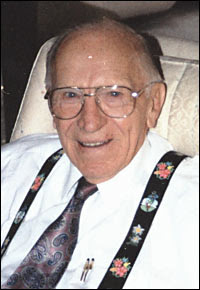
Lewis "Bill" Rickett (seen at the left) was the non-commissioned officer in charge (NCOIC) of the CIC office in Roswell in July 1947. Cavitt worked closely with him.

When I said, "No," Cavitt visibly relaxed.

I saw him again in 1993, when Don Schmitt and I visited him at his home in Washington. He told us that he had been sent to Roswell on Special Order No. 121, dated 11 June 1947. He was given a five day delay in route. He claimed not to have been physically present at Roswell in early July, 1947, so he could not have been involved in the retrieval. That, we would learn later was not accurate.

During the interview held on March 27, 1993, Cavitt again said that he had not gone out to the Brazel ranch. We talked about that for a while and then Cavitt asked, "Are you guys convinced that I wasn’t there."

Mary Cavitt said, "If he had been way overnight, at that time... I would for sure remember it."

I mentioned that there were some problems with the Marcel testimony, meaning the things that Pratt had reported.

Cavitt said, "You better believe that. He [Marcel] says I was out there is his biggest problem."

But then, as we continued to talk with Cavitt, he made it clear that he was, in fact, in Roswell at the right time. He had just arrived, or was about to arrive, depending on the date of the crash and his mood at the moment. His wife had arrived on July 2, after a wedding in Oregon and Cavitt was supposed to have arrived a day or so after that.

The last personal interview with Cavitt took place on June 25, 1994, just weeks after Colonel Richard Weaver had been there for the Air Force investigation of Roswell. We covered much of the same ground. I mention that Marcel had identified him as the one who went out to the site. That Marcel had described him as "a good west Texas boy from San Angelo."

Cavitt said, "Sort of nails me, doesn’t it?" But he would go no further, and even though Weaver had identified him as the man who had gone out with Marcel, and that interview would be published, Cavitt still tried to make us believe that he had not participated in the event. This despite what Marcel said and what Rickett said.

What all this boils down to is that Cavitt said he wasn’t in Roswell at the time of the recovery, that he was there but that he didn’t go out, he didn’t go out with Marcel, that he was involved in no recoveries of balloon debris, he wasn’t gone overnight, and he doesn’t know why he was cast into this role.

It is, you might say, Cavitt’s word against Marcel, and if you are in the debunker camp, you naturally fall on the side of Cavitt. He was just a good officer, doing his duty, at that time the only living witness according to the story, of what happened at the Brazel (Foster) ranch. So, who do you believe?

To answer that, let’s take a look at Cavitt’s testimony to Colonel Weaver, who visited him in 1995. That interview was published in Air Force produced, The Roswell Report: Fact vs Fiction in the New Mexico Desert (and we’ll see who wrote the fiction as we try to sort through all of this).

Remember that Cavitt told me, on tape and in other conversations that he had not participated in any balloon recoveries (Storm clouds over a portion of the debris field in 1989). Remember also, he was quite clear that he had not gone out with Marcel. That he wished Marcel hadn’t named him. He said, "You better believe that. He says I was out there is his biggest problem."

Now, here is what he told Weaver. "Well, there again I couldn’t swear to the dates, but in that time, which must have been July, we heard that someone had found some debris out not to far from Roswell and it looked suspicious; it was unidentified. So, I went out and I do not recall whether Marcel went with Rickett and me; I had Rickett with me. We went out to his site. There were no, as I understand, checkpoints or anything like that (going through guards and that sort of garbage) we went out there and we found it. It was a small amount of, as I recall, bamboo sticks, reflective sort of material that would, well at first glance, you would probably think it was aluminum foil, something of that type. And we gathered up some of it. I don’t know where we even tried to get all of it. It wasn’t scattered, well, what I would call, you know, extensively. Like it didn’t go along the ground and splatter off some here and some there. We gathered up some of it and took it back to the base and I remember I had turned it over to Marcel. As I say, I do not remember whether Marcel was there or not on the site. He could have been. We took it back to the intelligence room... in the CIC office."

So, here we now have Cavitt saying that he had gone out on a balloon recovery, that he might have gone out with Marcel, but he wasn’t sure, that he was involved in the recovery in early July, and that he might have turned over some of the recovered material to Marcel.

Weaver’s next question was, "What do you think it was when you recovered it?"

"I thought it was a weather balloon."

So Cavitt was able to identify it immediately. To me, Weaver’s next question, given the history of the case, should have been, "Did you communicate this rather important piece of information to Marcel?"

Instead, he asked, "Were you familiar with weather balloons at the time?"

And Cavitt said, "I had seen them."

It has always been an article of faith that the Mogul balloon array was unusual enough that it could stump the people who found it (One of the arrays seen at the left). Because it wasn’t a single balloon, but many, with many radar reflectors and long strings connecting everything, people who were familiar with weather balloons might not recognize them as such. But Cavitt claimed that he did. More importantly, he didn’t bother to tell Marcel what it was.

What we now know is that Marcel said that Cavitt had gone out there with him, but Cavitt had made it clear that he had not. We know that Marcel was right on that point, given Cavitt’s new information that Marcel might have been with him. It isn’t Marcel vs Cavitt here, but Cavitt vs Cavitt.

We can go further. Remember Cavitt said, "There were no, as I understand, checkpoints or anything like that (going through guards and that sort of garbage) we went out there and we found it."

Cavitt said he was with Rickett. Here is what Rickett said about that in a taped interview conducted by Don Schmitt, "I [meaning Rickett], Marcel went back out there that same afternoon. This time they had some security people from the Provost Marshal’s office out there."

Just so we have this straight, because it could be argued that Cavitt had not seen the security out there because it was put there after he had been in the field, Rickett said, "Cavitt and I came back together and I’m not sure if Marcel came with us... it was being protected..." So, Rickett was out there more than once, he was with Cavitt on, at least one of those trips, and Rickett saw the guards.
Later, to confirm this, Rickett said, "On the road we drove on, [there were] MP s standing there..."

The argument here is between Rickett and Cavitt. Cavitt said no guards and Rickett said guards. Others, such as Judd Roberts, William Woody and even C. Bertram Schultz said there were checkpoints along the dirt roads leading off the main highways to the north and west. This means that Cavitt was wrong on that point as well.

If we look at his description of the debris that he claimed he picked up, we find that it doesn’t match Project Mogul. There weren’t bamboo sticks in it. Balsa wood, yes. His description of the crash site matches no one else, including that supplied by Bessie Brazel, daughter of Mack, and who told investigators what she, her father and her brother Vernon, had seen. She also said that they picked up the debris so there was nothing in the field for Cavitt to see. But that is something to examine in another post.

What this means is that the testimony given by Cavitt is not very reliable. Clearly he was saying to Weaver what Weaver wanted him to say. Clearly, he was telling me things that were not consistent and that have since been proven false. He even proved to me that his statement that he wasn’t in Roswell was wrong because he showed me copies of his orders assigning him there.

This means that we must look at the statements provided by Cavitt and compare them with the statements of others. Do they fit into the picture, or it is Cavitt standing alone, making statements that are not corroborated by others. With Cavitt, even the man who worked directly under him, is contradicting him and as I noted, Cavitt doesn’t even agree with Cavitt.

While this doesn’t prove that Roswell involved extraterrestrial contact, it does show the extraordinary effort the Air Force went to in 1947 and later in 1994 to prove that it was just a weather balloon (yes, but Mogul was made up of weather balloons). And it shows that the testimony of Sheridan Cavitt, like so many others, isn’t completely reliable.