First, there is an interesting MADAR report from Louisville,
Kentucky on August 28 of last year. According to investigator Robert Speering,
the witness reported seeing an object that was, at first hovering over his
house and then slowly drifting off to the northeast. He said that he was nearly
under the object that was flying at about 300 feet.
The UFO had a round bottom and had yellowish, reddish and orange
lights with four dim white lights, all on the underside. The UFO itself was a
large hexagon shape but with the white lights also in a hexagon shape. All the
lights were steady. He said it looked as if the object was underwater and was
changing shape slightly though it was above him during the sighting.
The man said that he hadn’t believed in UFOs or alien visitation
prior to the sighting. He did say that nothing manmade could have operated the
way this object did. He said there was no noise, except for a slight humming
sound, gave off no heat and both hovered and flew in a straight line but there
were no signs of wings. He said the object was about 60 to 80 around.
At about the same time as the sighting, the MADAR node, also in
Louisville, detected an anomaly. The witness knew nothing of the MADAR node and
the node operator knew nothing of the UFO sighting. Speering, as he
crosschecked UFO sightings with MADAR detections spotted the connection.
Additional investigation is being conducted.
Albuquerque Flying Wing and the Lubbock Lights
For this months, retro sighting, I’m looking back to the Lubbock lights from August and September 1951. This was a series of sightings located in the panhandle of Texas and parts of New Mexico. The first of the sightings that would become known as the Lubbock Lights, was made in Albuquerque, New Mexico, in the early evening of August 25, 1951. A man and his wife (unidentified in the Project Blue Book files
 |
but who are Hugh and Emily Young) watched a huge, "wing-shaped" UFO with blue lights on the trailing edge as it passed over the outskirts of the city. In his statement, found in the Blue Book files, Young said:
This aircraft was flying in a south by east direction at a
speed I thought to be about 300 miles per hour.
The altitude was difficult to judge, but the aircraft was
low enough so that the lights from Central Ave. reflected from the lower side
of the wings.
This aircraft was unusual in the following ways, there was
no sound of motors or jets in fact there was no sound at all that I could hear.
I could see no fuselage on this aircraft. The size I judged to be at least one
and one half times as large as a B-36 and was shaped like a V with the wings
sloping back at an angle of about 15 degrees.
On the rear edge of the wings soft white lights were located
in pairs with not less than six of these on each side of center. These lights
were very different from motor or jet exhausts as seen at night. I am familiar
with the appearance of these.
From the front edge of the wing stripe extended to the rear
edge of the wings with the strip ending between the lights of each pair. These
strips had poor reflection.
Each pair of lights were separated by about eight times the
distance between the lights of one pair.
The wings appeared to retain their size from the center to
the end without any taper.
No identification or markings could be seen and this
aircraft had no colored lights of any kind that could be seen. The aircraft was
in my sight about ½ minute.
This is a true description of the aircraft as I observed and
remember it.
This was signed by Young and it was
certified as a true copy by John T. Hagood, an Air Force captain. It is clear
that the Air Force was taking the sighting seriously because Young was a
security guard at the Sandia Labs, which was part of the Atomic Energy
Commission and that provided a level of credibility to his report. In fact, it
was noted in one of the reports that Young was “apparently reliable.”
There were additional details of the
investigation included in the Blue Book files, along with a statement by Emily
Young, whose name was redacted throughout the file. Her statement provided the
same description as that of her husband. There is no reason to believe that
they did not discuss the sighting with each other before the Air Force
investigator arrived to take their statements.
In a confidential report submitted to
the Inspector General at the 17th District Office of Special
Investigation, Colonel S. H. Kirkland, Jr. (who was stationed at Kirtland AFB)
made a couple of important points. He wrote:
Reference is made to your Spot Intelligence Report of 27
August 1951, subject as given above [unconventional type of aircraft]. It is
not known whether or not you are familiar with a report from OSI District
Office No. 23, Carswell Air Force Base, Fort Worth, Texas, in which a similar
sighting over Lubbock, Texas, on 25 August 1951 is reported…
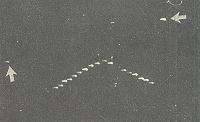
Also enclosed are four photographs taken by Mr. [name
redacted, but is Carl Hart, Jr.] on 30 August 1951 which are supposedly similar
to those seen over Lubbock, Texas, on 25 August 1951. It is requested that
these photographs by shown to Mr. [name redacted but is Hugh Young] and obtain
his opinion as to whether or not this is what he saw over Albuquerque on the
night of 25 August 1951. If he does concur that this is what he saw, have him
sketch in the wing he reported seeing and obtain any other details that he may
be able to give (Ibid.).
According to a letter found in the Blue
Book files and dated 14 November 1951, the photographs were shown to the
Youngs. They said that the formation of lights was similar to the wing that
they had seen. At that point Young made the sketch that had been requested.
Apparently, he drew the wing on one of Hart’s photographs and then provided a
separate sketch as well.
Had it not been for the sightings over
Lubbock within a couple of hours, the case would have had little real
significance and would have been noted as just another “Unidentified.”
The Lubbock Lights
Not long after that, college professors in Lubbock, sitting
outside on August 25, 1951, about 10 p.m. saw a group of lights fly over. They
didn’t make much in the way of scientific observations and began to discuss
what they should do if the lights returned. When the lights returned, the
professors made some of their observations and called the local newspaper,
wondering if there were any other reports of the lights.
The professors, W.L. Ducker, A.G. Oberg,
and W.I. Robinson, were annoyed that they hadn’t seen more. They discussed what
to do if the lights should reappear. Before the night was over, they had their
chance and made a series of quick and well-coordinated observations.
The lights were softly glowing, bluish
objects in a loose formation. The first group, they believed, had been in a
more rigid and more structured formation than later groups but they hadn’t
gotten a good look at them.
Jay Harris, the managing editor of the Lubbock Avalanche, first learned of the
lights when Ducker called the news desk to tell of the sighting. Harris wasn't
interested at first because it was basically about lights in the night sky, but
Ducker convinced him that it was important. Ducker wanted a story written so that
others who might have seen the lights could be found and comparisons with their
information could be made. Harris finally agreed, but only if the newspaper
could print Ducker's name because his position at Texas Tech gave him instant
credibility. Ducker didn't like that condition and momentarily refused.
But a few minutes later, Ducker called
back and said that the newspaper could use his name, and the names of Oberg and
Robinson. The only condition was that Harris would have to get permission of
the college (Texas Tech) public relations department before printing an of
their names.
There were at least four others who saw
the lights on that first night. Mrs. Earl Mediock, Mrs. F.A. Rogers, Mrs. R.A.
Rogers (in the convention of the time, women were often identified by their
husbands’ last name and their first names were not printed), and Professor Carl
Henninger all reported seeing the lights at 9:10 P.M. That was the first flight
described by the professors.
Joe Bryant of Brownfield, Texas, said
that he also saw the lights on that night of August 25. According to him, he
was sitting in his backyard when a group of the lights flew overhead. He said
there was "kind of a glow, a little bigger than a star." A short time
later, a second group of lights appeared. Neither group was in any kind of
regular formation which differs from what the professors and those others had
seen.
Bryant eventually saw a third flight
that same night, but instead of flying over his house, this time the lights
dropped down and circled the building. Now he could see the objects quite
clearly and they were birds. One of them chirped and Bryant recognized them as
"plover." The next day, as he read the account of the lights in the
newspaper, he realized that if he hadn't identified the lights as birds, he
would have been as fooled as the professors.
Over the next two weeks, the professors
saw the lights on several occasions, but were unable to obtain any useful data.
Joined by Grayson Meade, E.R. Hienaman and J.P Brand, they equipped two teams
with two-way radios, measured a base line from the location of the original
sightings, and sent the teams out to opposite ends of that base to watch. They
hoped that sightings along the base line would provide them with enough
information to allow triangulation which would allow them to determine the
size, altitude, and speed of the lights,
They did manage to make a few
observations over the next several weeks. The lights traveled through about 90
degrees of sky in a matter of seconds. They normally appeared 45 degrees above
the horizon and disappeared about 45 degrees above the opposite horizon. During
the first observation, the lights had been in a roughly semicircular formation.
In subsequent sightings no regular pattern was noticed.
None of the deployed teams ever made a
sighting, through on one or two occasions, the wives of the men, who had
remained behind, said they had seen the lights while the men were at the bases.
That would suggest that the lights were much lower than the professors had originally
thought which would also reduce the estimated size and speed.
On August 30, the case took a radical
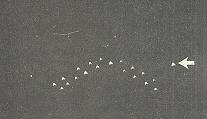
turn. A nineteen-year-old amateur photographer, Carl Hart, Jr., (seen here)managed to take
five pictures of the lights as they flew over his house. Because it was hot
that night, he had pushed his bed close to the window and was looking out and
up. He said, "I liked to sleep with the windows open with my head stuck
out the window - and there they were." Knowing that the lights had
returned on several occasions based on the articles in the newspaper, he
grabbed his 35-mm camera, set the shutter at f-3.5 and went outside.

A few minutes later the lights flew
over a second time and Hart took two photographs of them. Not long after that,
another group of lights appeared, and Hart apparently took three additional
pictures. Some controversy about the number of photographs developed in the
weeks following the sighting.
Harris, who had spoken to Ducker on the
first night, learned of the pictures when a photographer who worked for the
newspaper periodically, called to tell him that Hart had just been to his
studio to develop the film. Harris, reluctant as ever, suggested that Hart
should bring the pictures by the newspaper office. It was the first tangible
evidence that there was something to the stories. It was the first physical
evidence of something in the sky.
Harris, and the newspaper's head
photographer William Hams, feared a hoax. Harris, after seeing the photos
called Hart a number of times and bluntly asked him if he had
faked them. Hart replied that he hadn't faked anything.
He had photographed something as it flew over his house in south Lubbock. Hart
just didn't care what Harris thought. He didn't care about payment for the
pictures either, though he eventually received about ten dollars for them from
the newspaper. Later the pictures were printed in dozens of magazines and
books, but Hart rarely received any payment for their use, though he was
sometimes credited with having taken the pictures. He had failed to have any of
the pictures copyrighted, on the advice of another photographer who said that
the copyright would suggest hoax. That poor advice would surface in several
other photographic cases.
"Advice from a friend and
professional journalist at the time was that if [I] copyright them, somebody's
going to think [I] faked them and [was] trying to make money out of them,"
Hart told me. "I was interested in that part of it [proving the pictures
authentic] and didn't do it [copyright them.]"
Harris later decided to put the photos
on the news wire, but before he did, he called Hart one more time. This time
Harris warned Hart that if he found out the pictures were faked, there would be
grave consequences and that Hart would never work as a professional photographer.
Once the photographs went out on the wire, nationwide, Harris said, Hart's
problems would be far worse if he was lying about them. Hart still insisted his
pictures were authentic. There was no fraud.
Hams, however, decided that he was
going to try to duplicate Hart's pictures. By doing that, Hams believed he
might be able to figure out exactly what they showed, or, at the very least,
how Hart had managed to take them. It might also suggest how he, Hart, faked
them. Hams took a Speed Graphic camera loaded with a tungsten ASA 80 film and a
GE#22 flash bulb in a concentrating reflector to the roof of the Avalanche building. It was the same
equipment that he used to photograph night football games at the local high
schools and college. Of course, a flash wouldn’t be effective if the objects
were several hundred feet above him.
He waited, but saw nothing other than a
flight of migratory birds. They were barely visible in the glow of the sodium
vapor lights on the street five or six floors below him. They flew in a ragged
V-formation, and he could see them dimly outlined against the deeper black of
the night sky. He was surprised because they were so quiet. Ducks and geese, as
they flew, could be heard squawking.
When Hams developed the film, he found
an image that was so weak that he couldn't print it. He repeated the experiment
on another occasion and failed again. From his own experience, he was convinced
that Hart could not have photographed birds under any circumstances. That
didn’t mean that he hadn’t faked them, only that they didn’t show birds.
The photographs became one of the most
important aspects of the Lubbock case. Here was physical evidence that could be
seen and tested. Measurements and studies of the photos could be made, and
professionals could attempt to duplicate them. Hams, and the photography staff
at the newspaper, could find no evidence of a hoax. They believed that if Hart
faked the pictures, he was wasting his time in college. Clearly, he was the
best photographer in the area. He would have a career in Hollywood special
effects if he wanted... if he had faked them.
Hart continued to insist that he had
not faked anything. In fact, he told me, "I heard some unofficial things
that came out later... about [how] they thought I had faked them somehow or
another." This is based on an experiment conducted by Dr. Donald Menzel, a
Harvard astronomer and UFO debunker. He suggested lights reflecting off an
inversion layer, one of his favorite explanations.
In September, 1951, the Air Force began
the official investigation of the Lubbock Lights episode. The Albuquerque
sighting was checked by intelligence officers from Kirtland AFB. They made
several visits to the house of the witnesses and asked hundreds of questions
during the interrogation. Emily Young provided a drawing of the object which
was then forwarded to Wright-Patterson AFB. After several weeks, and partly
because of the reliability of the witness, the sighting was listed as an
unidentified. That is the way it was carried until the end of the official Air
Force investigation in 1969.
In Lubbock, quite a bit of time was
spent on the photographs taken by Hart, simply because they were evidence of
the sighting. Although the official file contains the results of other aspects
of the investigation, the majority of the paperwork covers the
photographs. Officers, including Lt.
John Farley and Special Agent Howard N. Bossert of the Air Force Office of
Special Investigation, both from Reese AFB, just outside of Lubbock, were
dispatched a number of times with questions for Hart. Lieutenant (later
Captain) Ed Ruppelt even made a special trip into Lubbock to conduct his own
investigation into the lights and to interview Hart himself. The negatives were
examined by a variety of military and civilian experts at photo labs at
Wright-Patterson.
On September 20, 1951, Bossert and
Farley interviewed Hart at his home and asked for the negatives. Hart could
only find four of the five. The fifth negative was never found and it was not
printed in any newspaper. Hart turned the negatives over the military for their
analysis. Bossert's initial report, dated October 8, 1951, was sent to AFOSI
Headquarters in Washington, D.C. Copies were also sent to the commanding
general of the Air Materiel Command at Wright-Patterson AFB, and to the
commanding officer at Reese AFB in Lubbock
Between November 6 and 9, 1951, another
investigation of the Lubbock Lights was conducted. Ruppelt, accompanied by
Bossert, again interviewed Hart at his home and were told the same story that
Hart had told during all the other interrogations.
"Hart's story could not be 'picked
apart' because it was entirely logical," according to the official report.
"He [Hart] was questioned on why he did certain things and his answers
were all logical, concise, and without hesitation (Ruppelt, 1956)."
Ruppelt also interviewed the college
professors. They provided signed statements about what they had seen and done
and how they had attempted to gather scientific observations. In addition to
recounting several flights, they mentioned an unusual event on September 2.
While the flight passed directly overhead, as had the others, and was made up
of 15 to 30 lights, one professor noticed an irregularly shaped yellow light at
the rear of the formation. That was the only difference any of them had ever
observed in relation to the lights.
A technical report, WCEFP-2-4, Physics
Branch Sensitometry Unit, dated 29 November 1951, revealed nothing about the
sightings other than that the lights photographed by Hart were individual lights
and not part of a larger, dark object. The lights moved in relation to one
another in the formation. The Air Force physicists did estimate that if the
lights had been attached to an object one mile from the camera [or at 5,280
feet of altitude], it would have been 310 feet in diameter. If closer, it would
be smaller, and if farther away, it would be larger. These were speculations
because there had been no information on the negatives to provide clues to
altitude or size.
The report concluded, "There is
relative movement within the formation of spots, so that there are not lights
on a fixed object." The important statement, however, came from the final
conclusion. "The pattern of spot brightness is such as to prove conclusively
that all 3 frames (negatives) - 5, 7, and 8 - were exposed to the same object
pattern of spots.”
An examination of the photographs and
the negatives turned up no evidence that Hart was lying. The sequence of shots,
as he described them, was corroborated by the negatives. Hart's story was
hanging together.
Ruppelt's interview in November was not
the last conducted by the military. On December 2, Hart was questioned yet
again. This time, according to the documentation in the Blue Book files, Hart
was given his rights. These were explained to him as "The rights of a
private citizen under the Fifth Amendment of the Constitution of the United
States...he acknowledged his understanding of such rights."
According to the AFOSI report, Hart was
interviewed in private and was asked for a written statement. The statement
said, "On August 50, 1951 [typographical error in letter of transmittal
and not original statement] at about 11:30 P.M. took pictures of strange
objects passing overhead from north to south. I saw three separate groups of
objects. Two pictures are of the second group. Three are of the third group.
The last negative was not found and is not in my possession."
Documentation in the Blue Book files,
reveals an extraordinary effort went into investigating the Lubbock case, as
opposed to many of the other investigations conducted by Air Force officers.
Murray S. Sturgis, the Air Adjutant at Carswell AFB [Fort Worth, Texas] wrote,
"Reference OSI Letter 24-0 dated 7 September 1951 to OSI, Hq USAF, concerning
unidentified aircraft at Lubbock, Texas. Request A-2 [Air Intelligence Officer]
forward by air mail as expeditiously as possible form 112 on subjects Carl
Hart, Jr., Mrs. Tom Tilson, Mrs. M.G. Bethard; if possible forward by air mail
original negatives of photographs Carl Hart, Jr., is stated to have
taken..."
The "Report of Investigation"
was written by Howard N. Bossert. He said that he, along with Lieutenant John
Farley interviewed Hart at his home (this in addition to the other interviews
with Hart at his home). Bossert reported that he found Hart to be "a very
intelligent young man, very interested in photography, which is a hobby. He
seemed sincere in his efforts to relate all incidents to the best of his
ability."
Bossert learned that Hart had also seen
the lights on September 1, but he hadn't photographed them then. At that time,
no one was talking about UFOs in relation to the lights. Although the lights
looked the same, Hart thought they were at a greater altitude and were in a
single line. They flew from the northwest to the southeast.
By the end of the year, the Air Force
investigation began to wind down. Investigators had spoken to all the witnesses
several times, concentrating on Hart. After they interviewed Bryant, the man
who had seen the plover, and to another west Texan, T.E. Snider, who reported
he had seen the lights but identified them as ducks, the official answer became
birds.
In still another, later report, Air
Force investigators wrote, "It was concluded that birds, with street
lights reflecting from them, were the probable cause of these sightings. The
angular velocity was less. In all instances, the witnesses were located in an
area where their eyes were dark-adapted, thus making the objects appear
brighter."
Of course, that conclusion overlooks
the fact that there are no migratory birds in the Lubbock area at that time of
year. Loren Smith at Texas Tech told me that there are ducks that fly in
V-formations in the area in late August. They just aren't migratory.
The Glossy Iris, for example, inhabits
west Texas and does fly in the proper formation as suggested by the
photographs. The problem, however, is that species is reddish-maroon and has no
white to reflect the street lights no matter how bright those street lights
might be. The Glossy Iris is not satisfactory as the explanation. In fact,
there are no birds in west Texas that are satisfactory as an explanation for
all the sightings.
The report continues, "Mr. Hart,
when taking his pictures, had to do so by 'panning' his camera. Panning is
quite difficult, and the relative high degree of success of this photographer
is further indication that the angular velocity of the objects was not as high
as estimated."
The report concludes, "The kind of
birds responsible for this sighting is not known, but it is highly probable
that they were ducks or plover. Since plover do not usually fly in formations
of more than six or seven, ducks become the more probable..." Nor do
plover fly in a “V” formation.
Such a solution might be the proper
explanation for some of the sightings, especially those by Bryant and Snider.
There might be other reports from the Lubbock area that are explained by the
birds, but certainly not all of them. Each sighting should be investigated as a
separate event because each was a separate event. Their relation to one another
is simply the timing and the location. A solution for one set of sightings does
not translate into a solution for the others. When that is completed, those
left over should then be seen as the pattern.
The photographs taken by Hart show
this. Clearly, the pictures taken by him do not show birds. Experimentation by
professionals was unable to duplicate the photos taken by Hart. Project Blue
Book records, however, list the case as solved - as birds.
But that wasn't the last of it. In June
1952, Dr. Donald H. Menzel, the Harvard astronomer and a rabid opponent of the
alien visitation theory, published an article in Look claiming that the Lubbock Lights were not birds, but
reflections of the city's lights... "mirages caused by atmospheric
conditions known as 'temperature inversion.'" This is, of course, the same
explanation that would be used to solve the mystery of the Washington Nationals
that were seen over Washington, D.C. in the summer of 1952 a few months later.
Menzel, using chemicals, was able to
reproduce what he claimed were the Lubbock Lights in his laboratory. His
pictures, taken of stationary objects in his lab, showed lights in a similar
formation, but the lights in his photographs were more diffused than those
taken by Hart.
Interestingly, the early television
show, Science Fiction Theater, had a
story about UFO-like lights over a city. In the end, a scientist, using an
aquarium filled with two chemicals to duplicate the temperature inversion,
reproduced the objects seen by the story’s witnesses. This episode was clearly
based on the Lubbock Lights and used Menzel’s theory as the basis for the
tale’s explanation.
Dr. E.F. George, one of the scientists
who had actually seen the lights, disagreed with Menzel’s explanation. He said,
"I don't believe what I saw was a reflection from street lights."
Since he had actually seen them, his testimony should take precedence over
Menzel’s claims.
Ruppelt, in his book, examines the
whole of the Lubbock Lights case from a unique perspective. He was one of the
Air Force officers involved in the original investigation. He spoke to the
individuals within weeks of the events, to the experts who could provide some
information about the case, to scientists who might have a solution for the
sightings and saw the area where Hart took his photographs. Unlike those who
followed, he was on the scene which is often one of the most helpful aspects in
an investigation.
Of the photographs by Hart, Ruppelt
(1956) wrote, "...the investigation ended at a blank wall. My official
conclusion, which was later given to the press, was that, 'The photos were
never proven to be a hoax but neither were they proven to be genuine.' There is
no definite answer."
Of the other sightings, Ruppelt wrote,
"Personally I thought that the professor's lights might have been some
kind of bird reflecting from mercury-vapor street lights, but I was wrong. They
weren't birds, they weren't refracted light, but they weren't spaceships. The
lights that the professors saw - the backbone of the Lubbock Light series -
have been positively identified as a very commonplace and easily explainable
natural phenomena."
Ruppelt then explained, in his 1956
book, that he couldn’t offer the final solution because it came from a
professor who would be easily identified if the solution was published. Ruppelt
said that it makes perfect sense to him, but he was going to honor his promise
to the scientist that he wouldn’t use that explanation.
In the years before his death Ruppelt
received letters from UFO investigators who wanted to know the final answer.
Always Ruppelt answered the same way. He would not violate the confidence. But
when Ruppelt died at a relatively young age, he left notes and documents, and
in those notes and documents, now housed at the J. Allen Hynek Center for UFO
Studies, is Ruppelt's answer. The professors saw - fireflies.
Ruppelt's explanation is as ridiculous
as that of all the others. It does not explain the situation nor does it
explain the photographs. And, it doesn't explain why the professors only saw
the fireflies at the end of August and the beginning of September 1951. Did the
conditions around Lubbock change to produce an abundance of fireflies that year
and then return to the original conditions so that they didn't fly over the
city in later years. And when was the last time that fireflies were seen in any
sort of formation. They might be seen as individual insects buzzing about, but
not in any sort of V-shaped formation. Not to mention that they would have been
described as flashing lights rather than steady as nearly all the witnesses
claimed.
Often times, long after the event, a
man who was responsible for a fake photograph, will confess. Those who have
faked photographs as teenagers have come forward as adults to explain the
situation. But Carl Hart is not among that rather large number. Interviewed
again, in 1993, Hart told me that he had no explanation for the pictures. I
asked if he believed in flying saucers. Hart said, "I don't particularly
disbelieve." When asked if he knew what the lights were, he told me,
"I really don't."
Carl Hart, Jr. died on September 24, 2020, in
Lubbock.
(For
those interested, the complete story of the Lubbock Lights appears in The Best
of Project Blue Book, available at Amazon.com as an ebook and a hard copy
edition).