Showing posts with label Socorro UFO landing. Show all posts

Thursday, January 31, 2019

X-Zone Broadcast Network - Paul Hynek


In a change of pace, rather than interview, I chatted with Paul Hynek about History’s Project Blue Book. This all came about, as I have mentioned, because I wondered how the Hynek family was reacting to the program. Many of us thought that J. Allen Hynek would be upset by the way he was presented. Paul thought his father would sit there, a big bowl of popcorn in his lap, and enjoy what he was watching. You can listen to the show here:

https://www.spreaker.com/episode/16887709

The thing that came out in the discussion, was that the Hynek family, and some of us in the UFO community, understand that this is a drama and not a documentary. Paul took it a little farther than that, suggesting that it was put
Paul Hynek
together the way it is because of other considerations. For example, it is set in the early 1950s (though the timeline is certainly skewed) so that it would address some other issues including Russian meddling. While I don’t want to get dragged into political discussions here because that isn’t the purpose of the blog, I will note that there certainly is a tie in between the spying of the cold war and the meddling with public opinion today… and yes, I was more than a little careful with the wording to avoid those political discussions.

We did discuss some of Allen Hynek’s favorite cases. Paul mentioned the Socorro UFO landing specifically. He said that his father was impressed with Lonnie Zamora as a witness. I didn’t mention that there had been an opportunity to find additional witnesses in 1964 based on what Captain Holder, of the Army, had learned on the night of the landing. Nor did I mention that another sighting, in northern New Mexico, a day or so later was not investigated by Hynek, though, according to the record, he had requested permission to do so.

We also talked about David O’Leary, the creator of the series and Auturo Interian, who is a vice president at A&E, and directly involved in the show. Both men are well versed in the UFO field. In my communications with Interian, I have been impressed with his depth of knowledge that moves into some rather esoteric areas. In talking about some of the background, he mentioned the 4602d Air Intelligence Service Squadron, an organization that some of those deep into Ufology know nothing about.

Paul is of the opinion that even though Project Blue Book is very loosely based on real events, it does spark an interest in UFOs. If it moves some to explore the topic more deeply, or search for more information, then that’s not necessarily a bad thing.

You can listen to the interview and see what you all think about it. I should have the opportunity in the near future to interview some of the others involved with the show. If there are questions you’d like to hear answered, or short points that you’d like to make, append them here in the comments, and I’ll do what I can to get them answered.

Sunday, October 21, 2018

Barrel Launches and the Socorro Landing


It has taken awhile, but I have now been able to follow up on the tale originally told to us by Kevin Ashley, as told by someone he knew. To briefly recap, Ashley said that he was talking about the Socorro UFO landing when another man entered the conversation, suggesting that this was an experiment by either staff or students at the New Mexico Institute of Mining and Technology. They had launched a barrel
Lonnie Zamora
about the time that Lonnie Zamora arrived on the scene. Zamora had seen their experiment, had seen them, and that these guys escaped later while leaving no trace.

Both Tony Bragalia and I communicated with Ashley, who provided additional information about what he knew on October 4, 2018. In fact, he produced a report about it, covering several of the points. He does suggest the balloon explanation isn’t viable because, as he wrote, based on his assumptions about the sighting, “… a balloon only ten feet long would not be large enough to support two individuals and if the balloon were left to float away by itself, then the question arises as to where the people who launched the balloon went considering that the site was examined immediately afterwards.”

In addressing the barrel theory, Ashely wrote, “This explanation also has the problem of where did the perpetrators go, since the site was examined immediately after the sightings by both Officer Zamora an Sgt. Chavez.”

And that has been my thinking as well. The people responsible for launching either the balloon or the barrel would have been seen leaving the area. There is no way for them to have escaped unless they were in the balloon.

Of course, these are Ashley’s thoughts based on what he knows about the case, but not based on first-hand observations. Remember, in the original story, he had accepted the theory that Zamora had seen something extraordinary. It wasn’t until the fellow he identified as Bruno gave him the details of what happened that he began to change his mind. The details, then, were second hand… but it does get worse.

As noted, Bruno had told Tony that he and another fellow were responsible for the sighting. They had been launching a barrel using explosives. It was some sort of an experiment. Zamora had stumbled onto it, and they had fled, fearing they might be expelled if their involvement was uncovered by the school. There were problems with the information and there were certainly questions left unanswered. Some of them were suggested by those who visit here on a regular basis.

According to Tony, Bruno seemed somewhat reluctant to talk about any of this, though in the world today, nothing that happened so long ago would adversely affect Bruno. He certainly wouldn’t be expelled. Anyway, there seemed to be nothing new coming, so I sent Bruno a rather benign email with a couple of questions. I didn’t expect a response, but on October 20, there was one.

About the first thing he wrote was, “I am not admitting that I was involved in this incident of the UPO (sic), and feel sad if it had caused any grief for the Zamora family.”

This is in conflict with what he had told Tony, but it could be suggested that he said this just so that he wouldn’t be overwhelmed by UFO researchers asking for information… Or it could be the truth.

He then wrote, “I learned only recently that this UFO hoax had caused so much publicity.”

Hoax is not the correct word in this scenario. There was no intention to fool anyone. It wasn’t designed to convince anyone that some sort of alien craft had landed. It was, according to Bruno, an experiment, one seen by Zamora by accident.

According to Bruno, two students from the New Mexico Institute of Mining and Technology were trying to produce an explosion that would resemble an atom bomb blast. He wrote:

Exploring old abandoned mines they found a military hand held blasting machine that was operated by twisting the handle.  The magneto inside the blasting machine produced enough current to set off 10 electric blasting caps in a series connection.  Also found in abandoned mines were several sacks of ammonium nitrate.  The plan was to pour some gasoline into a shallow pan, put a board across the pan to hold a sack of ammonium nitrate with a stick of dynamite inserted to set off the ammonium nitrate.  An electric blasting cap inserted in the dynamite was used to start the explosion.  The experiment was set up close to a dirt road, a safe distance from town, and far enough away so that nobody would see the experiment.  A 55 gallon drum was placed open end down, to cover the gasoline pan and explosives.  The idea was to let the hot sun beat down on the 55 gallon drum to produce gasoline fumes, thereby causing a fire ball that would rise up to form a mushroom cloud.  Just when the action was to take place, our scientists noticed a dust cloud on the road from an approaching vehicle, which turned out to be a police car. 
Given what we know about the location of the landing site, I’m not all that sure they were safely out of town. Watching Mythbusters, I know they routinely blew up stuff near Socorro with the help of the school, but I don’t think they were ever as close as this experiment had to be. There was then, and still is now, lots of open area around Socorro. I don’t think they needed to be as close to the town as they were.

Bruno wrote that with the police car approaching, they made the decision to detonate the mixture before the police car would be in danger, as opposed, I guess, as waiting until the police car was gone. According to Bruno:

The experiment was near perfect with a large red ball of flame rising up from the ground to form a nice mushroom cloud.  The police car came to a stop, the policeman jumped out of the car watching the result of the experiment.  The policeman got back in his car, turned the car around, and took off back to town.  Our happy scientists slowly gathered up the debris from the experiment such as pieces of 55 gallon drum, rolled up the blasting wire, and took all the stuff back with them on the jeep.
This is where the tale really slides off the rails. Those of us who have studied the case know that there was no mushroom cloud, that the site was never without someone on it from the time that Zamora saw the craft until much later that night.
Captain Richard Holder had ordered MPs to the site and it is unclear if they remained overnight. The next morning, there were all sorts of people there including Dorothy Landoll, who recently told me that she and her husband went out to look over the place. There is no way that the “happy scientists” could have returned to collect their debris.

The final bit of information was, “They got in their jeep, and as they were following the news directions, something started looking familiar.  It turned out that it was their experiment site.  Reporters had come in from Albuquerque, and were overheard talking about places where weeds were burned, and ground had been singed from the UFO takeoff.”

Although it is probably unnecessary, I will point out that samples were gathered by Holder that night and forwarded to the Air Force. Their analysis found no trace of any of the components of the “experiment.” Such residue would have been left, and Bruno tells us that the “happy scientists,” returned to confirm that their experimental site was the same as Zamora’s landing site. According to that Blue Book, “Laboratory analysis of soil samples disclosed no foreign material… analysis of the burned bush showed no chemicals which would indicate a type of propellant.”

While none of this proves that was Zamora saw was an alien spacecraft, it does eliminate this particular explanation. There are simply too many problems with this explanation, as I have noted. I think that we can close this particular chapter of the Socorro landing.

Wednesday, September 26, 2018

The Socorro Barrel and Bruno R.


I now know more about the barrel launching Bruno R (name left out of the original post that Dave Thomas put on his website at: http://www.nmsr.org/socorro.htm). Tony Bragalia, working with a little information that I supplied and searching through other sources, was able to speak with Bruno in an attempt to corroborate Kevin Ashley’s story at Thomas’s site. Bruno said that he did not remember revealing his involvement to Ashely.

Bruno said that he was, in fact, responsible for the Socorro UFO sighting. He, and a colleague he refused to name, said they were using Ammonium Nitrate, an electric blasting cap, dynamite, a large barrel and a gasoline pan. This was how they launched the barrel, and as we’ve seen, the lift off
Barrel launch.
would be with a roar as the barrel shot straight up into the air.

Bruno said that both of them were wearing blue jeans and not white coveralls. He said that he wasn’t short, as suggested by Lonnie Zamora’s statements. He also said they had not decorated the barrel in any way so he doesn’t know what the insignia was that Zamora had mentioned.

Interestingly, he said that he and his partner said nothing about this because they were afraid they would be expelled. He said that after graduation, he had left to work in Central America so that he was unavailable to anyone searching for him. He did say, “Now I feel bad for Lonnie.” Which is interesting given the theory that the sighting was a hoax designed to torment Zamora.

My initial reaction is that this doesn’t fit in with the physical evidence that was gathered on the site within hours of the craft lifting off. This included soil samples. Captain Richard T. Holder, according to the Project Blue Book files, took soil samples. He gave these to Dr. J. Allen Hynek, who was on the scene as the Air Force Consultant to Blue Book. This means, of course, that the samples were gathered before the scene was trampled by curiosity seekers. Remember that Dorothy Landoll told me that she and her husband were out there the next day.

According to the Blue Book files, “Laboratory analysis of soil samples disclosed no foreign material… analysis of the burned bush showed no chemicals which would indicate a type of propellant.”

Lonnie Zamora and various individuals on the
landing site.
In the descriptions of the site by those who were there that evening including Zamora, his friend Sergeant Sam Chavez, Holder, FBI agent Arthur Byrnes, several other law enforcement officers and military police, no one said a word about a battered barrel (I am assuming here that the barrel would be battered after being blasted upwards and falling back). They talked of other things they saw including burned bits of cardboard, so they were talking about all sorts of debris.

The landing traces and there were four, were not what you would expect from the launching of the barrel. These were suggested to be landing gear imprints and not the haphazard craters created by denotating dynamite. To those on the scene the impressions looked as if they had been pressed into the ground rather than caused by an explosion, or for that matter, by a shovel.

There are some other problems with this tale. How did Bruno and his partner get away without some kind of vehicle in the area, and the area was searched for tire tracks?  Bruno said that they had not decorated the barrel so he doesn’t know where that insignia came from that Zamora had reported. As I say, what happened to that barrel? It was not found.

There are some problems with this confession (well, this interview or conversation… it really wasn’t a confession). It just doesn’t fit in with what we really know based on the interviews conducted on the night of the sighting. It doesn’t fit with the physical evidence collected. It doesn’t fit with the other sightings that were reported to the police prior to Zamora arriving on the scene.

Hector Quintanilla seated.
But I did think of one thing. Bruno suggested that maybe Zamora had embellished the sighting, embarrassed by all the commotion it had stirred. Hector Quintanilla, who was the chief of Project Blue Book in 1964, said that he could not find an explanation for he sighting and believed the solution might be hiding in Zamora’s head. He was saying, I think, that there might have been an observation or a bit of knowledge that Zamora had that he didn’t share with the investigators. If Zamora was embellishing the story, then that might be what Quintanilla was thinking.

As I wrote that last sentence, I knew that it would be misinterpreted by many. No, I don’t believe the barrel explanation solves the case. But, if I’m going to be intellectually honest about the investigation, I must look at all sides, and to be fair, I must present all information. I find this tale interesting and slightly disturbing, but I don’t believe this is the solution… which is not to say that Bruno and his pal weren’t blowing up barrels, or that he believes this solves Socorro. It is just one more complication as we attempt to learn what happened back in 1964.

Monday, September 24, 2018

Barrels of Fun in Socorro


As you all know, I have been looking at the Socorro UFO landing case and in the last couple of weeks published an article about it. In that article, I mentioned that a fellow, Kevin Ashley, had heard a solution for the case from an engineer who had attended school at the New Mexico Institute of Mining and Technology in 1964. His story, though a bit hard to believe was that he and a pal had been responsible for what Socorro Police Officer Lonnie Zamora had found. To recap for those who might not have seen that post:

He [Bruno, the former student] said that he and another mining student were bored and looking for something to do that day. They got their hands on some dynamite (possibly from the dynamite shack mentioned in Officer Zamora’s account) and decided to have some fun setting it off under an old overturned metal barrel. The first time they did this the barrel went flying into the air which they found very amusing so they did it a couple more times. (It was probably the third explosion that attracted the attention of Officer Zamora.) Delighted with the result of the barrel being thrown in the air again, they set about putting together one more explosion. As they were bending down getting everything set they were apparently seen from across the arroyo by Officer Zamora. The two of them, who were wearing white coveralls, were seized with a sudden need to get the hell out of there because being caught doing a stupid stunt like this with dynamite would get them both expelled… Evidently the fuse had already been lit when Bruno and his friend legged it for their vehicle to get away. Office Zamora started toward the site when the explosion went off and as he dived for cover he lost his glasses. What he saw the couple of times he glanced up was the oil drum being projected upwards with flame coming out from the bottom.
As I mentioned, this seems a little bit farfetched. So, why bring it up again? Tony Bragalia found, on YouTube, a couple of videos that show people putting quarter sticks of dynamite under upside down barrels. It does show, to some degree, what Zamora had reported. You can watch these short videos at:
and
The trouble here is that the barrels just didn’t disappear. They come back down, though in the first video, you don’t see that until the very end. In the second, you see it immediately. No barrel was found at the scene.
Launching a barrel with dynamite.
And, the dynamite would have left residue on the scene. Soil samples were taken, but none found any evidence of a pyrotechnic detonation. In other words, no evidence of dynamite being detonated on that site at the time indicated.
Of course, the barrel wasn’t found, though there was discussion of debris on the scene such as burned cardboard. Those who were there didn’t believe the cardboard was related to the sighting.
Anyway, Tony sent me the links and I thought them interesting enough to post here. This doesn’t seem to be a viable solution given the other evidence and the number of people who were there in a matter of minutes, but the videos are fun. If there was any evidence for this solution, then it might be the answer. Without any sort of evidence or even a statement or two from Bruno, this is a nonstarter, but as I say, it is a fun explanation.

Friday, September 14, 2018

New Socorro UFO Landing Information


The other day Rich Reynolds over at the UFO Conjectures blog, sent me a link to a skeptics site. He wondered if I had seen the information published there about the Socorro UFO landing. I had not, but found the information interesting. You can see that here for yourself:

Dave Thomas, who hosts the site, gave me permission to quote from the two new stories that he had put up there. Neither had been available when I wrote Encounter in the Desert. Had they been, I would have mentioned them, though one is a tad bit farfetched.

Thomas published a letter from Ron Landoll, whose mother lived in Socorro at the time of Lonnie Zamora’s sighting. He related what she told him, but I am disinterested in it. The tale is second hand, but in this case, it turns out that this second-hand testimony accurately reflects what his mother told him. I’m ignoring it because the second letter published by Thomas is from Landoll’s mother, Dorothy.

There are some very interesting things in that letter. First, she wrote that she was at home, in Socorro, taking care of the baby (Ron) when her husband called. He was a senior at New Mexico Institute of Mining and Technology (NMIMT) and said that the campus was “abuzz with a UFO that had been sighted.”

She turned on the radio and said that it was tuned to KOMA, which was (or is) an Oklahoma City station. I know that at one time it played rock and roll, because when I lived in Texas some four or five years after the Zamora case, I listened to it. But the real point here is that an Oklahoma City radio station was broadcasting the news of the UFO landing within, what minutes, certainly hours, of the landing. They, like other members of the media got onto the story quickly. This is a point that would become somewhat important later when two men from Dubuque, Iowa claimed to have been in Socorro at the time. Their story seemed to surface almost as did that from Zamora, but a careful reading of suggests it was an invention by those men for some reason. Some of the details they gave turned out to be from a different sighting. They’d gotten their facts mixed up.

The next morning, which would be April 25, 1964, the Landolls drove out to the site. Dorothy Landoll wrote to Thomas:

The next morning we drove out to the site. There was a police car sitting off to one side. There were perhaps 7 or 8 cars parked over to the other side and folks just standing around looking. There wasn't a lot to see. There was one round indentation in the dust near where we were standing (I don't know how many total) - about like what our tires were making. There was no indentation into the hard packed ground as some later stories said. I walked up to the little mesquite bush in the middle and it was somewhat blackened. I didn't touch it but it may have been burned a little and might have had a bit of oil on it. We stood around for a bit too and then left to go home.
While it is interesting to have another first-hand account of what was going on that next morning, it is also necessary to point out that there were impressions in the ground. These were seen by nearly everyone else and either the Army or the police had surrounded the markings with rocks to protect them. They were photographed by
Landing impression. Photo courtesy
of the USAF.
several people including members of the military. Jim and Coral Lorenzen published a picture of one of the landing gear imprints in the May 1964 edition of The A.P.R.O. Bulletin. That picture was taken by State Police Sergeant Sam Chavez.
Dorothy Landoll continued her narrative of the incident. She wrote that:
Holm Bursum III was president of the First State Bank and Polo Pineda was his right-hand man [were there]. At the time of the sighting, Polo was acting sheriff… [I worked at the bank and] still took my morning breaks with her, Polo and one of the tellers. On Monday morning we were in the kitchen when Polo came in… He was as mad as a hornet. Ruth asked him what was going on with the UFO. His first comment was that he'd been told that he wasn't to talk to anyone about what had happened but this was his town and he'd talk to whoever he pleased! He sat down with his coffee and proceeded to tell us.
She provided a synopsis of the Zamora tale and then added an interesting note. She wrote:
Lonnie Zamora was pursuing a vehicle going south near the edge of town when something caught his eye. He drove up on the mesa and looked down to see a round craft with two individuals in silver suits walking around it. After a minute or two they got in and it took off. Describing the craft, he said that it had markings on it similar to what Boeing puts on its planes. Lonnie was so upset/scared that he first headed to the Catholic church for confessional and then contacted Polo. Shortly after that, I was in the front of the bank and there were two obviously FBI men - black suits and sunglasses (which they took off as they entered). They went up to one of the tellers and asked for Polo. I went back and told Polo they were looking for him.
I would like to have known if there was anything more to this encounter between the sheriff and the FBI. We know that one FBI agent was there from the beginning. I don’t know of a second FBI agent in the area, but that doesn’t mean that there hadn’t been one.
It also seems a little strange that the FBI would tell the sheriff not to talk about this when the information had been broadcast on April 24, on a radio station that had the power to reach all the way to Socorro. And that station reached into several other states as well. It was one of the powerhouses of that era.
I do know that Captain Richard Holder, an Army officer involved within about 90 minutes, and the FBI agent Arthur Byrnes, had spoken to Zamora, suggesting that he not talk about seeing any beings associated with the sighting, and to keep the true insignia to himself. Byrnes thought the news media might be a little rough of Zamora for seeing “little green men,” and Holder thought keeping the insignia hidden would help to weed out copycats.
Landoll, in her letter to Thomas, also suggests a solution for the Socorro craft that Zamora reported. She wrote:
The following year we were living in Midland, TX, I'm guessing maybe May or June, my husband had brought in the newspaper and it was lying on the couch. I glanced down at it and hollered to my husband that Lonnie's UFO was on the front page of the paper. What I saw fit the exact description that Polo had given us. It was a photo of a LEM with an article. I wish I had kept that newspaper but it simply wasn't anything of consequence at the time.
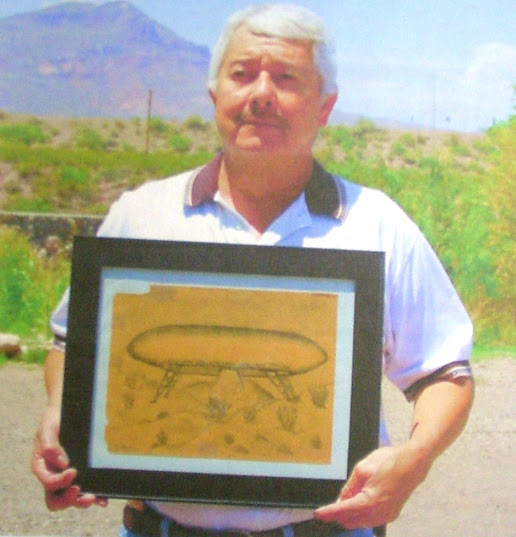
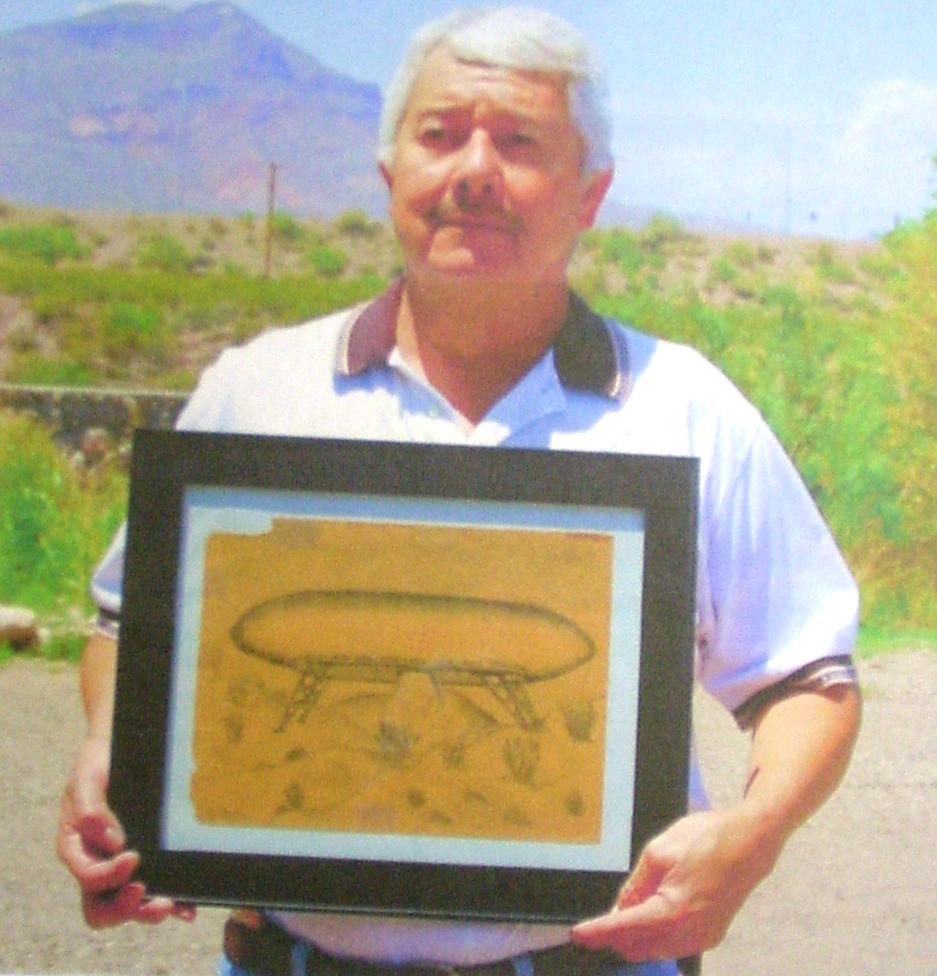
And, for those of us who have been paying attention, the illustration drawn by Rick Baca, under the guidance of Zamora, does resemble the LEM. But documentation suggests that the prototype LEMs being tested in New
Rick Baca holding the illustration he made in
consultation with Lonnie Zamora. Photo
copyright by Rich Baca.
Mexico at the time were not powered. The testing involved a helicopter. It seems unlikely that this is the explanation, especially when it is remembered that the Captain Hector Quintanilla, the chief of Blue Book at the time, looked into that possibility. He carried a top-secret clearance, and personally checked at Holloman Air Force Base and the White Sands Missile Range to see if they might have the explanation for the sighting.
But this isn’t the only new additions to Thomas’s skeptics website. He received another communication that provided a much more exciting solution for the case. Kevin J. Ashley wrote that he had been a student at the NMIMT a few years later and that he had been interested in the Zamora sighting. According to him, once he graduated and was employed, he told co-workers about the case. He wrote:
In short, I know the answer to the Socorro Saucer Siting [sic] because I talked to one of the people who was on the other side of the arroyo that morning when Officer Zamora showed up. His name is Bruno R____ and he was a mining engineering student at Tech in the early 1960’s…
As I finished the story I noticed one of the other mining engineers who worked there leaning against the door and laughing. When I asked him what he was laughing at he said, “It was me.”
He then told his story about the incident. He said that he and another mining student were bored and looking for something to do that day. They got their hands on some dynamite (possibly from the dynamite shack mentioned in Officer Zamora’s account) and decided to have some fun setting it off under an old overturned metal barrel. The first time they did this the barrel went flying into the air which they found very amusing so they did it a couple more times. (It was probably the third explosion that attracted the attention of Officer Zamora.) Delighted with the result of the barrel being thrown in the air again, they set about putting together one more explosion. As they were bending down getting everything set they were apparently seen from across the arroyo by Officer Zamora. The two of them, who were wearing white coveralls, were seized with a sudden need to get the hell out of there because being caught doing a stupid stunt like this with dynamite would get them both expelled. (Officer Zamora notes in his statement that one of the persons looked at him and seemed very concerned.) Evidently the fuse had already been lit when Bruno and his friend legged it for their vehicle to get away. Office Zamora started toward the site when the explosion went off and as he dived for cover he lost his glasses. What he saw the couple of times he glanced up was the oil drum being projected upwards with flame coming out from the bottom. Bruno and his friend kept a low profile throughout the entire affair after that and I may have been the first person he told this story to. This was in 1980, sixteen years after the affair.
I suppose, we could believe that two college students, in their early 20s would be dumb enough to play with dynamite in that fashion. And we could believe that Zamora somehow concocted a craft that roared off into the sky out of this.
Ashley did, however, elaborate on what he had been told. This according to what Bruno R. told Ashely:
Reading over the account by Officer Zamora his original description seems to fit well with Bruno’s account. It is the “filling in” of details where the mystery arises. For instance, when people went back and found four burn spots, these became a configuration of thrusters from a vehicle, not the scorched remnants of multiple dynamite explosions. Also important is that this was not a hoax. Bruno and his friend were not trying to fool anyone. This is just a case of an observer trying to explain something that they have not seen before.
The problem here, however, is that the four markings were never considered to be marks of the thrusters, but marks made by the landing gear. The area that would have been under the center of the craft had showed evidence of high heat. No evidence that would have been left behind by dynamite explosions was found, which, I believe rules out this explanation.
Tony Bragalia, who is a proponent of the hoax theory, noted that Bruno R. thougt Ashely, had gotten some of the facts right. Bragalia theorized that three students had been involved, Zamora had been chasing a speeder and the roar of the craft did capture his attention. Bragalia also noted that this wasn’t “innocent” fun as suggested by Ashley, but that it was a planned hoax.
Ashley supplies a little more information about Bruno R. Apparently, he lives in Felton, California. Thomas didn’t follow up on the story imediately. I think he thought the same thing as me. It really is rather farfetched. But then, I do believe we should follow up because we don’t know exactly what Bruno said. I have tried to locate him given the information supplied, but have had no success. Bragalia is also trying. His resources in this are better than mine, so there might be more learned.
The real point here is that we have some new information. I find the tale told by Dorothy Landoll quite interesting because she said she was on the scene the next morning. She described what she saw… and importantly, felt no obligation to share that information with anyone until decades after the sighting. I’m hoping to reach her to find out why she didn’t come forward before now.
If I learn anything new about this, I’ll post it here. For now, you can read the entire text of the letters from the Landolls and Ashley at Thomas’s New Mexico Skeptics website, and for the complete story, you can take a look at Encounter in the Desert, which provides quite a bit of new and additional information about the Socorro Landing.

Sunday, January 14, 2018

Fake News and La Madera

The UFO community has had to put up with fake news for much more than a century. In 1897 there were a number of Great Airship stories that were printed by newspapers. The reporters and editors had to know that some of them were fake, but the interest was there, the stories were there and the bottom line is that newspapers need to make money. Hype a story that doesn’t deserve it, add details that the reporters invent and a few quotes to make the story better or just make it up completely.

Aurora, Texas in the early 1970s. Photo copyright by
Kevin Randle.
I am convinced, by the evidence, or the lack there of, that the Aurora UFO crash of April, 1897, is a hoax begun by a newspaper stringer who wanted to do something for his town. Beyond the story printed in 1897, there isn’t much evidence of the airship crash, until UFO researchers became involved in the 1970s. The point here, however, is that in today’s world, this would be labeled as fake news.

To bring this closer to us, here in 2018, and keeping with the theme of the last few posts, I looked at the La Madera UFO landing. This was a sighting that took place in the hours after the Zamora sighting, and by hours, I mean something like 30 hours after the landing in Socorro. Orlando Gallegos said that just after 12:30 a.m. on April 26, 1964, he had gone outside and about 200 yards away, saw something he told Sheriff Martin Vigil, looked to be as long as a telephone pole and as big a round as a car. He said there was a bluish-white flame all around it and as Gallegos watched, the flames went out. I provided a long report on this sighting in Encounter in the Desert, for those who wish to learn more about the case.

The point here is not to talk about the sighting, but about one of the newspaper reports that appeared in the Santa Fe New Mexican on December 28, 1969, some five years after the sighting. At the end of the story written by Ron Longto, Vigil is quoted as saying, “I’m not going to speculate on just what was at La Madera that night… but I hope it never comes back.”

Dr. James McDonald
Dr. James McDonald had seen the story and wanted to check on the veracity of it, meaning the quotes attributed to Vigil, not to mention some of the facts of the case. He couldn’t get Gallegos on the telephone but he could find Vigil. In a March 12, 1970, letter, McDonald wrote:

Upon explaining the purpose of my call and citing the press story, I got a laughing but emphatic statement from Vigil, “They absolutely misquoted me.” I presumed from that he was about to disclaim everything in the story but that was not the case at all. Instead, his strong initial reaction was sensitivity to the closing sentence of the story, in which the reporter took the liberty of inventing the quote that Vigil “hopes [sic] it never comes back.” The one other disclaimer was to the effect that he had said nothing to reporter Longo to suggest that “they really put the heat on Gallegos to keep his mouth shut about that sighting in La Madera.”
There is one other thing to say about all this. I have been accused of misquoting people on a number of occasions, but those allegations were untrue. I had taped the interviews and the transcripts reflected what I had said they said. J. Bond Johnson, the man who took most of the photographs in General Ramey’s office after the Roswell story broke in 1947, said that I had misquoted him on a number of points. When I read the transcripts to him over the telephone, he said that he hadn’t said those things because they weren’t true. He was convinced that I had misquoted him and he wanted to hear the tapes so he could prove it.

I sent him an edited version so that he wouldn’t have to sit through the whole four hours of interviews, but that had the quotes on them. His response was to say that I had admitted to editing the tapes and he couldn’t find all the quotes. So, I sent him all four hours, plus the transcripts, twice, and the best he could do was show that I had left an unimportant conjunction out of the transcripts. That, of course, didn’t satisfy him and even though he had the tapes, he continued to say that I had misquoted him. He had gone from telling the truth in the interviews I conducted to an assault on me, even when he knew he was wrong.

The point is that sometimes, when people don’t like the direction of the quotes, they claim to have been misquoted. Here, with Vigil, I see no reason he would claim to have been misquoted on something as innocuous as the last line in the story unless that was something that he hadn’t said. The quote is a nice wrap up for the story, a good final line, and the impression of the reporter might have been that Vigil felt that way, but Vigil said he didn’t say it. At least he said he hadn’t said it.

Is this overly important to the overall story? Not really, other than give us a look at something that in the world today would be called fake news. Vigil didn’t seem overly upset by the quote given his reaction to it. But it also demonstrates that we, as investigators, researchers, writers, and proponents of a point of view must get this stuff right even when it is something as inconsequential as that last line. E must be careful or we can damage all the work we have done.

And, besides all that, I thought it was kind of an interesting anecdote…

Wednesday, December 20, 2017

Socorro, Fused Sand and Mary Mayes (Update 5)

When I was researching my book on the Socorro UFO landing, I had come across information about some fused sand that had been recovered at the site. Both Ray Stanford and Jerry Clark had reported on it. The information source seemed to be unidentified, the fused sand wasn’t mentioned in the Project Blue Book files, and the analysis of other physical evidence seemed to be about whatever you wanted it to be. Jerry Clark wrote, “If such ‘notes and materials’ exist [about the fused sand], they have never come to light. They are not in the Blue Book file on the case.”

This seemed to be more of the unconfirmed information that dot this case. We have those pesky three people (or rather the three telephone calls) to the Socorro police about the flame in the sky as noted by Captain Richard Holder. We have the car of tourists talking to Opal Grinder about low-flying aircraft that nearly smashed into them. We have the auditory witnesses, mentioned by Ray Stanford, who heard the roar of the object but who apparently didn’t see an object and whose names have been lost. Given all that, and the fact that this information, about the fused sand was not very well documented, I reported what I knew and let it go.

Dick Hall
But, as always happens, once the book is published, new information is found. This time it was spurred by a question at this blog about that particular aspect of the case, one that I didn’t think of as important. I decided that I needed to know more about this, so I went back to Stanford’s book, Socorro Saucer in a Pentagon Pantry. His entry was somewhat misleading, given the way he reported on it. Although he credited Dr. James McDonald as the source, he failed to mention it was in a letter to Dick Hall of NICAP, who provided a copy to him. Stanford wrote:

…a woman who is now [1968] a radiological chemist with the Public Health Service in Las Vegas [Nevada]… [who] was involved in some special analysis of materials collected at the Socorro site, and when she was there the morning after, she claims that there was a patch of melted and resolidified [vitrified] sand right under the landing area. I [McDonald] have talked to her both by telephone and in person here in Tucson recently. Shortly after she finished the work [on the Socorro specimens], air force personnel came and took all her notes and materials and told her she wasn’t to talk about it anymore (My [Stanford’s] emphasis. A copy in my files.)
That, of course, is not the whole story. In fact, as noted, this is very misleading based on everything that McDonald put in his letter. When you read what McDonald wrote, it tells us some more about all this. He wrote (differences highlighted in bold:

One last point: Have you ever heard of any reports that there was a patch of “fused sand” near the site of the Socorro landing? As a result of a remark that Hank Kalapaca made to me at lunch in the Rayburn building on 7/29 [I will assume here the year was 1968], I followed up a lead that Stan Friedman picked up when he spoke to a nuclear society in Las Vegas. I’m still in the process of checking it, so won’t elaborate the details here. Briefly, a woman who is now a radiological chemist with the Public Health Service in Las Vegas was involved in some special analyses of materials collected at the Socorro site, and when she was there, the morning after, she claims that there was a patch of melted and resolidified sand right under the landing area. I have talked to her both by telephone and in person here in Tucson recently, and am asking Charlie Moore to do some further checking. I must say, it’s very hard to imagine how such material could have been there not only on the evening of the 24th but still there on the morning of the 25th without it ever having been reported before. She mentioned it to Stan rather casually, as if she assumed that everybody knew about the fused sand. She was surprised to be told, especially by me, that nothing like that had ever before been reports. She did the analyses on the plant-fluids exuded from the stems of greasewood and mesquite that had been scorched. She said there were a few organic materials they couldn’t identify, but most of the stuff that had come out through the cracks and blisters in the stems were just saps from the phloem and xylem. Shortly after she finished the work, Air Force personnel came and took all her notes and materials and told her she wasn’t to talk about it anymore. Grand coverup? Not necessarily. The fused sand might be another matter.
By comparing the two reports, that is, what McDonald actually wrote with what Stanford provided, you can see that this information isn’t quite as strong as Stanford suggested. In fact, McDonald didn’t seem to be particularly impressed with it, but he did what all good researchers would do. He decided to see what he could learn about the witness, who isn’t named here but whose name appears in other correspondence written by McDonald, and to see if he could find additional information.

The first thing that I wanted to know, now that I had a copy of the letter, is what Stan might have remembered about this. It was, of course, fifty years ago, so his
Mary Mayes, 1959.
memory might be a little vague. He told me that as best he could recall, “Mary Mayes approached me after I lectured to a technical group saying that she had been a student at NMIT [New Mexico Institute of Mining and Technology] at Socorro when she was asked to check on the soil which she had done. I told Jim [McDonald] about it as he was much closer obviously than I was. No need for me to be a middleman.”

The next question was if this Mary Mayes’ name could be verified since it wasn’t mentioned in the original letter. On November 25, 1968, Charles Moore (yes, that Charles Moore) reported that he had talked with both Raymond Senn and Sam Chavez about the melted sand. Neither of them saw any melted sand on the site and neither remembered Mayes, though in his letter, Moore incorrectly identified her as Nayes. He also mentioned a Mary Rumph, which as I have just learned from Don  Ecsedy was her maiden name. 

And, since we’re trying to get to the bottom of all this, I’ll note here that Moore wrote, “Our instrument man at the Institute, Mr. John Reiche, visited the Zamora site on the night of April 24th, 1964. John, an active amateur scientist and rock collector, tells me that he saw nothing unusual other than a burned bush, the markings on the ground which were at that time ringed by stones. Reiche appears agnostic about the whole sighting but places no high value on Zamora’s credibility. He says that Zamora reported other highly unusual events such as deer passing through the Socorro plaza at night when no one else has ever seen such things in modern times.”

This, is, of course, disturbing. It suggests something about Zamora that had not been mentioned by anyone else over the years, and while this letter, from Moore to McDonald has been available to researchers for a long, it seems that information from it had been overlooked.

One of the landing pad impressions found by Zamora. Photo courtesy USAF.
Moore goes on to say, “Reiche has also told me that the markings on the ground (presumably made by the support gear of the flying object) seems ‘wrong’. The soil on the sides of the indentations was loose and appeared as though it had been moved by a shovel; it did not appear to have the character that it should have, had it been made by the intrusion of a load bearing support.”

Which is another bit of information that hasn’t seen much in the way of publicity. While it seems that Reiche doesn’t care about any agenda, only the truth, it is also clear that he has raised some questions about Zamora and about the landing gear traces. I haven’t seen much like this in the research that I had conducted until now. But I will note that some of that loose dirt seemed to be explained by the landing gear sliding in the dirt as the weight was applied to the landing pad and the dirt shifted under the added weight.

Charles Moore at the Institute Library. Photo copyright
by Kevin Randle.
As for the melted sand, Moore wrote, “As I told you earlier, I screened the dirt in the arroyo bottom in an effort to find any evidence of fused material and found nothing that suggested the spalling off of rhyolite, melting of any vesicular lava nor the fusing of any sand. While it is true that the arroyo is subject to washing during summer thunderstorms, the fragments of the burned bush are still there, and I examined carefully the vicinity of the roots of the burned bush but found no evidence of fusing heat.”

We now have evidence that suggests Mayes’ tale might not be true. Although Moore called her Nayes in his letter, it would seem that if Senn heard the name Nayes, he would have mentioned that he knew someone named Mayes. Instead, he denied knowing her.

To complicate the issue, McDonald asked Mayes about these negative results. He talked to her on the telephone and then in person. He said that she had “remarried as Mrs. Mary White.”

According to McDonald’s letter to Moore dated April 2, 1970, mentioning the investigation, he wrote:

She [Mayes/White] seemed to be quite astonished that Senn said he did not know her, and she said not only had her family known him for many years, but she, herself, had “stood up for him” at his wedding… I had frankly tended to dismiss her story on the basis of what you’d turned up and Senn’s not knowing her. She again went very briefly over it - - where the fused sand lay relative to the impression, etc. No signs of evasive coverup or backtracking to mend her story. And reexpressed surprise at Senn’s saying he didn’t know her.
I pointed out that Reiche saw nothing like that when he was there, and she seemed genuinely puzzled.
Don Ecsedy tells me that there was a fellow namd Rumpf at Senn's wedding and is mentioned on the documentation available on line. So it seems possible that Mayes was at the wedding but that Senn knew her as Mary Rumpf rather than Mary Mayes. But I also have to wonder why, when McDonald asked her about this, she didn't mention that she was Mary Rumpf at the time. It would have cleared up this one point of disagreement and that she didn't seems curious.

There are more technical aspects to this claim of melted sand. According to a report from McDonald to Colonel L. DeGoes (apparently an officer assigned to ATIC at the time), “Charlie [Moore] took to the lab at NMIMT specimens of vesicular lavas that are abundant near the site and also a sample of a rhyolite present in abundance. A welding torch melted the vesicular lava to a smooth obsidian-like form, without sputtering. The torch would not melt the rhyolite, but it flaked off. A thorough search by Moore and a graduate student failed to turn up any sputtered-drop spherules in the dirt near the center of the site.”

But here’s the rub. Moore told McDonald that he had gotten to know Zamora and according to that same report by McDonald:

It came out a few weeks ago in the course of a rather careful recheck done by C.B. Moore of NMIMT at Socorro. Charlie has been out to the site with Zamora and… Zamora happened to volunteer the information about a “bubbly lava” rock one side of which had melted down. It was something like a foot across… and was located near the geometric center of the four leg holes i.e., right in the most heavily charred by the flame of the object in takeoff. Zamora said “some official” took it away that night… Holder makes no mention of such a rock…
Going through the entire Blue Book file on the case, there is no mention of the fused sand by anyone who was on the scene. From the moment that Zamora saw the thing in the arroyo there were people on the site. Holder even had military
Although this picture has been published suggesting it is Mary Mayes on the scene, this photograph was staged some time later with Zamora looking on.
police from White Sands cordon the area, take measurements and preserve the scene. Although it is not clear if the MPs were there overnight, but next day, there were any number of people on the scene, but no one mentioned Mayes and her colleagues being there. They would have needed some guidance to find the right place, so they would have had to come into contact with the Socorro police or the government officials (Holder and FBI Agent Byrnes). Photographs, taken the evening of the 24th and at other times give no hint of the melted sand, and those taking samples, from the damaged bush, from the soil around the landing area, and from other parts of the arroyo have nothing to suggest a high heat that would melt the sand.

Here's something else. According to Stanford, when he was on the site with Hynek and Zamora, he, Zamora, spotted a rock with what looked like metal scrapings on it. He pointed it out, but it seemed that no one cared about these possible metal sample from an alien spacecraft. Once the site was cleared, sometime that afternoon, Stanford returned and retrieved the rock and its metallic samples. This does not seem to be the same rock that was near the melted sand that Mayes mentioned and that Zamora seemed to confirm existed some two years later but I wonder if Zamora wasn’t confused by the disappearance of the rock taken by Stanford.

Zamora, and others, thought that the Air Force had retrieved the melted sand sometime later and that it was taken to a secret lab for analysis. Again, there is no testimony anywhere in the Blue Book files to confirm that this melted sand existed or that there was any analysis done of it. There are, in the documents I now have, a suggestion that Holder had written a five-page report, but I have not located it yet.

To recap what we’ve learned here. Mayes told Friedman about the melted sand some two years after the landing and that she had analyzed it. Friedman passed the information to McDonald, who followed up on it. Mayes said she was at the scene the next day, April 25, but that seems to be unlikely given the statements of others. At any rate, she claimed to have found an area of melted sand near the burned bush and recovered it, taking it to her lab for analysis. Once that was completed, the Air Force arrived, confiscated all the material and her notes, and told her not to talk about it. She had nothing to prove any of this, though there are those who accept the story without question.

Apparently, no one who was on the site on the evening of April 24th, who examined the burned bush carefully, who studied the landing gear impressions, and made measurements, noticed the area of melted sand near the bush and therefore none reported it. Other examinations of the site, in the months and years to follow found no evidence of heat high enough to fuse the sand, or any other indications of fused sand. It would seem, if we accept Mayes as telling the truth, that she collected the entirety of this evidence.

We have found, or rather Don Ecsedy Reported, that Mary G. Mayes is listed as a junior in the University of New Mexico 1959 Yearbook (page 42). He also reported that she had two years of college in Texas, but then she seemed to have claimed that she had attended NMIMT at some point so that she was familiar with the Socorro area. She told McDonald that she was a doctoral student at the University of New Mexico. She drops out of the picture after telling her tale to Stan and the beginning of the investigation by McDonald. In a letter dated March 13, 1969, McDonald wrote, “You 11/25 letter, for which thanks, indicated that neither Senn nor Chaves could in any way confirm the statements made to me by Mrs. Mary Nayes (sic) concerning the ‘fused sand.’ That certainly tends to cast strong doubt on her account. I have written to her but she has never replied, which may be further indication of something seriously amiss there.”

This was, of course superseded by his April 2, 1970 letter that actually explains nothing, other to reaffirm her original story. In the long run, no one can place her at the scene, no one saw the fused sand she talked about and she had no documentation to back up what she had claimed. All of this might have gotten more attention than it deserved, though there are still some avenues to pursue. (I will note here that Rumpf/Mayes/White died in 2007.) For those who wish to know who is Colonel DeGoes see:


 ftp://rock.geosociety.org/pub/Memorials/v29/degoes.pdf. 


Overall, this might be as far as we can take this, which is farther than I thought we could get. I have a couple of inquiries out that might pay off, but then again, we are pursuing something that is now over half a century old. Time might just be the one hurtle that we are unable to leap.

Saturday, December 09, 2017

Lonnie Zamora as the Hoaxer*

We have talked about the possibility of a hoax in the Socorro UFO landing case. We have, or at least I have, thought that the idea of a student hoax has been rejected as implausible. There were way too many moving parts that required way too many unpredictable actions to be a reasonable scenario. From the very beginning, it required Lonnie Zamora to react in a way the students needed him to react so that he would find his way to the location of the landing.

Socorro, New Mexico. Photo copyright by
Kevin Randle.
Dr. J. Allen Hynek, who seemed to have liked Zamora and thought of him as a good police officer also paid him a left-handed compliment. Hynek, according his “Report on Socorro New Mexico Trip” found in the Project Blue Book files, “That Zamora, although not overly bright or articulate, is basically sincere, honest, and reliable. He would not be capable of contriving a complex hoax, nor would his temperament indicate that he would have the slightest interest insuch (sic).”

Hynek seemed to be indicating that Zamora, on his own, couldn’t have pulled this off. He would have needed help which is suggestive of a conspiracy involving at least one other. Philip Klass thought that it was the mayor of Socorro who had a financial motive and the intelligence to set this up. Research by others, including Paul Harden, proved that this was not the case.

But then I got to thinking about it.

The hoax scenarios, as they have been developed over the years, are way too complex. They involve balloons, which should have been recognized as such, several different people who left no trace of their presence at the landing site, and no way for them to escape before the arrival of others on the scene to spot them. Sergeant Sam Chavez of the New Mexico State Police arrived within three minutes of receiving the call from Zamora but, unfortunately not long after the craft had disappeared.

All this presupposes that Zamora related, accurately, what he had seen. It presupposes that he didn’t embellish in any way, and it presupposes he wasn’t clever enough to have pulled it off, just as Hynek suggested.

Let’s look at this from, well, a different perspective.

According to what we know, no one else saw the landed craft. No one else saw it lift off and disappear in seconds. No one else saw the little beings near the craft. All of this came from Zamora and if he wasn’t telling the truth about it, well, then, the hoax becomes easier to accept. Just assume that he hadn’t really seen all these
Lonnie Zamora
things, and some of the arguments about the alien nature of the craft and its capabilities are no longer relevant. The whole thing becomes much simpler to explain in terrestrial terms.

Chavez said something during his interviews with the Lorenzens, when viewed in this light seems strange. According to The A.P.R.O. Bulletin of May 1964 (page 3, second column), “Sgt. Chavez also told the Lorenzens that he had looked into Zamora’s car to see if there were any implements of any kind with which the indentations and fire could have been effected. There were not. Mrs. L asked Chavez why he did that. Chavez admitted that Zamora’s story had been so strange, and he followed the regular procedure to establish evidence.”

Going back, and looking specifically at the descriptions of the landing marks, it seems that the various witnesses talked mostly about how the soil had been scraped to one side or the other. That seemed to indicate that something heavy had set down, but in the process, as the weight was applied, the landing pads shifted slightly. It didn’t seem as if they had been scraped out in the way it would look if a shovel had been used but more as if it was the result of something having landed there.

Ray Stanford reported in his book, Socorro Saucer in a Pentagon Pantry, in the caption on page 37, “The southwest imprint photographed on the morning after by New Mexico State Police Sergeant Samuel Chavez, giving the distinct impression of having been gouged into the earth by great weight from above.”

One of the landing pad traces.
And, finally, Hynek wrote in a letter to Dr. Donald Menzel of Harvard, on September 29, 1964: “…I have the word of nine witnesses who saw the marks within hours of the incident, who tell me that the center of the marks were moist as though the top soil had been freshly pushed aside.”

But we have to remember here that those nine people only saw the landing impressions and the burned vegetation. There might have some embellishment simply because it seems that no one really saw the bush smoking after the craft took off. Oh, it seems to have been reported that steam or smoke was rising from that bush by Chavez, but it is one of those things that is hard to pin down in the world today.

Although many rejected the idea that Zamora had created the hoax on his own for some unknown reason, the Zamora hoax explanation is by far the simplest. It eliminates the need for a balloon either hot air or helium filled, it eliminates the need for other participants to create the illusion of something landing there, and it explains the lack of physical evidence that the hoax scenario should have left behind. If Zamora had done it, he just needed his shovel and a tape measure. Then he called the station to make his report and request that Chavez come out to meet with him. This also explains why none of those other people who said they had seen something ever came forward. All the rest of it, from the alien creatures, the banging of the hatch, the red symbol… all of it was so much window dressing created by Zamora.

And while that theory is applauded for its simplicity, it fails when other facts are figured into it. We can begin with the three telephone calls into the police station. Again, we know little about them, we don’t know who made them, but they are documented in the records gathered that night and in the report filed by Richard Holder. It would mean that, at the very least, one other person had to be involved. He or she could have made the three telephone calls though it is more likely to have been three people.

It would have involved Opal Grinder who said that he had talked to the tourists from Colorado who mentioned the low flying aircraft. That adds another person to the conspiracy which is, of course, another person to spill the beans on this unless, of course, Grinder was the one who made the telephone calls to the police.

We also have to wonder what inspired Zamora to create the hoax. The Project Blue Book files confirm that there were no other reports of UFOs in New Mexico at the time and there had been very little publicity about them anywhere prior to Zamora’s sighting. In fact, from Hynek’s “Report on the Trip to Socorro – Albuquerque, March 12 – 12, 1965, we see, “One should remember that before the time of the sighting there had been no talk in the Socorro region of unidentified flying objects.”

Hynek also mentioned, “No paraphernalia of a hoax was ever found. It would be rather hard to have done away with all the tell-tale evidence, such as tubes of helium, release mechanism, etc.”

And one thing that might argue the loudest against Zamora doing it on his own was that the impressions on the ground, when corrected for the terrain features are symmetrical and the burned bush seemed to be located at the precise center where you would expect the rocket or jet used to lift it would be situated. That seems to be much too sophisticated for Zamora to have pulled off. It is one of those things that he might have lucked into, but it does seem to argue against a Zamora alone hoax.

I’m not a fan of the Zamora hoaxed the sighting without any real motivation and no real inspiration. Again, Hynek mentioned there had been no UFO sightings reported around Socorro prior to Zamora’s sighting, but afterwards, there were many (some of which were hoaxes). The sightings for April 1964 from other parts of the world are fairly mundane and didn’t receive much in the way of publicity if any at all. Had Zamora’s sighting come in the middle of the wave, it might be that these other reports suggested the idea to him.

I like this idea, that Zamora hoaxed it by himself because of the simplicity of it. However, when we add in other factors, all the factors, it seems that the theory is flawed. Hector Quintanilla suggested the solution for the case would probably be found in Zamora’s head, and had he hoaxed the thing, then Quintanilla had it right. But Zamora never suggested to anyone that he had made up the story, his friends and his actions that night seem to argue against hoax, and there is no real motivation for him to have created the hoax that included the landing site.

And any theory, or solution, that has to discount some of the evidence to work is no real solution. In this case there are too many factors that argue against a Zamora designed hoax, not the least of which is the physical evidence and the other, unidentified witnesses. If we can come up with a theory that explains all that, then we have something. Until that time, the case remains, “Unidentified.”


(Blogger’s note: I thought it important to say that in one aspect of my training as an intelligence officer, we were taught that you needed to review all possible scenarios when assessing a situation. In one example of that, I was analyzing the military and political situation on East Timor. In one of the most ridiculous scenarios, I had to determine the possibility of the United States and Australian peacekeeping forces engaging in some sort of conflict. The possibility of that happening was almost zero, but, given that armed military forces were occupying the same terrain, there was the possibility that something would go horribly wrong. Didn’t mean that it would, it was just one of the possible outcomes. I mention this because the idea that Zamora invented the whole tale it practically zero, but it is one possibility. I say this because I don’t believe it happened that way, but I do like the simplicity of that solution.)

*I had thought that "hoaxster" was a proper name for someone who had created a hoax... I just liked the sound of it better. But, after a number of people suggested that the word was not correct, I tried to look it up in my whopping, huge dictionary, but it wasn't there. So, I corrected it.