Saturday, November 11, 2006

More OOPARTS

I am always surprised when what I write, which I believe to be clear and unmistakable is misunderstood. For example, I was not suggesting that the Masons were running around the world planting OOPARTs (see the following article) but that they might have planted this particular article, or they inserted Tubal Cain’s name into it for some private reason.

I also understood who Tubal Cain was, or was supposed to be. I’d read the various articles on the Internet. It was quite clear to me that Tubal Cain was not an early resident of Dorchester county, but an ancient blacksmith.

And thinking about it, maybe the misplaced "L" was not the letter slipping out of alignment, but was purposefully put there as just one more way of "hiding" the true name so that it looked like Tuba Cain rather than Tubal Cain.

And for those of you keeping score at home, I too have had a long interest in OOPARTs, or the name that I prefer, OOPTHs for Out Of Place Things. I did not invent the term. I think Ivan Sanderson came up with it three or four decades ago.

But, since this article struck a chord, let’s take a look at some other examples. In an account given before the British Association for the Advancement of Science, Sir David Brewster said that a nail had been found embedded in solid rock. About an inch of the nail was protruding and the rest was lying along the stone and projecting into a layer of ground, where it had rusted. The report suggests that the nail was partially in the stone but had not been driven into it. In other words, the nail was part of the sedimentary material that had congealed into granite so that it was part of the rock. That would mean that the nail had been manufactured millions of years earlier if all aspects of the report were true and the observations about it accurate.

Many more such objects seem to have been found in coal. Brad Steiger, in Mysteries of Time & Space reported that Wilbert H. Rusch, Sr., Professor of Biology, Concordia College, Ann Arbor, Michigan, quoted a letter from a friend had received from Frank J. Kenwood (yes, this sounds like the old friend of a friend), who said that he had been a fireman at the Municipal Electric Plant in Thomas, Oklahoma in 1912 when he split a large piece of coal and found an iron pot encased inside.

Quoting from the letter, Steiger wrote, "This iron pot fell from the center leaving the impression or mold of the pot in this piece of coal. I traced the source of the coal and found that it came from the Wilburton, Oklahoma, mines."

Others have made similar discoveries in lumps of coal. Mrs. S. W. Culp, according to the Morrisonville, Illinois Times, published on June 11, 1891, found an artifact when she broke a lump of coal as she was preparing to toss it in a stove. According to the story, "Mrs. Culp thought the chain had been dropped accidentally in the coal, but as she undertook to lift the chain up, the idea of its having been recently dropped was at once fallacious, for as the lump of coal broke, the middle of the chain became loosened while each end remained fastened to the coal."

The coal was identified as coming from mines in southern Illinois. Steiger suggests that the coal is from the Carboniferous era.

I queried the Smithsonian about this and several other like reports a number of years ago. They suggested, "… manufactured items… would not normally be found in rocks or coal since the latter were formed before the advent of man. The only such inclusion would be the rock material had been broken, and the artifacts had gotten lost among it and then moss had recemented it by sedimentary action."

This is certainly a conventional explanation and is, of course, possible. It is also possible, as in the case of the metal vessel from Dorchester (see the following article) that it had not been embedded in the rock, but was associated with material around the rock. That means, simply, that it could have been something buried in softer ground that was uprooted by the explosion and fell in among the debris of the quarry where it was found giving the impression that it was blown out of solid rock.

Some support for that conclusion comes from the study of the history of OOPARTs. Info Journal, #59 reported that about 1900 an Englishman found a coin embedded in a lump of coal. The coin was clearly dated 1397. So, we have an artifact that was found in coal that was clearly dated long after the coal was formed unless we are willing to believe that some ancient, unknown or alien civilization used a numbering system just like ours. We have seen, since the beginning of written history a variety of numbering systems so why believe the ancients would use the same system we do. Why wouldn’t they have invented their own? And would they have a base ten?

There is further information that sheds additional light on this and we don’t need philosophic discussions of numbering systems to understand it. After Mount St. Helens blew up a group of scientists discovered that peat deposits had developed in an unexpectedly short time at the bottom of a lake. It suggested that some coal beds could theoretically form in far less time than conventionally believed.

What all this tells us is that there are some interesting enigmas out there and that there seem to be some rational explanations for some of these strange finds. But, and this is critical, those explanations rely partly on speculation. Further study is required on this before we can either accept the data as proved, or reject it as flawed.

Friday, November 03, 2006

OOPARTS and Tubal Cain

There is a class of ancient artifacts such as iron nails found in solid rock, a delicate gold chain found in a lump of coal in the 1890s, or an ornate bell-shaped vessel inlaid with silver blasted from rock in a Massachusetts that are called Out Of Place Artifacts, known popularly as OOPARTs. They seem to suggest that someone had been manufacturing objects millions of years before the human race was capable of such fine and precise work or even before humans existed on this planet. These artifacts are, in essence, a form of proof that another intelligence had once walked the Earth, maybe before the dinosaurs disappeared and that those sophisticated beings probably originated in outer space given the fossil and geological records relied on by our modern day scientists. It is circumstantial evidence that, if accurate, provides us with the proof that some ancient sightings were of alien spacecraft.

One of the first of the Out of Place Artifacts (OOPARTs) I came across was a reference in several UFO books to some sort of "bell-shaped vessel" discovered during blasting in a quarry in Massachusetts in the mid-19th century. For some reason I have always envisioned this as a "gravy boat."

According to those UFO books, the original source was the Scientific American in 1851. The story was headlined "A relic of a by-gone age" although some suggested it was labeled as "A Curiosity."

The story, as reported in those other UFO books, was that the blasting in the quarry "threw an immense mass of rock… in all directions." Among the shattered debris, the workmen found a small metallic vessel in two pieces that when reassembled formed a "bell shape" about four and a quarter inches high and about six inches wide at the top. The whole thing was something like an eighth of an inch thick.

The report continued, saying that it was made of zinc with "a considerable portion of silver." The sides were inlaid with silver and the carving was "exquisitely done by the art of some cunning workman." The magazine concluded, again according to all those other UFO books, that the find was worthy of additional investigation because the vessel was extremely old, pre-dating the first inhabitants of the continent.

I discovered that the University of Iowa library, (Pat Williams looks through the 1852 Scientific American in the bound periodicals) in it’s bound periodically section, held the entire run of Scientific American. It would be easy enough to check the primary source of the story. So I did. To my disappointment, but not great surprise, there was nothing in the 1851 issues about anything like the metal vessel being found. True, there were a number of things labeled as "curiosities" but nothing that told of manufactured items coming out of a quarry.

But research isn’t always that simple, and there is always the chance that someone had written down a date wrong and it was then copied by all those others who failed to do primary research but who believed the others had. So, I decided to look in both 1850 and 1852, and being somewhat compulsive about such things, I quite naturally started in 1850 because it came before 1852.

The article appeared in the June 5, 1852 edition of the Scientific American, on page 298. The details as listed in most of the UFO books were substantially correct. There was some additional information in that article, including that "On the sides there are six figures of a flower or bouquet, beautifully inlaid with pure silver, and around the lower part of the vessel a vine, or wreath, inlaid also with silver. The chasing, carving, and inlaying are exquisitely done by the art of some cunning workman."

The entry continues, noting "There is no doubt that this curiosity was blown out of the rock… but will … some other scientific man please to tell us how it came there?"

While I had been at the mercy of those other writers in the past, until I began to roam the stacks in the bound periodicals section of the University of Iowa library, researchers today aren’t so restricted (and I wouldn’t be surprised to learn that some of them have never seen the inside of a library). I typed "Scientific American 1852" into a search engine and in seconds was looking at a complete listing for Scientific American available on-line. Since I already knew the date, I could easily pull up what I wanted. Anyone with access to a computer and an on-line service could do the same (and therefore stay out of the library).

Like so much else in the UFO field, there is always something left out of the stories in all those UFO books. What is rarely mentioned is a paragraph at the end of the article in which it is suggested that Tuba Cain, one of the first residents of the area, meaning from the 17th century, had made the vessel.

But sometimes UFO research takes off on strange tangents. On closer examination of the Scientific American, it begins to look as if the mark at the end of the sentence that I thought originally was an artifact caused by the microfilm process, and right after the word Tuba, is an "L" that slipped out of alignment and into the margin. This means the name is a reference to Tubal Cain and Tubal Cain probably wasn’t an early reference to one of the first residents of Dorchester County, but was a descendent of Adam and Eve. Tubal Cain refers to blacksmiths from antiquity and the original Tubal Cain supposedly worked with bronze and iron in the far distant past and no where near the New World.

Here is something else from outside the UFO field (and that I wouldn’t have known if it hadn’t been for access to the Internet), Tubal Cain is a secret Masonic phrase, and something that certainly wasn’t well known in 1852. So now the question becomes is this tale of a metallic vessel found in solid rock true or does it have some significance to the Masons and the use of Tubal Cain is the clue. I confess that I don’t know. I am more than a little disturbed to learn of the history of Tubal Cain and the reference to it, or him, in this particular article. There is no reason for those other writers to have made anything out of the reference, unless they themselves were Masons and knew the code. Without the Internet, I certainly would not have made the connection, nor would I have been able to ask the question.

Ignoring that little bit of diversion, we find that if we are going to look at the rest of the case with a scientific detachment, we must ask a couple of other questions. First, did they find anything to suggest the vessel had been embedded in the rock? Did they find bits of rock that matched the contours of the vessel? If we were to date the "vessel" according to standard archaeological methodology we would be forced to conclude that the vessel was millions of years old because that was the age of the material in which it was found.

Second, they suggest that a scientific man should take a look at the vessel and named Professor Agassiz, as someone to study the find. The Scientific American wondered what Agassiz’s credentials were to make any sort of study. I confess that in today’s world, I’m a little curious about the man’s credentials as well, though there is nothing to suggest that he ever looked at the vessel or rendered an opinion about it so this is really a dead issue.

In the end, we’re left with many unanswered questions, including that of the placement of the vessel and if it was actually embedded in the stone as originally suggested. It is always possible that it was not embedded in the stone but was associated with it. That means, simply, that the vessel was in the ground on top of the stone maybe lost in it, but had not been embedded in the stone.

And we now wonder if there was a hidden meaning in this article that was meant for the Masons because of the use of Tubal Cain. In a world filled with speculations about a da Vinci code, Templars, and a bloodline related to Christ, it is not difficult to believe that the Mason of the 19th Century planted the article for some, probably trivial reason.

Sunday, September 17, 2006

THE JOPLIN SPOOKLIGHT

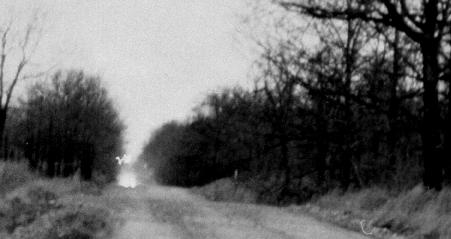
The legend of the Joplin, Missouri Spooklight began in 1884 when, according to a pamphlet written by the original owner of the Spooklight Museum, Spooky (Arthur P.) Meadows, a young Quapaw Indian girl saw it weaving through the trees in northeastern Oklahoma.

Or, maybe it began when a miner, heading home just after dark, got lost in the woods. Some say that his wife, fearing the worst, grabbed an old lantern and set out to look for him, wandering until dawn. When her husband failed to return a second night, she set out again, and from that point on, each night, until she died. Now her ghost, carrying that lantern, searches for her husband.

Some say her lantern is the light that the Quapaw girl saw. Others suggest that the light was already there when the first of the white man arrived in the area around the beginning of the nineteenth century. Some thought it might have actually appeared about the time of Christ, but there were no humans around the area two thousand years ago. At least none who left a record for us to find.

Whatever the source of the light, or origin of the legend, the light is still there. I know because I have seen it. It appeared on each of the nights I was there, showing up about dusk and flashing around the sky until we left four or five hours later. Given what I know, I suspect it stayed until dawn and then gradually faded into the brightness of the day.
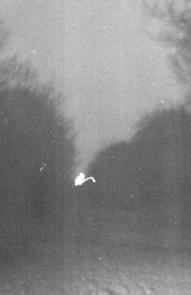
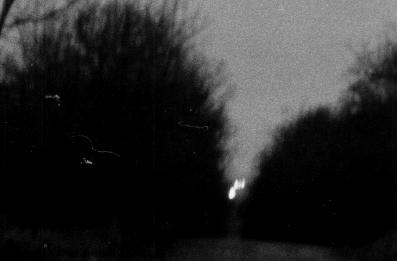
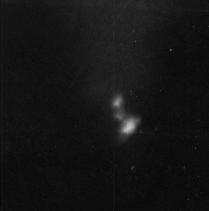
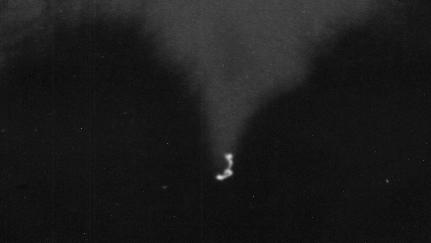
I spent a week in Joplin with Monty Skelton who, at one time, was the president of the North American UFO Organization. That first night, in the mid-1970s, as we pulled up near the somewhat dilapidated Spooklight Museum, about dusk, the light twinkled into existence hovering down the road. As Skelton stopped the car, I pulled my camera from the back, set up the tripod, and began to shoot. I hadn’t expected to see anything and hadn’t been fully prepared. I had only part of a roll of film.

Garland Middleton, who owned the museum in the 1970s, told me later that night, "I’ve seen a lot of people try to take pictures, but none of them got anything."

I finished the roll of film and the Spooklight was still there. Using binoculars, I watched it bob and weave, seeming to be about a hundred feet above the ground. It broke into three parts, and then five, and finally vanished for several seconds. Moments later it burst out again, outshining everything around it.

When it was totally dark, the outside lights of the museum had been turned on and I could see Middleton’s car, the door labeled "Spooklight," sitting close to it. While others stood on the road watching the light, and other cars arrived and left, I walked over to the museum.

Middleton was sitting on a couch by an old wood burning stove. He had worked with the original owner, Meadows, had run the museum for him, opening it in morning and sometimes closing it at night.
Meadows had been estranged from his own family telling Ron Bogue of the Joplin Globe, "I’ve got three sons. One of them I haven’t seen in twenty years. I don’t know where he is. My other two boys live in Kansas but they never come to see me... I don’t know them." Middleton, who shared a love of the Spooklight became, to some extent, Meadows’s heir, replacing the family who had no time for him.

When Meadows died, Middleton took over the museum, living out on what Meadows had called "Spooklight Corner." In the mid-seventies, there were two pool tables and three pinball machines in the museum. On one wall there were dozens of clippings about the light, several photographs of it and a short story about the museum. I read the clippings which told me little about the light and a lot about the legends including one that said river boat passengers had sometimes reported the light. Today I’m not sure what river boats the writer meant, or even what river the boats would have been traveling.

I studied the photographs which suggested that Middleton might have been exaggerating when he said that no one had much luck taking pictures. He was even selling post cards that had picture of the light on the front. It was apparently one of many taken by Meadows who had been a photographer in his younger years.

In the mid-1970s, Middleton was an old man, fairly tall and very thin. He was friendly and eager to talk about the light. He told me, "I first seen the light forty-years ago. It looks the same today as it did then. Now it usually stays away but it used to come right down the road, almost to the corner."

Middleton, like so many of the others I talked to, told of friends who had been within twenty feet of the light. He said that he had once gotten to within fifteen feet, but that was years ago. "Nowadays it seems to stay away more. It doesn’t come very close but it’s always out there."

There were a couple of teenagers in the museum. I asked these young men, who were playing pool, if they had seen the light. The taller of the two, who had slightly reddish hair and couldn’t have been more than eighteen said that he hadn’t really seen it and didn’t care to. He was just there to play pool. The other, shorter, stockier kid said that he had seen it but he wasn’t all that interested in it now. Pinball and pool had drawn him, and his friend, out to the museum. They could play uninterrupted because rarely anyone else came in to play pool.

Back outside, I traveled up the road where the Spooklight floated but when I reached the top of the last hill, the light vanished. Below me, stretched for miles, was part of Oklahoma. In the distance I could see lights flickering along a stretch of highway and some of them looked remarkably like the Spooklight but everyone said they weren’t.

"Besides," said James Smith of Joplin, "the light was here long before the town or cars or electricity."

Well, maybe.

We turned around and started back to the museum. In the rearview mirror we could catch glimpses of the light still hovering over the hilltops, seeming to pulsate and change color.

Although we tried to drive up on it several times, we always failed. One man volunteered that he sometimes came in from another direction, using some of the back roads and that way he could "fool it." Once, as he turned onto "Spooklight Road" it had passed over his car. At least that is what he said.

He wasn’t alone in making such a claim. Others said that they had friends, family, cousins, or had just heard that the light sometimes came down the road. One man said that his brother reported that the Spooklight had touched the hood of his car, sitting on it for several seconds before disappearing. When I traced the brother, he said, no, that had been a friend. But then the friend related that he had heard it from someone else. The story had evolved into the old "friend of a friend" routine. I could never get to the original source.

I returned on a couple of other nights. Once I was there with Marta Poyner, a reporter for the Joplin Globe. She said that she had been out several times but had never seen the Spooklight. Just as we pulled up, it flared once and seemed to split into pieces. I pointed it out and she said, "Oh, I’ve seen that before. I always thought it was car headlights."

One of those who had driven out that night overheard her comment and said, "It’s been here since 1811, long before there were any cars."

Well, maybe.

We both took pictures, and just like the batch I had taken the first night, these too, came out, contrary to the legend. Once we had finished, we tried walking down the road to the light, but after a mile or so, we gave up. The light wasn’t any closer, and I had already tried to approach it in a car.

Back at the museum, I ran into John Wysong, a long time Joplin resident. He was with his wife and son, and though he had first seen the light in 1955, he returned two or three times a year to look at it.

James Wysong, the son, had also seen the light before, but his wife, from Arizona had not. She hadn’t even heard of the light until after she was married into the Wysong clan.

I asked her what she thought of it. She said, "I didn’t know what they were talking about. I really didn’t believe that I would see it but there it is. I don’t know what to make of it but I know there must be some kind of explanation for it."

The younger Wysong said that he had tried to find out exactly what it was. One night he had tried to stalk it, but after only a few minutes had given up. He didn’t say it, but seemed to imply he didn’t really want to get too close to it. He didn’t know what he might discover and that had concerned him.

The older Mrs. Wysong leaned across the front seat of the van and said, "After studying it all these years, you would think that someone would be able to figure it out what it is. It’s a real mystery to me."

Well, she was right. You would think that after all the studies someone would have a logical explanation for the Spooklight.

During the Second World War, the Army Corps of Engineers spent some time studying the Spooklight. Colonel Dennis E. McCunniff was interviewed in his headquarters at Camp Crowder and said, "I know that no one is going to like this, or even believe this, but we found a few interesting things about the Spooklight. We discovered that it is seen more frequently in the winter but I believe that is due to the lack of foliage. Leaves off the trees and that kind of thing. After looking at it, we’ve determined that it’s a refraction of light. An optical illusion."

Well, maybe.

In 1960, William K. Underwood, a high school student from Carthage, Missouri, spent 400 hours studying the light for his high school science project. He claimed that the lights were from a section of highway going east out of Quapaw, Oklahoma, and directly west of the road where the Spooklight is seen. Underwood, with the help of his friends and family, designed a number of experiments to prove his theory. Using a spectroscopic photograph, Underwood discovered that the light was from an incandescent source. In other words, the light came from car headlights. This seems to corroborate the theory given by Colonel McCunniff.

He also had friends drive down the stretch of highway, some with colored filters on their headlights. He watched as they flashed signals at him that were reflected in the Spooklight, verifying, to some degree his theory.

Others, equipped with mirrors, binoculars and cameras made similar experiments. Given that the signals were flashed in random patterns so that those at the museum didn’t know exactly when they were coming or what the signals would be, it provided some dynamic evidence.

A Joplin resident, who didn’t want to be named, said that he believed the Spooklight to be some kind of magnetic aberration that caused an ionization of the atmosphere near it. That caused the gases to glow and could account for the reports that the light had been attracted to cars. The gases would have one electrical charge and the car would have the opposite. The problem was that the glow lasted for hours and that suggested it wasn’t an ionization. Besides, there was no real mechanism in the explanation to cause the glow. The air might be ionized, but that, in and of itself, does not cause it to glow.
Spooky Meadows, in 1969, told Bogue of the Globe that he had formed his own opinion of what, according to Bogue, "has baffled everyone from Army Engineers down to amateur scientists." Meadows said, "It’s a light, of course. But the mystery is - what causes it?"

Most of those who live in Joplin will tell those who ask that there is no good explanation for the Spooklight. They will tell you that the Army studied it, as have scientists and investigators, but no one has explained it. They will tell you that it is probably some kind of a natural phenomenon, but they will refuse to identify exactly what that phenomenon is, preferring to sound somewhat skeptical while denying any and all explanations.

They will also mention, whenever an explanation is offered, that the light was there long before cars and electricity arrived on the scene. I could find no documentation to support that. The first of the newspaper articles and other documents are from the beginning of the twentieth century.

Those who live in Joplin are going to believe what they want to believe and they won’t listen to an outsider with an explanation. That attitude was typified on a call-in radio program originating in Joplin. One woman heard that we were there and wondered why we didn’t just stay home. The light wasn’t ours to study, but it was theirs. It belonged to Joplin. "If they want to study something, why don’t they do it at home and leave us alone," she said.

Friday, September 15, 2006

Faked? Who Knows?


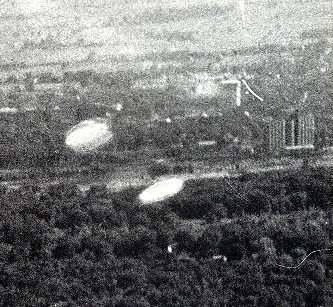
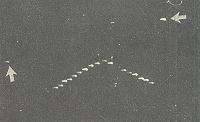
A number of years ago, more than I like to think about, I used to visit newspaper morgues and ask about UFO stories. Sometimes I got lucky and found information on cases that hadn’t been reported outside the local area. In Cedar Rapids I was given a photograph of two objects (seen at the left) as they flew over town. I deduced the date as late August or early September based on evidence in the picture and was told that it had been taken by Fay Clark, one time the mayor of little Hiawatha, Iowa.

Later I learned that the picture had been taken on September 3, 1955, and was pleased that I had figured the time of year properly. I learned that Sam Stochl had been commissioned by the mayor, Clark, to take aerial photographs of Hiawatha but hadn’t seen the objects in the picture. Clark said that "knowing the airplane was flying at 1,200 feet... we can triangulate the objects as approximately 33 feet in diameter... at an altitude of 800 feet."

All well and good, but the picture always struck me as looking as if the objects had been drawn on the photographic paper and then the picture printed. You might remember how you could put designs on Easter eggs using wax to protect the shell from the dye. I always thought the objects had that sort of a quality too them. I especially thought this after learning that no one had seen the objects in broad daylight.

Now I learn a little more about Fay Clark. He is credited with founding Hiawatha. He was a rock hound, a flying saucer enthusiast and had an interest in photography. He wrote about book in 1958, Beyond the Light, about astral projection and parapsychology.

Given this information, especially about his interests in UFOs and photography, given the look of the photograph, and given that the actual photographer, Sam Stochl didn’t see the objects, I think we can conclude that Clark created the photograph. It was undoubtedly meant as a local oddity and nothing more, though it has appeared in one book published for a national audience some years later.

This is just another in a long list of UFO photographs that doesn’t deserve much more than a casual glance. And even if we called the photograph authentic (meaning of real UFOs) there isn’t much more we can do. There are no eyewitnesses and the evidence offered is of little value without additional information. It is an oddity, it is interesting, and it does nothing to increase our knowledge.

Disappearing Aircraft - Part 3 The Bermuda Triangle


The Bermuda Triangle is a place out in the Atlantic that supposedly swallows ships and aircraft with frightening regularity. These aircraft, according to legend, are often in radio contact with some kind of flight following agency, or in sight of land or airfields, and are said to disappear without a trace. The mystery deepens because there is never any wreckage suggesting to many that something supernatural or other worldly had occurred.

Such is the case of a C-119 Flying Boxcar that vanished in June 1965 while on enroute to Grand Turk Island from Homestead Air Force Base in Florida. The crew made a badly garbled radio transmission only minutes out and were never heard from again. It was suggested, by those who write about such things, that some kind of desperate last message had been sent, possibly about UFOs.

The International UFO Bureau, in 1973, took the idea of UFOs even further when they suggested that the UFO allegedly seen by James McDivitt and Ed White on a Gemini space mission was somehow tied into the disappearance of the C-119. McDivitt reported a strange object while over the Carribean and the International UFO Bureau thought that the UFO seen by the astronauts might have "captured" the cargo plane.

The real story, although as tragic, is not as dramatic. According to members of the Air Force Reserve and the 440th Tactical Airlift Wing at Milwaukee’s Billy Mitchell Field, the unit to which the aircraft and crew were assigned, the disappearance wasn’t nearly as total, nor as strange.

"We know," one officer told me, "that everything was fine about thirty minutes before landing. Major Louis Giuntoli [the pilot] had made a position report about 11 p.m."

A search was launched when the aircraft failed to arrive. Nearly 100,000 square miles of ocean were covered by boats and planes. By June 8, the Miami newspapers were calling attention to the Bermuda Triangle, recounting that dozens of planes had disappeared without a trace in the area.

The search was abandoned on June 10 when searchers failed to find any sign of the missing plane. But just two days later debris, stenciled with serial numbers and the tail number of the aircraft, was found. Although none of the wreckage was from the structure of the aircraft, the debris was from inside it.

About a month later, in early July, a wheel chock stenciled with the tail number turned up near Ackins Island. This was in the general area where the rest of the debris had been found.

The intelligence officer of the 928th Tactical Airlift Group, a subordinate unit to the 440th, said that he had talked to a number of officers in the wing and their belief was that the C-119 lost an engine just after the pilot had made his position report. He said, "If there was a corresponding electrical failure, which wouldn’t have been all that uncommon in those circumstances, they would have had no lights and no radio. Since this was at night when a light haze forms that makes it nearly impossible to see the horizon, the deck was stacked against them."

It means, simply, that the sky would have combined with the water surface giving the pilots the look of flying at a wall. With the instruments out because of the electrical failure, the pilots would have had nothing to use to keep the aircraft flying straight and level. The eventual outcome would be they would have flown into the ocean. It is not unlike what happened to JFK Jr. when he, his wife, and their female companion were killed in an aircraft accident.

Given the full story, the interviews with members of the missing aircraft’s unit members, the discovery of debris, and the circumstances, it is not difficult to understand how the aircraft might have crashed. Unlike the chroniclers of the Bermuda Triangle legend claim, wreckage was found, though not very much. The reasons for the crash are understood. It seems that this is one mystery that has been solved.

Friday, September 01, 2006

Disappearing Aircraft Part 2 - Kinross


When I had the chance, back in 1976, to look at the then recently declassified Project Blue Book files, one of the first cases I asked to see was that on the disappearance of an F-89 over Lake Superior on November 23, 1953. This was the story of a jet, scrambled into a stormy night to identify a UFO detected by radar. Those watching the intercept on radar saw the blip of the fighter merge with that of the UFO and then the single blip disappear from the scope. The fighter was never seen again and the two officers on board, Felix Moncla, Jr., and Robert R. Wilson were gone.

No one was sure what happened. By coincidence, earlier in the day, an F-89 from the same squadron had crashed near Madison Wisconsin, killing both pilots. They had been testing the afterburners and the test seemed to go fine. Not long after that witnesses reported they heard an explosion and the jet crashed into a swamp. It was a bad day for a unit that wasn’t involved in combat operations. No one is quite sure what happened there either, though both Donald Keyhoe and Frank Edwards speculated that flying saucers might have been involved (which makes for a great tale but doesn’t appear to be true).

But the case that I wanted to see when I had the first chance was that of Moncla and Wilson. When I was given the file, I was surprised. It contained two sheets of paper. One was a note explaining that the case was not a UFO sighting but an aircraft accident and the other was the page proof from a debunking book on UFOs. Neither was much help but they certainly provided a glimpse into the Air Force mind set in 1953.

What we know is this. On the evening of November 23, about six hours after the crash near Madison, radar at Truax Air Force Base picked up an unidentified blip over the Soo Locks in restricted airspace. Since it was unidentified, an interceptor was scrambled. Ground radar vectored the jet toward the UFO. Wilson said that he was unable to find the object on his radar, so the ground radars continued to vector the jet toward the object that had seemed to be hovering but was beginning to accelerate as it headed out over the lake.

For nine minutes the chase continued with Moncla able to gain slightly on the UFO and Wilson finally able to get a fix on it. The gap between the jet and the UFO narrowed, closed and then merged as Moncla caught the UFO.

At first no one was concerned because the ground radar had no high-finding capability and it was possible the jet had flown over or under the object but the blips didn’t separate. They hung together and then the lone blip flashed off the screen. The jet, apparently, was gone.

Attempts to reach Moncla failed. Radar operators called for Search and Rescue, providing the last known position of the jet. Through the night they continued to search, later joined by the Canadians. They found nothing. They found no clue about the fate of the jet or the crew. No wreckage and no sign that the crew had bailed out.

An early edition of the Chicago Tribune carried a story about the accident with the radar operator’s opinion that the jet had hit something. While the search continued, the Air Force moved to suppress the idea that the jet had hit anything.
Although a well-coordinated search was conducted, and everyone thought they knew where the jet had been because of the radar tracking, they never found anything. There was no wreckage, no oil slick, no bodies, nothing. The last trace of the jet had been when the two radar blips merged.

In the years that followed the Air Force offered a variety of answers for the accident. They claimed the radar operators had misread the scope and that Moncla had actually been chasing a Canadian DC-3. After Moncla had caught and identified it, he turned, only to have something happen then. Something so swift that he had time to neither report the identity of the unidentified blip or suggest the nature of the his sudden problem.

The Canadians quickly denied the jet had hit one of their aircraft, but the Air Force, for about a year, stuck to the DC-3 story until, finally, changing it to an RCAF jet. The Canadians, quite naturally, denied this, too. The Air Force later suggested that Moncla’s jet exploded at high altitude (which given what had happened earlier in the day wasn’t all that far out of line). That sort of an accident should have left wreckage scattered over the surface of the lake, but nothing was found.

The Air Force officers who were stationed at Truax in 1953 had their own theories. I talked to a lieutenant colonel (yes, I know exactly who the lieutenant colonel is, but given the way things operate in today’s environment, I’m not inclined to publish his name... I will reveal it to researchers who have a genuine interest in the case) who verified that the jet disappeared and that the search failed to find anything. He told me there were two schools of thought about what happened. "One group thought the plane had gone straight into the lake. If it didn’t break up, there would have been no oil slick or wreckage. That’s entirely possible. The other school thought that Moncla had been ‘taken’ by the UFO."

Not long after Moncla and Wilson disappeared, according to the lieutenant colonel, two jets found themselves paced by a large, bright UFO. They went through a series of turns and banks to make sure the UFO was not some bizarre reflection on the canopy or other optical illusion. Then, knowing what had happened to Moncla and Wilson, the flight leader called the break and both aircraft turned into the UFO. It hesitated for an instant and then flashed from sight. The lieutenant colonel, who had been there, told me that the pilots had, as regulations demanded, made a report to Project Blue Book. When I searched the Blue Book files, I could find no indication of this report. The lieutenant colonel said that he was surprised that no report could be found.

Some fifteen years after the disappearance, according to the Sault Daily Star two prospectors found aircraft parts, including a tail section, on the eastern shore of Lake Superior. The paper quoted Air Force sources saying the parts belonged to "a high performance military jet aircraft." Speculation was that the wreckage as from the missing F-89.

So that’s where the mystery stood for more than fifty years. What became known as the Kinross Incident puzzled researchers and while it didn’t prove UFOs were hostile, it certainly suggested they were dangerous. Neither the jet nor the missing airmen had been found.

Now, an outfit known as Great Lake Dive Company claims they have found the wreckage of the aircraft sitting on the bottom of Lake Superior in about 500 feet of water. On their website, www.greatlakesdive.com is a photograph of an aircraft that could be the missing jet. It is in surprisingly good shape considering having crashed into the lake.

If this is the missing jet, then one question has been answered. We will know what happened to the aircraft. If Great Lake Dive succeeds in getting down to the aircraft and can verify that it is the missing jet, then they might be able to suggest something about the fate of the two men on board.

There are some, inside the UFO community, who caution that we should wait for more information. Finding the wreckage of an aircraft that could be an F-89 doesn’t automatically mean that it was the one flown by Moncla and Wilson, though the wreckage on the bottom seems to be missing the same pieces that were found in 1968. Even that doesn’t prove it was the jet flown by Moncla and Wilson. What we have here is the possible solution to a mystery. All we need is a little patience, along with a little more information.

Monday, August 28, 2006

Disappearing Aircraft - Part 1 Stardust


There is, in UFO history, a number of reports of aircraft disappearing into the mists of time. In 1947 the Stardust, a passenger plane on its way to Santiago, Chile disappeared allegedly in sight of the airfield. The search, conducted over the next week found no sign of the wreckage.

In November 1953, an Air Force interceptor, sent to identify an object over Lake Superior disappeared from radar after its image was seen to merge with that of an intruder. The search, conducted over the next week found no sign of the wreckage.

In the mid-1950s, according to a retired Air Force brigadier general, four aircraft on a mission over Kentucky disappeared. According to the general, no sign of wreckage was ever found.

The first of these strange disappearances occurred on August 2, 1947, the Stardust, with eleven people on board took from Buenos Aires for Santiago. It was a routine flight for the British South American Airways plane. The weather was deteriorating and later would approach blizzard conditions, but it wasn’t so bad that the captain, Reginald Cook thought he needed to cancel the flight.

At 5:33 p.m. the radio operator Dennis Harmer sent a message to the Santiago Tower that they were slightly behind schedule but they believed they would arrive at the airfield in about twelve minutes. Then, at 5:41, Harmer made the last transmission. It said, "ETA Santiago, 17:45 hours. Stendec."

In the Santiago Tower, the operator didn’t understand the last word and asked that it be repeated. It was. Twice. Stendec. No one knew what that meant. It was also the last word ever heard from the aircraft. It had simply vanished from the face of the Earth.

Because of a snow storm, the search for the aircraft couldn’t begin until August 3. At first, given the position provided by the aircraft, the search centered near Santiago. When nothing was found there, the search was expanded but no trace of the aircraft was found. At least none was found in 1953.

Nearly forty-seven years later, in January, 2000, five mountaineers, climbing the rugged Mount Tupungato in Argentina, discovered the wreckage of an old aircraft. They also found the remains of three people. The Argentine Army sent an expedition into the area, which is so rugged that the soldiers had to hike the last few miles because even the burros were unable to make it. Using serial numbers from the engines and other bits of wreckage, they identified the aircraft as the long missing Stardust.

The aircraft, not fifty miles from Santiago as the pilots had believed and still over the Andes, was caught in the snow. The pilot, thinking he was approaching Santiago, but with no visual evidence outside the cockpit, began to descend. Unfortunately, their navigation was off and rather than being over the relatively flat ground near the Santiago airport, were still in the mountains. Tragically, they flew into the side of a mountain glacier. The show covered the wreckage during the night, concealing it from the aerial search along the flight route. Then, slowly the glacier swallowed all remnants of the aircraft. For fifty years that wreckage "flowed" downhill with the glacier. It finally flowed to the surface a couple of miles down the mountain. It was here, on a plateau, the wreckage was exposed and discovered.

The army expedition uncovered more wreckage, retrieved the remains of most of the victims some of whom were identified using DNA techniques, and confirmed the identity of the aircraft. The mystery of the Stardust had been solved... Well, most of it. No one has ever figured out what the strange word sent by Harmer meant. It is the only mystery about the crash that remains.

Friday, August 25, 2006

Russ Estes is Gone

Since I returned from Iraq in 2004, too many of my friends in the UFO field have died. The latest was Karl Pflock whose obituary can be accessed in the June 2006 Archives.

Philip Klass, who clashed with so many of us in the field died after a long fight with various diseases. Too many delighted that he was gone. While Philip and I disagreed on many aspects of the UFO field, I believe that we had a mutual respect for each other’s position. Yes, I’ve heard the stories of his nasty attacks on people, well aware that he was capable of doing anything he could to make life miserable for those on the other side of the fence. Some of his attacks were unfair, but certainly no worse than what those of us on our side have done to our own.

But the death that hit closest to home was Russ Estes. I had first met him in Albuquerque when he was working on a documentary about UFOs. He was at the MUFON Convention there, interviewing the speakers, the investigators, and anyone else who might have an interesting story to tell. I was one of those who sat down for his camera. I really remember little of what I said, other than providing information about my investigations into Roswell.

Months later, Don Ecker of UFO magazine, was arranging for UFO researchers to meet at Disney World to help promote the opening of a new "experience" with an alien theme. On my way to Florida I met Russ on the aircraft. I remembered him because he was a huge man.

While in Florida we spent quite a bit of time together talking about UFOs. Russ was as interested as I. We formed a friendship there that would last until his death.

After Florida I stayed in touch with Russ. He planned more documentaries and thought I could help him. I liked the idea of putting some of these ideas onto film, or more accurately, video tape.

Over the next decade we would meet many times. I traveled to California to visit him. I watched as he worked his magic with video tape and learned that the was an accomplished artist, had performed on a regular basis at the old Playboy Clubs, served in Vietnam with the Army Security Agency, and had lectured on a variety of topics.

Russ and I wrote a couple of books together. In two of them, he was more the illustrator than the writer, though he did contribute to the writing while I did little to contribute to the illustration. Together with Dr. William Cone, we wrote The Abduction Enigma about alien abductions. I was always a little disappointed that the book didn’t get a wider circulation because I thought it made some important points about abductions. Russ and Bill Cone had worked out much of the insight, though I believe I added to those insights.

In his last years, Russ had trouble with diabetes. At first it was an annoyance, meaning he had to eat on a fairly rigid schedule, but later it caused other troubles, as diabetes does. He might have suffered a fatal heart attack because of the diabetes, but given his location and circumstances, he was revived for a few more years. Think about that for a moment. He died of a heart attack, and was revived to live another few years. Not many can say that.

We’d had a tradition that I would call him just after midnight on New Year’s Day, asking how things were back in the past. I failed to make the call as 2004 slipped into 2005 because I hadn’t been back from Iraq all that long and I fell asleep. He tried to call me, but for some reason, I didn’t hear the telephone. I called him the next day. It was the last time we’d speak.

Russ had a fine mind and saw through much of the nonsense in the UFO field quickly. He’d ask the hard questions and that would, of course, annoy others. Exposing the flaws in a theory should make those proposing the theory reevaluate it but in the world of UFOs, it gets you labeled as a debunker and a government agent.

Russ was both these things... in some respects. Yes, he had once had ties to the intelligence community, but like me, those ties were of a non UFO nature and never really influenced what he thought and did. He had been a government agent just as anyone who served in the military, or worked for the IRS or the FBI or FEMA had been a government agent.

And he was a debunker in the best sense of the word. He took the bunk out of some aspects of the UFO field. You just have to watch the video of Harley Byrd going on and on about how he is the only real UFO researcher and he knows everything about UFOs. Russ didn’t really ask questions. He just let Byrd talk.

He produced an audio tape of music related to the UFO field with some wonderful songs on it. He sang, along with Bill Cone and Val Bankston, who also wrote much of the music. For a supposedly amateur tape, it was surprisingly professional. Such was Russ’s talent.

And now my friend is gone way too soon. I miss our sometimes esoteric chats, our delight at seeing the truth emerge when no one else wanted to hear it (I think of Gerald Anderson here as but a single example) and our realization that Don Schmitt had feet of clay.

What he wanted in the UFO field was to get at the truth. He talked to everyone and presented those findings to those who would listen. He didn’t have a big name, just a big heart.

Russ could be over powering, but only because he had so many talents in so many places. He was opinionated, but backed up his opinions with facts. Sometimes he was intractable, but more often he would listen to others, searching for weakness in their arguments. He did much for the field but few realize his contribution.

Russ was unique. He was intelligent, talented, insightful and sometimes a control freak, but he was always a friend. He is impossible to replace and I certainly miss him.

Thursday, August 24, 2006

Carl Hart and the Lubbock Lights


It seems that every time I sit down to add to this blog, I’m exposing another myth or solving another mystery. It begins to look as if I’m really a debunker in disguise. The truth is that I believe that we must publish, as quickly as we can, the solutions to mysteries that have baffled us for years. I’m fascinated by answers to long held mysteries which is why I often jump at the chance to expose them. Coming up in later blogs will be the solution to the disappearance of the Stardust and a possible solution to the disappearance of an Air Force interceptor in 1953.

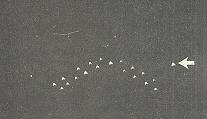
There are mysteries out there that remain intriguing. In August 1951 four college professors saw strange lights fly overhead in Lubbock, Texas, and the Lubbock Lights mystery was born. Many of those sightings have since been solved, and the solutions offered make sense. There is, however, one part of the case that remains as mysterious today as it did more than fifty years ago and that is the photographs taken by Carl Hart, Jr.

On February 1, 1993, I had the opportunity to interview Carl Hart about the photographs. What follows is that interview. (For those interested in more about the Lubbock Lights, I suggest a look at my 1997 book, Conspiracy of Silence.) I offer the notes of the interview without commentary (well, not much).

After learning that the man I was talking with had taken the famous pictures, I asked, "Were you looking for the lights when you saw them?"

He said, "Oh, no. Of course this was summer time and very hot. We didn’t have anything like central air conditioning. I slept with the windows open and I liked to sleep with my head stuck out the window and there they were."

"You saw them fly over one time?"

"Oh, I think if I remember there were like three formations... of course they had been in the news here for a week or two before I happened to see them and they usually showed up in several flights when they would so... when I saw them I went on outside with my camera..."

"Did you get a feel for the size of the objects or how high above you they were?"

"Not really... the only thing I saw was lights. Wasn’t any other objects associated with them. Wasn’t any noise..."

"Now you were questioned quite closely by the Air Force..."

"The Air Force and everybody else."

"Did the Air Force give you a final conclusion of what they thought you had photographed?"
"No, no they didn’t. I never did hear an official version. I heard some unofficial things that came out later... about how they thought I had faked them somehow or another." (Attempts to duplicate the pictures by a professional photographer failed... and because of that, this part of the mystery remains unsolved.)

"Of course you hadn’t faked them..."

"No."

"You have no idea what they were?"

"I really don’t. I’m not even sure who it was. There was someone tried to duplicate the light in a laboratory by reflecting light off a pan of water where they could cause a ripple run down the water and they could cause them to move and his theory was that it was a cold air inversion and that it had waves in it like the ocean and the sensation of them moving across the sky so I don’t know if that’s what happened or not." (This was Dr. Donald Menzel whose results were published in 1952. Later Menzel decided, without evidence, that Hart had faked the pictures. Menzel, it seems, could not admit that some aspects of the UFO phenomenon were inexplicable.)

"You really have no clue about what you saw..."

"I really don’t. Nothing’s ever come forward to explain those and there wasn’t anything for me to judge them by other than just the lights on the bottom of just one object or group of individual lights... They were lights either on something or individually."

Did you know the professors who had seen the things the first night?"

"Later on I did. I didn’t know them at the time."

"Were they aware you had taken the pictures?"

"Oh, yeah. I think there were some of the ones felt like I had stolen their glory... They weren’t too receptive of what I had done as best I could recall."

"Have you made any money off this thing?"

"I might have made three or four hundred dollars total over the years."

"The pictures appear in books and magazines all the time."

"I wasn’t aware enough of what was going on to copyright them. If anyone paid my anything it was to save themselves from possible legal problems later on... for several years people would ask before they would use them... My advice from a friend and professional journalist at the time was that if you copyright them somebody’s going to think you faked tem and are trying to make money out of them"

Hart did tell me that he doesn’t particularly disbelieve in flying saucers. He said, "I’m kind of open minded on that. If one would show up some place else here, I think I’d accept."

I asked him one last time if he knew what he had photographed.

"I really don’t."

(I have found that those faking UFO pictures eventually come clean, admitting the hoax, sometimes decades later. With Hart, although no one would really care at this late date if he had faked them, he maintained he didn’t know what he had photographed. Because of that, the photographic part of the Lubbock Lights remains unsolved.)

How Many Planets? Part 3

The International Astronomical Union had met and voted, and the correct answer to that question is now... Eight.

After what some have described as a hotly debated issue, a definition of a planet was produced that included three criteria. It had to be large enough to have a gravitational field strong enough to make it a round object, it had to orbit the sun, and finally it had to have "swept" that orbit of debris (or as the IAU put it, "cleared the neighborhood around its orbit"). Pluto failed because it crossed the orbit of Neptune.

Pluto is demoted to "dwarf" planet, which means the other objects, out in the Kuiper Belt and beyond would also be dwarf planets. Ceres, which held planetary status in the 19th Century, was demoted and then considered for promotion, would be a dwarf planet. Charon would remain a moon of Pluto.

Personally, I find this a little disappointing. I had hoped we were going to expand the Solar System (though I guess we have) and increase the number of planets. In writing science fiction when I have found it necessary to create solar systems in the far reaches of space, they always had more than nine planets (or as is now the case, eight).

The only positive in this is that here, in 2006, we actually debated the issue. I suspect, as our knowledge of the Solar System increases, we may find ourselves in this debate once again. In the Discover magazine article, they suggested that one of the objects out beyond Pluto was the size of Mars. That, it seems to me, would qualify it as a planet (if the size is confirmed), though it might not have the "clean" orbit now claimed as the third part of the definition.

So, now we have answer to the question. How many planets in the Solar System? Eight.

Saturday, August 19, 2006

How Many Planets - Part Two


About a year ago I wrote a column asking how many planets there were in the Solar System. The only real conclusion I drew was that the true number wasn’t nine. If Pluto was demoted, the answer was eight, and if not, the answer was twelve. Either way, changes were coming to our definitions.

Now the International Astronomical Union has suggested the correct answer is... twelve. I was right. But I picked the wrong objects.

According to the IAU, 1 Ceres, once thought to be a planet, demoted to asteroid, would once again reach planetary status. Charon (which for some reason I called Clarion) would be named a planet, orbiting a central point with Pluto and both orbiting the Sun (See photo of Pluto, Charon and their two moons, photo courtesy of NASA). Kind of a strange relation between the two.

And 2003 UB313 (aka Xena) would also be called a planet. These three objects along with 1 Ceres would be known as Plutons, a sort of small planet. All would be out with Pluto or beyond with the obvious exception of 1 Ceres.

But if this is voted on by the membership of the IAU, then it opens the door for a number of other objects far out into space, one of them about half the way to Alpha Centuri.

Discover magazine, in November 2004, carried a story about these new objects, suggesting that Sedna (aka 2003 VB12) should be considered as a planet. According to the figures published them, it is larger than 1 Ceres, and could be twice as large.

According to the magazine, in addition of Sedna, there were an additional seven objects that ranged in size from about five hundred miles in diameter up to about a thousand miles (2004 DW).

The IAU’s seven member Planet Definition Committee recommended that 1 Ceres, Charon and Xena all be awarded planetary status. They created two criteria for this. The object had to be large enough so that its gravity would pull it into a nearly spherical shape and it must orbit the Sun. That second criterion eliminates the largest of the moons in the Solar System. Many of those objects out beyond Pluto, in the Kuiper Belt, just barely make it, but the latest information makes them large enough.

So, at the moment, there are nine planets in the Solar System, but after the membership of the IAU votes, the answer will probably change with three additions, which makes twelve. In the years to come, if the information we have holds up, the answer will rise to, at a minimum of nineteen with some astronomers believing that thirty is a more likely answer.

As I said before, this is an exciting time to study astronomy. Maybe 19 planets in our Solar System, more than 200 planets discovered around other stars, and much more to be found.

Spitzbergen UFO Crash


For the last ten years or so, there has been a list of UFO whistle blowers circulating. There are many names on the list but few of them have anything spectacular to tell. Most of the stories are of seeing UFOs and reporting them up the chain of command. Some of these witnesses tell of seeing classified documents relating to UFOs and UFO crashes.

One such witness is former Air Force Lieutenant Colonel Dwayne Arneson. Now, don’t get me wrong here. I believe that Lt. Col. Arneson served in the Air Force just as he claimed. I believe that a check of his record will corroborate what he says about his military career. In fact, I was in email communication with Lt. Col. Arneson at one time but haven’t heard from him in months (I suspect it was because I suggested that the Spitzbergen crash was a hoax, but I get ahead of myself here).

According to Dr. Stephen Greer’s Disclosure documents, Lt. Col. Arneson said, "I was a top secret control officer. I happened to see a classified message go through my com [communications] center which said, ‘A UFO has crashed on the Island of Spitzbergen, Norway, and a team of scientists are coming to investigate it."

I believe this to be true as well. In fact, I shouldn’t say that I believe it. I know it’s true. Classified communications among various Air Force locations about a crash in Spitzbergen did take place. I too have seen the documents. I have copies of them. Lt. Col. Arneson is correct.

But, that isn’t the whole story. In a classified document available in the Project Blue Book files, we read, "Info derived from foreign broadcasts to effect that German newspaper CMA [meaning comma, used rather than punctuation] carried article stating that a flying saucer-like flying object crashed Spitzbergen 9 July and that NAF [Norwegian Air Force] recovered it [usually, when using CMA for comma, they use PD for period but here they didn’t]. Claim diameter of 47 meters CMA constructed of steel of unknown alloy and that operating instructions written in Russian. Info apparently has had big play in German press running continuously since shortly after 9 July. Request validity of this info..."

Most UFO researchers now consider the case a hoax, but the late Frank Edwards, in his book, Flying Saucers - Serious Business, carries the report, attributing it to Stuttgarter Tageblatt which quotes a Colonel who provides additional details. He suggests the case is authentic. Ryan Woods, in his book, Majic Eyes Only, recounts the case, mentions that some think it a hoax, but rates it as one requiring further study. In my own, History of UFO Crashes, I suggest it’s a hoax.

Here, however, this doesn’t matter. What we have is a claim by a Disclosure Project witness about classified documentation that he saw while working with the Air Force. His story is true. He did see what he claimed. The only question left is if the report was of a real event or a hoax. Take your pick.

Wednesday, August 16, 2006

MJ-12 Revisited

I have, for a long time, thought there is no real government conspiracy to hide UFO information from us. I thought that we are so inept, that we accept so much as true with little or no proof, and that there are so many frauds, charlatans, fakers and liars out there that the government doesn’t need any program to discredit UFO reports. We do it to ourselves all the time.

But then I got to thinking about this MJ-12 stuff. I believed that it was created by certain members of the UFO community to propel themselves into the spotlight. It was a hoax from inside the community that wasn’t necessarily designed to mislead, but had another agenda behind it. This might have been a creation designed to shake information loose with the added benefit of media attention.

But then I began to reevaluate these thoughts.

And I began to look at those who were the initial reporters of MJ-12.

And I remembered something that Stan Friedman had told me a long time ago.

And I began to wonder if it wasn’t possible that MJ-12 was more of a government project that I had suspected.

Let me backtrack a little bit and mention William J. Moore who might be considered the father of MJ-12, who has been around the UFO field for a long time, and who admitted to ties to the intelligence community long ago. Moore had also once been on the Board of Directors of the Coral and Jim Lorenzen’s Aerial Phenomena Research Organization. Moore confessed that he was spying on UFO researchers for the government at that time.

I thought he was just making that up for some reason. He did accuse me of the same thing and since I knew that I wasn’t spying on anyone for any reason, I suppose that led me to my conclusion. Of course, he might have accused me as a justification for his own spying.

Friedman also told me that Moore had told him that he, Moore, was thinking about creating a Roswell type document because it might shake things loose. But what if the idea for this wasn’t Moore’s? What if it came from somewhere else?

Moore was also associated with Richard Doty, a former member of AFOSI who had lost his status as a member of AFOSI and finished his Air Force career in food service. This means, simply, that he was in charge of a Dining Facility or what we used to call a Mess Hall in the Army (now they’re DFACs which stands for Dining FACility).

Moore also said that he was responsible for some of the disinformation that was leaked to Paul Bennewitz. Moore said that he played along with this, even to the point of rearranging Bennewitz’s furniture to frighten him. Moore said he did it in the misguided belief that it would take him into the inner ring of the anti-UFO government programs so that he might be able to learn more about them and then expose them.

I thought at the time it was a load of crap, but probably because I was still being accused of being a government agent (this time by Don Schmitt who was supposedly my friend) and I knew this wasn’t true. But what if the government wanted to discredit UFO research. What if the plan was to throw out so many different ideas, so many tangents, that anyone who stumbled onto the right one might be dragged onto another. Or, if that didn’t work, just discredit all of UFO research by discrediting one small aspect of it.

For about twenty years we have been arguing the reality of MJ-12. Great amounts of effort, research and money have been dumped into the chase of MJ-12 and that is effort, research and money that was not available for other, possibly more productive lines of inquiry. And in that time, we haven’t uncovered anything that advances our knowledge of UFOs in any helpful way. We have not found the smoking gun documents but have found dozens, if not hundreds that are faked. In fact, some of the evidence suggests there were all faked. It even tells us who did it and why, but still the debate continues.

So, where does that leave us today? Well, Bill Moore did claim to be a government agent, he did admit to the harassment of Bennewitz for the government and he did admit to spying on researchers for the Air Force. Moore was the first to tell us of MJ-12 and it was Moore who worked to prove that MJ-12 was real. Maybe there is a connection here between the government and Moore that has accomplished the mission. Twenty years later and we’re still arguing about MJ-12 and when we divert our attention to MJ-12 we can’t focus it in other directions, and maybe that is the whole point.

Sunday, June 11, 2006

Karl Pflock Dies at 63

Karl Pflock, a long time researcher into UFOs and other related phenomena died June 5 from complications of ALS. He was 63.

I met Karl about fifteen years ago when he was associated with the Fund for UFO Research and I was beginning an investigation into the Roswell UFO crash. Karl convinced the Fund that another investigation should be initiated. Not long after that, Karl and his wife, Mary moved to New Mexico, which made it easier for him to investigate events in New Mexico.

Karl came to a different conclusion about the Roswell crash than I. Eventually; he was convinced that a balloon array launched in conjunction with the then top-secret Project Mogul was the best explanation. He found some of the eyewitness statements to be weak and without sufficient corroboration. He thought that the explanation offered by Charles Moore, one of the members of Project Mogul, to be persuasive. I did not.

He entered into a exclusive relationship with Glenn Dennis, the Roswell mortician who told the marvelous story of a nurse he had know out at the base, who told him about alien creatures and who soon disappeared. Karl didn’t know that Dennis already had an exclusive relationship with Mark Wolf.

Karl interviewed Frank Kaufmann, who I believed was telling the truth. Karl did not. He thought Kaufmann was spinning tales and based that on his interviews with Kaufmann. Kaufmann explained it away, but in the end, Karl was right about Kaufmann and I was wrong.

After a couple of years, neither of us believed much of what Glenn Dennis said. We’d seen too many of his tales collapse under investigation. So we agreed on that.

In fact, it turned out that we agreed on far more of the UFO field than we disagreed. We talked about Barney Barnett and how we found his tale of seeing the crashed Roswell saucer to be less than credible. We eventually wrote an article about it together, wondering what the UFO community would make of the collaboration. Karl, it turned out, had to do most of the final work because I found myself called to active duty in Iraq.

In the beginning, I think, we agreed on little and clashed more often than not. We debated the Mogul explanation at the 1997 Roswell Fiftieth Anniversary. We managed to fill the house but I think neither of us persuaded many in the audience. Those who believed in the aliens continued to do so and those who believed in Mogul continued to do so. If there was a winner, it was based solely on the beliefs of those who attended and not the merits of the arguments offered.

I believe he was a good researcher and he aspired to be a good writer as many of us do. Once I got away from the shadow of Don Schmitt, my relation with Karl became much more cordial. (I found that to be true with a number of other researchers with the exception of Tom Carey).

Karl, I think, had a bit of the flair for the dramatic, which explains to some extent, the Kurt Peters episode. Karl had told writers investigating a wave of cattle mutilations that his name was Kurt Peters rather than Karl Pflock. I was never convinced by his explanation for it, but heck, we've all done dumb stuff at younger ages. I had meant to ask him about it on a number of occasions but just never got that done.

I'm reminded too of a trip that he and I took in a limousine in LA nine years ago. We were going to do the Sci Fi Channel's SF Vortex and argue about Roswell and UFOs. Also in the car was Russ Estes and I realized that all three of us had been part of the intelligence community at some point. I wondered then what the conspiracy theorists would make of that... but now, two of those people are gone and given our ages, I wouldn't have expected it quite that quickly.

Just another note here. Karl had worked for the CIA but I never really knew what he had done for them. I suspect it wasn’t real exciting, in a covert way, but something necessary. I believe based on what he had said in the past that he had served in the Marines as well. He’d even been a Deputy Assistant Secretary of Defense. Those inside the UFO community like to suggest he was a "spook," but then, they like to say that about nearly everyone. Of course, his connection to the CIA didn’t help.

Karl liked to twist the tail of those in the UFO community, and sometimes we need it. I believe he was honest in most of what he did and said just as most of us are honest... I keep thinking of things to put here... things that many of us hold as self evident truths but that might not be quite as solid as we'd like them to be.

There were those in the UFO community who don’t see it this way and had their own arguments with Karl. It is impossible to do research and publish those results without offending some. It is also impossible to deal with people daily without offending some. Maybe there is good reason for that offense, but for me, Karl was fair and honest, and I believe we became friends.

We had planned to write a book together, though in the last couple of years, I think that was more of a dream for Karl. We exchanged ideas and thoughts, and had decided on a case to review at length. Then Karl suggested that he would gather the data and maybe I should do the writing. This was, of course, a result of ALS. I knew this and while I don’t really like these projects where I end up doing the writing, here it wasn’t Karl’s fault. Besides, he would do the editing and that is always a big problem. Finally, Karl had to bow out because he was afraid that he would be unable to finish his share of the work.

Anyway, I always enjoyed the exchanges with Karl, learned things during them, and kept in touch with him during my service in Iraq. I'm sorry that he was taken from us at this point because I think he could have added something to our research. He was much too young to be gone already.

Thursday, May 04, 2006

New Thoughts On the Autopsy Fake


When Ray Santilli admitted recently that he had faked the footage of the alien autopsy film there were those who were didn’t believe this new revelation. They began to suggest reasons why they didn’t believe Santilli was telling the truth. And they asked a very interesting question of the rest of us. If we didn’t believe Santilli in the beginning, when he first released the film, why did we believe him now?

The answer is simple. Evidence.

When Santilli appeared on the scene in the mid-1990s, he came with what seemed to be hard evidence. He had the statement from the cameraman who took the film and he had the film itself. At the time he first appeared he made a number of statements such as claiming that President Truman could be seen on the debris field and that trucks and cranes were there, all things hard if not impossible to fake. There were supposed to be nearly two hours of film including the in the field, preliminary autopsy and then another conducted in a morgue. At one point Santilli produced some classification sheets that he said were on the film canisters but which were more consistent with something from Hollywood than they were with military orders. After they were criticized, he quickly withdrew them.

Here are a few of the original problems. Take the film. This is a piece of physical evidence. We can examine what is on the film and see if it conforms to the standards of other such films shot at the time. First, it didn’t conform. Autopsy footage, according to former military cameramen, was always shot in color. There were normally three cameras, one fixed motion picture, one motion picture camera operated by a human operator, and one still camera operator. Santilli’s footage was in black and white with a single movie camera. Although the alien autopsy would have been a unique event, there was no reason to violate the norms of the time.

The film could be tested for age. Kodak said they would do it, but they wanted a frame of the film with the alien on it. Santilli never would allow that to happen providing a variety of excuses. If the film was dated to the proper time, 1947, while not proving the footage real, it certainly would go a long way in that direction. Refusal, however, suggested that there was either no film at all (meaning the thing was only on videotape) or that Santilli knew that Kodak would learn the truth about the age and that would uncut its value.

Kodak did say that all its film stock was marked with a code so that the year of manufacture could be determined. The problem was that they recycled the codes. So, while Santilli’s film had the code for 1947, the proper year, it could also have been 1967 or 1987. This proved nothing.

The real trouble was the lack of provenance for the film. Santilli said that it came from an U.S. Army cameraman who had inadvertently ended up with some canisters of classified film. He hadn’t known what to do with it or how to return it to the Army. But, Santilli would never identify the cameraman. Instead, he produced a transcript of an interview with the cameraman. It was filled with British colloquialisms. When challenged, Santilli said his British secretary had typed it, though that didn’t explain why an American was using British terminology. A new version was released without the British accent.

Then, while viewing footage of the wreckage on display in a tent, there was a metallic I-beam with some kind of strange symbols on it. Well, not so strange. The symbols spelled out video. What were the odds that alien symbols would spell out an English word when we had so few samples of the alien writing? That seemed to tell many of us that this was a video joke.

These, among other things, raised red flags for many of us. These were questions that were asked but were never satisfactorily answered. Instead, we were told that no one had come forward admitting this film was a hoax. It couldn’t have been carried out by one man, so where were all the others claiming they had participated in its creation?

Then, several years ago Phillip Mantle released a statement that the tent footage had been faked. This was of the first, preliminary autopsy, allegedly conducted in a tent on the crash site. Santilli, the story went, was disappointed by the quality of the tent footage, so he had recreated it in hopes of having something a little better to show and to make a little more money. Santilli was admitting that the tent footage was a hoax. He and friends had created it. The reason for it was irrelevant. The point was that it had been faked.

Now, several years later, Santilli was telling us all the footage was a recreation. He even identified the man who made the alien body and that man had expertise that allowed him to create it. Not only that, the man was proud of his work and confirmed that he had made the alien creature.

So, why do we believe Santilli now when we didn’t so long ago? Because all the evidence supports the admission and there is corroborating testimony from a man who has been identified as one of the participants in the hoax. There is no cameraman, and if there is film (as opposed to only videotape) of the autopsy, it was film Santilli and his friends created. There is no evidence to suggest that the alien autopsy is real and there never was.

But what astonishes me, as it has in the past, is that the man responsible has admitted the hoax and there are people who refuse to believe him. He told us how it was done, identified the other participants, and gave us a good reason for why it was done. And still people want to believe that the footage is real.

Well, it’s not. It’s a fake and I would hope that we never have to deal with it again. This is, however, UFO research and no matter what the outcome of a case, no matter how thoroughly it has been researched and then explained, it will resurface as people with little critical thinking skills tell us why it was real.

Friday, April 07, 2006

The End of the Alien Autopsy


I first saw the Alien Autopsy film when working on a documentary with a British film producer for a show to highlight the film. He sought comments from those of us who had spent time and money investigating the Roswell UFO crash. I studied the film, saw that it bore no resemblance to the descriptions of the aliens provided to us, noticed many other things wrong with the film, and thought that the autopsy as portrayed seemed to be rather superficial if not a bit cavalier.

We learned later that one part of the autopsy had been faked. Philip Mantle, a British UFO researcher had learned that the tent footage, a rather poorly lit, hard to see segment of the film had been "recreated" because the original footage was too poor to use on television. The tent autopsy wasn’t used because it was nearly blacked out and the body on the table could have been almost anything. In other words, the tent footage had been faked, though for the best of reasons, according to Ray Santilli, the man responsible for the whole Alien Autopsy mess. He had recreated it.

Now, comes more interesting news. Mantle, in a letter posted to various places on the Internet, tells us:

Tonight showed the SKY ONE TV show 'Eamon Investigates - Alien Autopsy’. The show starts of with Santilli still claiming that he saw real film of aliens and that he purchased it from a former US military cameraman. However, there is now a change in the story. Santilli & his colleague Gary Shoefield claim that it took 2 years to buy the film & that when it finally arrived in London 95% of it had 'oxidised' and the remaining 5% was in very poor condition.

They therefore decided to 'reconstruct' it based on Santilli's recollection and a few frames that were left. To do this they hired UK sculptor John Humphreys. Humphreys tells of how he used sheep’s brain for the brain and a lamb’s leg for the leg joint.

The cameraman's interview film is also a fake. The man in the film is someone they literally brought in off the street and gave him a prepared script to read from.

Santilli and Shoefield continually try to insist that the AA film as we know it is a restoration, but in fact it was made by John Humphreys.

To try and justify they claim that some of the surviving original frames are seen mixed in with the reconstruction/restoration. Interestingly neither Santilli, Shoefield or Humphreys could point out where and which are these frames when viewing the AA film.

Santilli admitted that the six-fingered panels in the debris film were the result of 'artistic license' and he even produced one of the I-beams from the boot of his car. The debris film was also made by John Humphreys.

In fact, Humphreys is the surgeon in the film, and a former employee of Shoefield's in behind the window. He's Gareth Watson, a man I met several times in Ray's office.

Nick Pope and myself appear briefly in this show and I dare say Nick will have his own comments to make.

For anyone interested in the AA film I do recommend watching this if you can. I've taken part in another show for Channel Five in the UK the content of which I am not permitted to disclose.

After watching this tonight I can honestly say that I do not believe one word of either Santilli or Shoefield and I have no doubt that the film is nothing more than a complete fake.

There is and never was any original film and there is and never was any US military cameraman. Santilli & Shoefield had little credibility as it was but now they have none.

The alien autopsy film is dead and I hope to put it to rest, once and for all, soon. Watch this space.

Philip Mantle

I could review the many reasons that I believed the film to be a fake, but those who are interested can find the opinions in my 1997 book, The Randle Report: UFOs in the ‘90s. You can also look at the Alien Autopsy wetsite hosted by v j enterprises at:

This also sets up a number of interesting questions. As some have pointed out, there are those who claimed to have seen the footage elsewhere. It was those witnesses, and Cliff Stone comes to mind here, who said they saw the footage long before Santilli released it into the public arena. Interestingly, none of those people are on record about such a film prior to the announcements made in 1995. Even more interestingly, with Santilli’s admission, none of those people ever said that the film didn’t look quite right. They just claimed to have seen it all before.

Yes, I know what the fall back position will be. Santilli said the film was so poor that they could use very little of it, so they recreated it. A very small part of the footage is real and the rest reconstructed. So, those claiming to have seen the film can now say, well, yes, it’s a reconstruction of what I saw long ago. I just couldn’t compare the original to what I saw but it looked like the same thing.

Crap.

Mantle said it all when he said the Alien Autopsy is dead. That’s where it should be, but there will be those who will claim that the government (whose… US or UK) got to Santilli and forced him to say the film was a recreation. There will be those who claim that the sheep’s brain or the lamb’s leg don’t make sense and this is proof of government pressure to discredit the film. There will be those who will see conspiracy everywhere in the confession, but will never acknowledge the real conspiracy is the one created by Santilli and friends to make money.

So, I agree with Mantle. The Alien Autopsy is dead. Let’s leave it there and move on.