Wednesday, February 21, 2007

National Geographics and UFOs

I was watching the National Geographic Channel the other day because the topic was on alien life and SETI. I was curious about how a "scientifically" oriented channel would deal with this slightly outside the mainstream of science topic and if they would even address UFOs.

They did.

And in what has to be among the shortest segments ever broadcast about the Roswell case, they dismissed it in about a minute and a half. They said that some believed that Roswell represented the crash of an alien craft, but the Air Force explained that it was actually a balloon with the then top secret Project Mogul and the drop of anthropomorphic dummies during tests of ejection systems some six to tn years after the completion of Mogul. They made it sound as if this was the final answer and that any thinking person would know it.

The problem as I see it, based on my years of research into the Roswell case is that they ignored evidence because it didn’t fit into their preconceived notions of the case. The Air Force said that they had the answer and the Air Force must be right. This was an "appeal to authority" meaning that we should except the answer because an authoritarian organization said it is so.

Now, I don’t care if you believe Roswell represents the crash of a spacecraft or not. I will say that one of the poorest answers for the case is saying it was a balloon, or a balloon array, and dummies that were dropped near Roswell a decade later. Let’s take a look at these ideas, especially Project Mogul.

First, we must accept the idea that Project Mogul was highly classified and therefore wouldn’t be known to those outside the small group conducting the tests and the Air Force officers overseeing the project. This, unfortunately, is not the case.

Mogul used off-the-shelf weather balloons. These would just like those launched four to six times a day by weather stations and weather officers all over the United States. There was nothing about the Mogul balloons that would make them difficult to identify and no reason that a reasonably competent person, whether a rancher living near Corona, New Mexico or an Air Intelligence Officer stationed at the air field would be fooled by them.

True, the Mogul array (seen to the left in flight) contained enough balloons and rawin radar detectors to make it unusual, it still was made of common place balloons and radar detectors. Mack Brazel who found the debris said that he had found weather observation balloons on two other occasions and if this was basically the same, there was no reason for him to become excited and report the balloons to the military.

Second, Charles Moore, one of the engineers on Project Mogul told me, personally, that members of his team had traveled to Roswell to confer with the base personnel. They wanted the military to help them recover their balloons and to help them track them. The officers told the "college boys" that they had more important things to do and couldn’t be bothered with wasting time on this. So, the "college boys" were left to their own devices, but only after they had told the officers at Roswell they would be launching balloon arrays. And not, some sixty years after that, Moore gets a little payback. He’ll show them what "college boys" can do.

Third, the CAA (forerunner to the FAA) required the Mogul engineers to post NOTAMs. These NO tices To Air Men alerted pilots that balloon arrays were being launched from the Alamogordo area. In other words, the times, dates, and locations of the launches were not classified, and were, in fact, published. Roswell, being a flying base, would receive these NOTAMs so that they would be aware of the balloon arrays.

And finally, in what might be the biggest blow to the Mogul explanation, two days after the newspapers reported the recovery of a flying saucer, newspapers reported on the balloons being launched from Alamogordo. There were even pictures of the balloon arrays (similar to that seen at the left being assembled). So, Mogul was so secret, or rather the equipment was so secret that pictures of it were published in newspapers around the country on July 10, 1947.

What this means is that there is little doubt that the rancher, Brazel, or the Air Intelligence Officer, Major Jesse Marcel, should have been able to identify the debris as a balloon if that’s what it was. When they didn’t, it means that the debris was something else.

Oh, you say, it was an array of balloons and multiple radar detectors so that both might be fooled. Let’s grant that point for a moment. I will counter with the interview conducted with retired Lieutenant Colonel (then a captain) Sheridan Cavitt )seen to the left) who accompanied Marcel out into the field where Brazel showed them the debris.

On May 24, 1994, Colonel Richard Weaver, who was "investigating" the Roswell case for the Air Force, interviewed Cavitt at his home. Cavitt told Weaver that he had been out to the site where the debris was found (confirming the recollections of Jesse Marcel and others who said Cavitt had gone out there) and that they took some of it back to the intelligence room.

Weaver then asked, "What did you think it was when you recovered it?"

Cavitt said, "I thought a weather balloon."

Weaver said, "O.K. (Air Force interpretation of how to spell "Okay"). Were you familiar with weather balloons at the time?"

And Cavitt said that he was.

Think about this. Cavitt went out there and recovered the remains of a balloon. He recognized what it was immediately. He wasn’t influenced by the "flying saucer" hysteria that was sweeping the base because he knew it was a weather balloon.

It seems to me that Weaver’s next question should have been, "Did you report this rather vital piece of intelligence to Marcel or Colonel Blanchard (who was base commander in 1947). But Weaver goes off on a tangent so we never learn why Cavitt didn’t tell anyone that it was a weather balloon at the time. Instead he sits back and lets the press release out telling the world they had a flying saucer.

As an aside, I will note here that Lewis "Bill" Rickett, who was the senior sergeant in the Counter-Intelligence Corps (CIC) office at Roswell with Cavitt, had told us that he went out to the site with Cavitt. He said that they went through a check point manned by Military Police who examined their identification.

Cavitt, in his interview with Weaver said, "There were no, as I understand, check points or anything like that (going through guards and that sort of garbage)."

So, we now have Cavitt in conflict with Rickett, just as we have Cavitt in conflict with Marcel. Of course, he was also in conflict with Brazel but he agreed with Charles Moore, who wasn’t involved in the Roswell recovery, whatever it might have been.

We do have some records for Project Mogul. The project engineers published their findings and in those publications were indications of what happened with each of the balloon flights. They were tracked, and when possible, the equipment was recovered. Every Mogul flight was recorded with a single exception.

Skeptics have focused their attention on Flight No. 4 which was launched on June 4, 1947. It was not included in any of the official documentation. In fact, there were no real indications about a flight four and that is why the skeptics focused on it.

Charles Moore attempted to learn why the numbered flights jumped from three to five. He communicated with Dr. Albert Crary’s widow, Crary being the project leader. Crary kept a personal diary and that might explain what happened to Flight No. 4.

According to the diary, the flight was to be made of a cluster of regular balloons and a sonobuoy or type of microphone. It was to be launched in conjunction with a rocket from White Sands. The purpose was to determine if the noise made by the launch and some explosions detonated on the ground would be detectable by the array. Mogul’s overall purpose was to place balloons at a constant level in the atmosphere as a way to monitor Soviet research into atomic weapons.

According the information available the rocket launch was scrubbed, meaning there was no flight and therefore nothing to Mogul to monitor. Crary’s diary for June 4 said, "Out to Tularosa Range and fired charges between 00 [midnight] and 06 this am. No balloon flight again on account of clouds."

That would seem to end the controversy right there but this is the Roswell case and nothing is ever quite this easy. The entry continues, "Flew regular sonobuoy mike up in cluster of balloons and had good luck on receiver on ground but poor on plane."

Moore, in a document he called "The New York University Balloon Flights During Early June, 1947," suggests that this flight was made up of a sonobuoy, a cluster of balloons and the radar targets. They now have all the material on them that could possibly account for the debris that Mack Brazel found. But, of course, that isn’t what the diary said and there is no indication that they attached the radar targets to this flight.

Further, there are no records of where it went or where it came down. Moore suggests that it was lost somewhere around Arabela, New Mexico and that he remembered this because the exotic sounding names of the place.

Using winds aloft data that I supplied to him, he worked out the probable path and believes that the balloons might well have come down on the Brazel ranch, but he isn’t completely sure. There is a wide range of precise calculations necessary to understand this, and it seems that a relatively minor change in the data at one or two points changes the outcome radically. In other words, there is no evidence that the balloons ever moved north of Arabela, no evidence that they came down on the Brazel ranch, and certainly no reason for the radar detectors (if they had been attached and the evidence suggests they weren’t) to explode as indicated by the descriptions of the debris by those who saw it.

Given all this information, there is very little reason to believe that Mogul was responsible for the debris Brazel found. Descriptions of it, supplied by Marcel, Bill Brazel (the son of Mack and who had found some small fragments himself), the Proctors (who saw a small piece of debris that Mack Brazel carried with him), and a dozen other witnesses, suggest something more extraordinary than the remains of a balloon that should have been readily identifiable to those who found it. If Cavitt could tell it was a balloon, then why couldn’t Brazel or Marcel.

Which leads us all back to the anthropomorphic dummies (seen at the left with Air Force testers) which the Air Force trotted out to explain the tales of the bodies. Interestingly, the Air Force wasn’t saying that bodies of some kind hadn’t been found, they were saying that the witnesses who reported bodies had mistaken these dummies for alien creatures and were mistaken about the year they were found.

I’m not going to take a lot of time with this because it doesn’t deserve a lot of time. The Air Force suggested that people who had seen the dummies had just been mistaken about the time frame and over the years had come to believe that these sightings of the dummies conformed to the UFO crash.

The problem here is that descriptions of the bodies bore no resemblance to the dummies. The test dummies were about six feet tall, had human looking faces, arms and legs. The bodies reported were small, no more than five feet tall, had facial features that could be described as resembling that of humans but were not. The eyes were too large, the nose too small, and the placement of the ears all wrong.

Now, as I said, I don’t care if you believe that Roswell was extraterrestrial or that there is some more mundane answer, but I will say that Mogul and anthropomorphic dummies (seen in the field at the left) is no longer a viable explanation. It ignores too many of the facts, introduces explanations that have no basis in reality, and suggests a grasping at any straw to answer the questions. These explanations fail to take into account too much information that can be corroborated and documented.

For those interested in more information, I have a number of books that can provide that information including the coming Roswell Revisited.

Saturday, January 13, 2007

Kinross Revisited

We have talked about the F-89 that disappeared over Lake Superior in 1953. The legend has been that the aircraft was scrambled to chase a UFO, the blips of both the fighter and the UFO merged, and then the single blip left the scope. The fighter was never found...

Then, just last year (2006), a company announced that they may have found the missing jet on the bottom of the lake and offered photographs to prove it. If true, one UFO mystery had been solved. But then, Gord Heath wrote to UFO magazine in November 2006 reporting on his investigation. He posted the same to UFO UpDates in January 2007. Following is his letter.

Dear Editor,
I read your article on the alleged discovery of the missing F-89 in your November issue and was quite surprised to note that it contained no mention that this discovery is now widely believed to be a hoax. Also, contrary to the brief follow-up comments by Dirk Vander Ploeg in the December issue of UFO magazine, there seems to be nothing of the story which can be verified.
Many individuals have checked into this story and it seems that no one has yet been able to verify even the most basic information. I am sure that your readers would be interested to know the findings of the investigation by James Carrion, international director of MUFON into the claims of Adam Jimenez.I will briefly summarize the findings:
1) No one has yet been able to verify the existence of "Great Lakes Dive Company" (GLDC) which Jimenez claimed to be an incorporated company or LLC in the state of Michigan.
2) No one in the Great Lakes shipwreck searching community or dive community seems to have any knowledge of Great Lakes Dive Company as an organization actively involved in the searches they mentioned on their web site.
3) No one seems to have any basic information about Adam Jimenez to validate he is who he claims to be, such as an address or current phone number.
4) While the GLDC web site was operational, no photographs of team members, boats or sonar equipment were ever posted to the website to document their alleged discovery.
5) Some experts in the field of side scan sonar believe the alleged sonar images may be fakes.
6) The initial story quoted in an email that was forwarded to the UFO Updates list, appears to be faked as an Associated Press story from a Port Huron, Michigan publication.
It should be noted that Adam Jimenez claimed to have video recordings obtained from an ROV survey of the alleged F-89. He claimed that the tail code was visible in the video and that the canopy of the craft was intact, implying that the crew were still inside. Despite these claims, he never shared any of this evidence with any of the family of the missing pilot, Lt. Gene [most reports suggest his name was Felix] Moncla.
It is unfortunate that persisting questions surrounding the mysterious disappearance have largely been side-stepped in your coverage of what seems to be an elaborate hoax. I have spent many years researching this incident and my findings are published on the UFOBC website at www.ufobc.ca/kinross.
I am sure your readers will be quite interested to know that parts from a military jet aircraft were found in the bush near the eastern shore of Lake Superior back in October 1968. A photograph of the tail stabilizer is shown with an Ontario Provincial Police officer and USAF officer on the front page of the Sault Daily Star newspaper, accompanying articles about the discovery. It appears that the identity of the mystery jet was never released to the public and the Canadian government claims they have no file records of this discovery.
Were these parts from the missing F-89?The article in UFO Magazine also reprints a map which erroneously places the last position of the F-89 in the accident report as being at coordinates 45 degrees 00 minutes north at a location near Sturgeon Bay, Michigan. The actual coordinates are printed in several locations such as the Search and Rescue report prepared by the RCAF and in several telexes. All state the last coordinates were 48 degrees 00 minutes north and 86 degrees 49 minutes west, north of the US Canada border over Lake Superior.
In closing, I wish to bring to your attention the photograph which you published in your magazine of Lt. Moncla, contains no caption mentioning this photograph was provided to me by his sister, Leonie Shannon and his cousin, Carol Campbell. I don't know where you obtained the photograph but I know it has been published several times on the web since we first posted it in an article printed in the UFOBC quarterly and now posted on our web page devoted to the missing pilot http://www.ufobc.ca/kinross/persons/personsMonclaMain.htm I enjoyed reading many of the other articles in your November issue, but I couldn’t restrain myself from responding to your articles referring to the missing F-89.
Yours truly,
Gord Heath
UFOBC

Wednesday, December 27, 2006

Captain Lorenzo Kent Kimball and Roswell

Cruising through the blogsosphere the other day I found Paul Kimball’s comments about Captain Lorenzo Kent Kimball (no relation and seen on the left) and how some of us, Stan Friedman and me to be specific, have ignored his testimony. Well, we didn’t really ignore it, we knew about it, but thought that it added little to our understanding of the Roswell UFO case.

Kimball (the captain and not the blogger) was indeed assigned to the base hospital in Roswell as a Medical Supply Officer. That put him into the base hospital and he should have been aware of any unusual activity there in 1947 because he would have been in the center of it. Or so he would have us believe.

Instead, he wrote, "Most of the medical staff spent their time at the Officer’s Club swimming pool every afternoon after duty hours. The biggest excitement was the cut-throat hearts game in the BOQ and an intense bingo, bango bungo golf game at the local nine hole golf course for a nickel a point!! There was absolutely NO unusual activity on the Base..."


He also presents some facts about what Don Schmitt and I wrote about the crash, the alleged autopsy in the base hospital, and Jesse Johnson who was assigned as one of the doctors in 1947. Kimball wrote:

1. There was a physician named Jesse B. Johnson assigned to the Base Hospital. However, he was a 1st Lt., not a Major, and he was a radiologist, not a pathologist. He had no training as a pathologist and would have been the last member of the medical staff to have performed any autopsy on a human much less an alien. He is identified as a 1st Lt. in the 509th Yearbook.
2. After I learned of these assertions, I called Doctor Jack Comstock (seen at the left), who, as a Major, was the Hospital Commander in 1947, and in 1995 was living in retirement in Boulder, Colorado. I asked him if he recalled any such events occurring in July of 1947 and he said absolutely not. When I told him that Jesse B. was supposed to have conducted a preliminary autopsy on alien bodies, he had a hard time stopping laughing - his response was: PREPOSTEROUS!!
Kimball also takes us, meaning Schmitt and me, and Stan Friedman and Don Berliner, to task for identifying a two story brick building as the base hospital. Well, according to Glenn Dennis it was, and according to documentation, it was. The problem is that it was not built until after 1947, and that might give us a clue about what Kimball could have seen. In 1947, the base hospital was made up of a number of different, one story buildings clustered together in an nice neat, military formation. In other words, you could work in one building and not know what was happening in the others. That we all got this wrong is true, but it’s not as if we invented the information for the sake of the story.

And, here’s a bit of a problem for Kimball. In 1947, Jack Comstock was not the hospital commander. He was just one of the doctors. In 1947, the hospital commander was Lieutenant Colonel Harold Warne (seen at the left). A minor point I grant you, but, with Kimball writing the things he has, it would have been nice had he been right about this.


But let’s talk about Jesse Johnson. Here, I’m going to run into a little it of a problem and it’s going to seem as if I’m trying to shift blame, but I am tired of taking flack for mistakes that others made. I will point out here that Schmitt, because of his claimed background as a medical illustrator (a story I believed until I learned otherwise) did the background check on Johnson because it seemed a natural. He would know where to go and he supplied the information that we originally published about Johnson. Later, after I had found that some of the things Schmitt had reported were less than accurate, I decided to look the stuff up myself.

I learned, during 1947, First Lieutenant Jesse Johnson was assigned to the base hospital at the Roswell Army Air Field. There is no evidence that he played any role in the alleged autopsies of alien beings found near there in July 1947, though his name has been connected to it.

Information published suggested that Johnson, a pathologist in 1947, was called upon to perform, or assist in the performance of preliminary autopsies conducted at the base hospital. That information was based on two flawed tales. One of them was by Glenn Dennis, who claimed that he had known a nurse assigned to the base in 1947 and she told him about the autopsies.

The other assumption was that in 1947, Johnson was a pathologist. Using the source that Schmitt had used, The ABMS Compendium of Medical Specialists, I learned that in 1947, Johnson had just completed his medical training. He had no training as a pathologist in 1947 so there was no reason to suspect that he would have been brought in to assist in the autopsies.

In fact, the information available suggests that Johnson did, eventually train as a pathologist at the University of Texas Medical Branch in Galveston from 1948 to 1949. In other words, he did not have the training in 1947 but completed it after his military service. That he began the training so soon after his military service suggests an interest in it, but certainly doesn’t translate into participation in any alien autopsies.
An interview conducted with his wife in the early 1990s revealed nothing to suggest that Johnson was ever involved in the recovery of alien bodies, or the autopsy of them. She had no knowledge of any connection between her husband and the U.S. government. The fact he had once trained as a pathologist seems to have confused the issue. Dr. Johnson died in 1988.

Finally, Kimball wrote, "I got to know General Blanchard very well as an officer under his command at Roswell AAF and with the 7th Air Division. He was, as his record surely reflects, an outstanding officer, who was highly respected. According to Lt. Haut’s testimony about the event, Colonel Blanchard ordered him to issue a press release announcing that a "flying disk" have (sic) been recovered. While I am sure this is how Lt. Haut remembers it, I would argue that this [is] not the action that a responsible commander would have taken given the importance of such a discovery..."


Say what he will, the truth of the matter is that a news release was prepared and issued and in the absence of evidence to the contrary it must be concluded that Blanchard ordered it. There is no indication that Haut was reprimanded for the release, which certainly would have happened had he issued the release on his own. Kimball is speculating here with no foundation.


Kimball raised some good points but his conclusion that nothing happened because he saw nothing and no one he talked to had seen anything is flawed. Kimball’s attitude and his arrogance comes through in his writing. His information needs to be balanced against that from so many others who say differently.


And a final point to be made was that Kimball, while assigned to the hospital was not a doctor himself. He was a medical supply officer. His expertise in ordering equipment might be sought by the doctors and nurses, but in the matter of an alien autopsy and highly classified medical matters, he would be out of the loop.

Thursday, November 30, 2006

More of the Best UFO Photographs

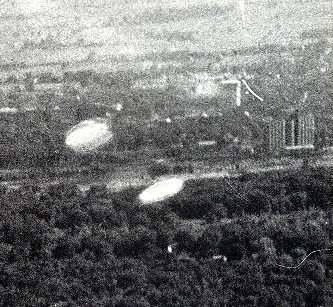
Although the reliability isn’t quite as high as the pictures taken in McMinnville, two shots taken in Phoenix do rank right up there. William A. Rhodes, a self-employed scientist living in Phoenix, reported that he had taken what might be considered the first good photographs of one of the flying discs. Rhodes said he had been on his way to his workshop at the rear of his house at the rear of his house when he heard a distinctive "whoosh" that he believed to be from a P-80 "Shooting Star" fighter jet. He grabbed his camera from the workshop bench and hurried to a small mount in his backyard. The object was circling in the east about a thousand feet in the air.

Rhodes sighted along the side of his camera and took his first photograph. He advanced the film, and then hesitated, thinking that he would wait for the object to get closer. Then, worried that it would disappear without coming closer, snapped the second picture, finishing the role.

Rhodes’ story, along with the pictures, appeared in the Phoenix newspaper, The Arizona Republic. In the article, reporter Robert C. Hanika, wrote, "Men long experienced in aircraft recognition studied both the print and the negative from which they were made, and declined to make a guess on what the flying object might be."

He also wrote, "The marked interest Rhodes has for all aircraft has led most persons who have been in contact with other observers of the 'flying discs' to believe the photographs are the first authentic photographs of the missiles, since Rhodes easily can identify practically any aircraft."
Rhodes said that the object appeared to be elliptical in shape and have a diameter of twenty to thirty feet. It appeared to be at 5000 feet when first seen and was traveling, according to Rhodes, at 400 to 600 miles an hour. It was gray which tended to blend with the overcast background of the sky.

The object had, according to Rhodes and a confidential report from the Project Blue Book files, "what appeared to be a cockpit canopy in the center which extended toward the back and beneath the object. The 'cockpit did not protrude from the surface but was clearly visible with the naked eye." There were no propellers or landing gear, but there did seem to be trails of turbulent air behind the trailing points of the object. Speculation was that there were jet engines of some kind located there. The craft moved silently, although Rhodes had said that a jet-like roar was what called his attention to it.

The news stories apparently alerted the military to Rhodes' sighting. Various investigations were launched. On July 14, 1947, Lynn C. Aldrich, a special agent for the Army's counterintelligence corps (CIC) in a memo for the record available in the Project Blue Book files wrote, "On 8 July 1947, this Agent obtained pictures of unidentifiable objects (Exhibits 1 and 2) from the managing editor of the Arizona Republic newspaper. The pictures were taken by Mr. William A. Rhodes... [of] Phoenix, Arizona, at sunset, on 7 July 1947."

Then, on August 29, according to a "Memorandum for the Officer in Charge," George Fugate, Jr., a special agent of the CIC and stationed at Fourth Air Force Headquarters, interviewed Rhodes in person. Fugate was accompanied by Special Agent Brower of the Phoenix FBI Office. This interview is important because of some of the confusion about location of the negatives and prints of the photographs that would develop later.

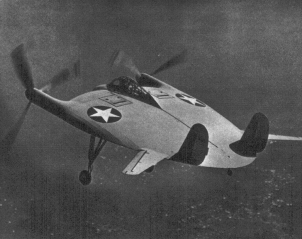
During the interview, Rhodes again told the story, suggesting that he thought, at first, it might have been the Navy's "Flying Flapjack" (seen at the left) which had been featured on the May 1947 cover of Mechanix Illustrated. He rejected the idea because he saw no propellers or landing gear. Research shows that the Navy built a single "Flapjack" and that it never flew outside the Bridgeport, Connecticut area.

At the end of Fugate's report, he wrote, "Mr. Rhodes stated that he developed the negatives himself. He still had the negative of the first photograph (Exhibit III), but he could not find the negative for the second photograph."

On February 19, 1948, Lewis C. Gust, the chief, Technical Project Officer, Intelligence Department (though the Project Blue Book files fail to identify the man or his organization beyond that), wrote what might be considered a preliminary report on the analysis of the photographs. "It is concluded that the image is of true photographic nature, and is not due to imperfections in the emulsion, or lack of development in the section in question. The image exhibits a 'tail' indicating the proper type of distortion due to the type of shutter used, the speed of the object and the fixed speed of the shutter. This trailing off conforms to the general information given in the report."

On May 11, 1948, Rhodes was again interviewed but this time by high-ranking people. Lieutenant Colonel James C. Beam, who worked with the head of intelligence at Wright field Colonel Howard McCoy, and Alfred C. Loedding, who was a civilian employee at AMC and part of Project Sign, traveled to Phoenix. In their official report of their trip, they wrote, "Although Mr. Rhodes is currently employed as a piano player in a night club, his primary interest is in a small but quite complete laboratory behind his home. According to his business card, this laboratory is called "Panoramic Research Laboratory and Mr. Rhodes is referred to as the 'Chief of Staff.' Mr. Rhodes appeared to be completely sincere and apparently is quite interested in scientific experiments."

During the interview with Beam and Loedding, Rhodes mentioned that he did not believe that what he had seen was wind blown debris. This is an obvious reference to Dr. Irving Langmuir's conclusion published in the "Project Grudge Report," that the object in the photographs could be "merely paper swept up by the winds."

In fact, that same Grudge Report noted, "In subsequent correspondence to the reporter of this incident, the observer refers to himself as Chief of Staff of Panoramic Research Laboratory, the letterhead of which lists photography among its specialities. Yet, the negative was carelessly cut and faultily developed. It is covered with streaks and over a period of six months, has faded very noticeably."

The AMC opinion in the Project Grudge report, which followed Langmuir's statement about the possibility of wind blown debris, was, "In view of the apparent character of the witness, the conclusion of Dr. Langmuir [that the photographs be discounted as paper swept up by the wind] seems entirely probably (sic)."

On June 5, 1952, now nearly five years after the pictures were taken, and before the massive publicity about UFOs was about to burst on the public consciousness, Colonel Arno H. Luehman, Deputy Director of Public Information wrote about "Declassifying Photographs of Unidentified Flying Objects." In the first paragraph of his letter, he wrote, "This office understands that two photographs were taken by Mr. William A. Rhodes of Phoenix, Arizona, and that these photographs were turned over to Fourth Air Force Intelligence in July of 1947. This office has been contacted by Mr. Rhodes who is requesting return of his original negatives."

The letter continued, "The two photographs were copied by the Photographic Records and Services Division of the Air Adjutant General's Office at this headquarters and are in a confidential file of Unidentified Missiles as A-34921AC and 34921AC."

But the important part of the document comes at the end. Aldrich wrote, "...On the morning of August 30, 1947, when Mr. Rhodes called at the Phoenix office [of the FBI] to deliver the negatives, they were accepted only after he was advised that they were being given to Mr. FUGATE, a representative of the Army Air Force Intelligence, United States Army, and that there was little, if any chance of his getting the negatives back. Mr. Rhodes turned them over to this office with the full understanding that they were being given to the Army and that he would not get them back."

On July 14, 1952, in still another letter, we learn that the pictures and negatives were turned over to Air Force intelligence representatives at Hamilton Field on August 30, 1947. In that document, they are attempting to trace the course of the pictures from Rhodes to the FBI to Army intelligence. What this suggests is that the Air Force wasn't sure of where the pictures and negatives were. They were attempting to shift the blame to others for the apparent loss of those pictures, including Rhodes himself.

That same July 14 document, written by Gilbert R. Levy, noted, "A background investigation was run on Rhodes, by OSI, for the benefit of AMC, which reflected Rhodes had created the name PANORAMIC RESEARCH LABORATORY, to impress people with his importance. He was reported to be a musician by trade, but had no steady job. Neighbors considered him to be an excellent neighbor, who caused no trouble, but judged him to be emotionally high strung, egotistical, and a genius in fundamentals of radio. He conducts no business through his ‘Laboratory,’ but reportedly devotes all his time to research."

What all this means is that Rhodes had surrendered his photographs and negatives to the government. And, although there is a suggestion that he knew where they were, that simply isn't borne out in the documents. Even the Air Force officers didn't know where the photographs were. That was why there were letters written from one office to another.

But, more importantly, there has been no real discussion about why the Air Force investigators labeled the case as a probable hoax. The discussion seemed to center around Rhodes' lifestyle. He didn't have a "real" job and had letterhead that labeled him as the chief of staff of his laboratory. None of that is a good reason for labeling the case a hoax. If that was all their evidence, then it is fairly weak.

There is, however, one page of analysis of the photographs offered by John A. Clinton. There is no clue, in the files, about Clinton. The analysis is not on a letterhead and there is nothing in the signature block to tell us anything about Clinton, his expertise, or why he was consulted about this particular case.

In the undated analysis of the photographs, Clinton wrote, "Preliminary analysis of the negative and prints leads me to doubt the story told by Mr. William A. Rhodes. Judging from the dimensions, the negative was exposed in a simple camera of the box type, which usually has a fixed focus (about ten feet), fixed shutter speed (about 1/25 of a second) and a simple lens of the Meniscus type. Because of the above mentioned facts, it is unreasonable to assume that sharp outlines such as appears on the negative, could be secured from an object at 2,000 feet, traveling 400 to 600 mph. Furthermore, according to the story the object (flying craft) was painted gray to blend in with the clouds. But, even if the object would be painted jet black, under the circumstances described, to obtain a contrast such as appears on the negative is also very doubtful. On all the prints, excepting the print marked "exhibit A", judging from the outlines, the object has a rotating motion (revolves around its center) instead of a forward motion, contracting the version stated by Mr. Rhodes."

And that's all of the negative analysis of the photograph. Clinton, whoever he is, claimed the story told by Rhodes to be in conflict with that shown on the photographs. He assumed that the object is rotating based on something he saw on the prints. Besides, Rhodes talked of the craft circling east of his house, moving north to south when he first saw it. This seemed to be an explanation for the conclusion drawn by Clinton that might suggest the object is rotating.

More important are the suggestions about the limitations of the camera used and the sharpness of the photographs obtained. Of course, if Rhodes, for whatever reason, overestimated the distance and the speed, then those problems might be resolved.

By 1952, when Rhodes was trying to get the pictures back, Air Force investigators, including the then Captain Dewey Fournet suggested in a telephone conversation with the then Lieutenant Ed Ruppelt, that "There is no information available as to whether or not Rhodes ever sent his negatives to the Air Force or whether he just sent prints. We do have some rather poor quality prints of the object. As you know, we have concluded that these photos were probably not authentic. If seems as if Mr. Rhodes attempted to get on the 'picture selling bandwagon' and if he can prove he sent the negatives to ATIC or to the Air Force and they were never returned, it may lead to a touchy situation."

So now, after all this, Rhodes' photographs are going to be rejected because he wanted to sell them. Five years after the fact, without a single clue that such was the case, the Air Force rejected the photographs because Rhodes "may" want to sell them. There is no evidence anywhere that Rhodes ever sold the photographs nor is there any information in the Project Blue Book files to confirmed he made a dime from the pictures.

There is one disturbing thing about the case but is not evident in the Blue Book file. In the mid-1960s, Dr. James E. McDonald corresponded with Rhodes about his case. McDonald wrote to Richard Hall, of NICAP (and later of the Fund for UFO Research), on February 18, 1967 that "I did a lot of checking on Rhodes degrees, because there seemed something odd about an honorary Ph D based on the kind of work I could imagine him doing. Columbia said no record of any such degree. Geo. Washington said no record of a BA ever given to Rhodes in the period I specified. So I made a trip up there in December and spent an hour or so with him. Devoted most of my querying to the matter of the degree and his associations with inventory (sic), Lee DeForrest... He [Rhodes] showed me a photo-miniature in plastic of the alleged Columbia degree, and he said he had the original somewhere in his files but did not show it to me... As I kept going over the thing he finally volunteered the remark that he, himself, had checked with Columbia about a year after DeForrest presented him with the certificate, found no record of it, confronted DeForrest with the information, and was non-plussed by D F putting his arm over his shoulder and saying something to the effect, that, 'Well, my boy that's the way those things happen sometimes,' and saying no more about it... But the fact that he lists himself in the Phoenix phonebook as Dr. Wm Rhodes in the face of that history constitues (sic) a cloud that would be impossible to overlook. Everything else checks out solidly in his story."

There isn't much else to be said about the case. The Air Force eventually removed the possible from in front of hoax and listed it as "Other (Hoax)." They had no other explanation for it and too often, when they could find no plausible explanation, especially in cases of physical evidence such as this, they labeled it as a hoax. As we've seen, there simply is no justification for the label. Rhodes just fit no easy profiles so it was easy to label him an eccentric and his case as a hoax.

But the real facts that remain is that no one ever showed that Rhodes tale of seeing the craft was not as he described it. Analysis of the photographs left a great deal to be desired but there was nothing in the photos that suggested hoax.

Wednesday, November 29, 2006

Among the Best of the UFO Photographs


Let’s take care of a little business here. In the past I have been asked some questions and I think it’s time to deal with, at the very least, one of them. Paul Kimball, among others, wanted to know if there were any UFO photographs that I accepted as authentic. The answer should have been clear because I had posted an article that dealt with the pictures taken in Lubbock, Texas, in 1951 by Carl Hart, Jr. I thought I had made it clear that I believed the pictures showed something anomalous. There are but two answers for the Hart photographs. They are either genuine or they are faked. I don’t believe them to be faked.

Before I go further, I will say one thing. In today’s world it is so easy to fake photographs and video. There are so many programs available that allow for the manipulation of photographs and video tape and so few that allow us to spot th fakes, that nearly anyone can create a realistic picture. And that means that the pictures I’m going to point to were taken before the coming of computers, photoshop, digital cameras and digital recorders.

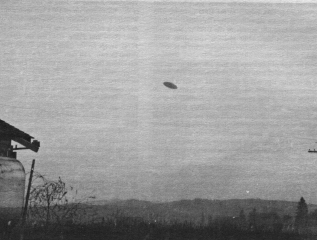
I believe that the best of the pictures (and this is my own opinion and not meant to be taken as the gospel) are the ones taken in McMinnville, Oregon in 1950. Paul Trent and his wife spotted an object in the evening, ran inside to get their camera and took two pictures of the UFO. Skeptics will tell you that the pictures were not taken in the evening as the Trents claimed, but in the morning and if they lied about that, what else have they lied about?

But the truth is that the Trents were not overly sophisticated people, they were using a rather basic camera, and no real evidence of a hoax has been found. The argument about the time of day is based on shadows under the eves on the garage which suggests a sun angle consistent with a morning picture. Bruce Maccabbe, a Navy physicist, said that the shadow is the result of "random light scattering" and is not consistent with a sun produce shadow. He believes the Trents on this and I confess I find no real reason to fault their story or Maccabee’s analysis.

If the object on the pictures is what it looks like, there really is no explanation for the pictures. A large circular object hovering over the ground suggests a foreign technology superior to ours, or, in other words, something extraterrestrial. It looks like nothing in the aviation inventory in the 1950s and you’d be hard pressed to find anything like it today. Those who had performed computer analysis on the pictures have failed to find evidence of a hoax, such as string holding up the craft.

The only place that th photographs are called a hoax is in the debunker camp and they do that because they have no other explanation. While the pictures do not prove the extraterrestrial case, they certainly can lead in that direction.

Thursday, November 16, 2006

Colonel Steve Wilson

There have been so many people coming forward with claims of inside knowledge about UFOs that it is becoming difficult to separate the truth from the fiction. When we find someone whose claims do not match the documented background, we are told that the person’s records have been changed or erased to invalidate their claims. I always find this silly because there is no way the government, no matter how they tried, could get all the records altered and the files lost on the scale claimed.

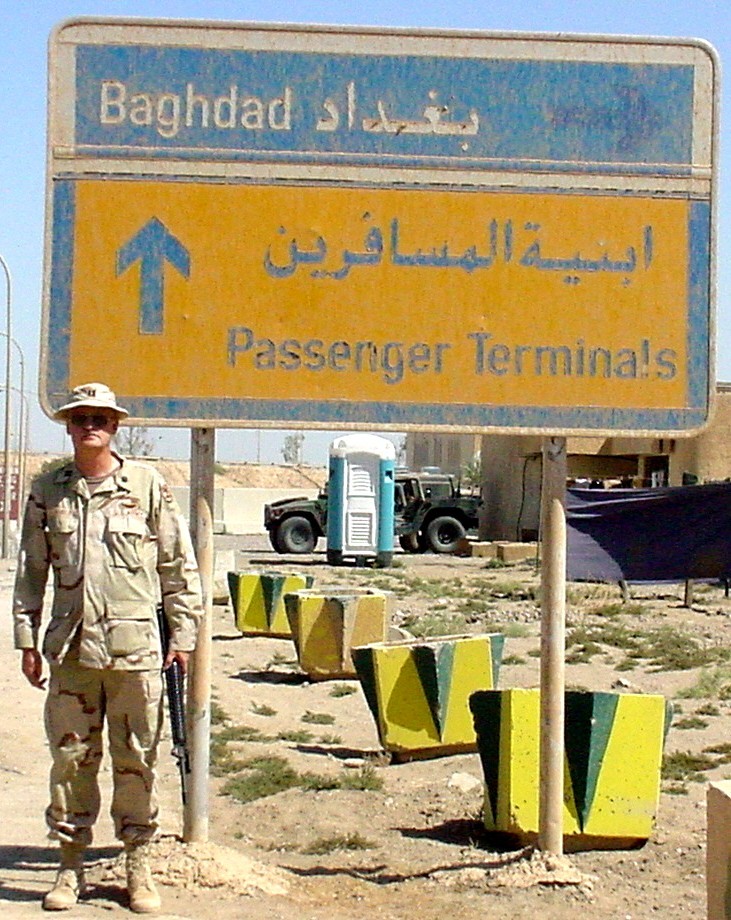
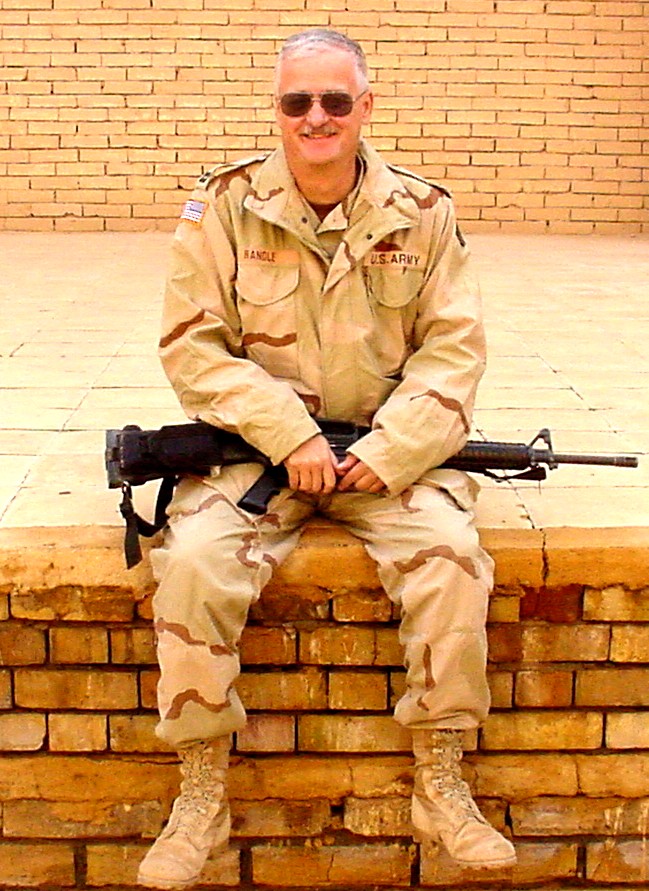
For example, there are some out there in Cyberspace who have been suggesting that my claims of a recent tour in Iraq and claim of being a member of the U.S. Army now (meaning the National Guard) are some of the same sort of embellishment. They have no proof that I have made up these facts, but they don’t like some of the conclusions I have drawn about their favorite cases or witnesses. They speculate without foundation.

While I refuse to place, on the Internet, documents that would prove my point, I have no real trouble putting up pictures (as seen on the left). Sure, I know that pictures can be easily faked in today’s world, and I’m sure that some of these critics will delight in pointing out how these pictures have been faked, but the truth is, I spent about 11 months in the Iraqi Theater, I have a couple of a thousand pictures I took and there are several hundred soldiers who saw me there. Dozens saw me on a daily basis.

In fact, for those interested, I suggest looking at the February 2005 issue of Soldier of Fortune magazine for some confirmation of my tour in Iraq.

The point here is that the critics can say what they want and rather than say I don’t care what they say and ignore the criticism, I offer some evidence to the contrary. There are others whose stories simply don’t check out. Just recently I came across the story of Colonel Steve Wilson who had an interesting story about his insider status. He seemed to know who made up the Majestic-12 committee in the 1990s, he was the commander of Project Pounce, which had the mission of recovering UFO crash debris, and he had a long, impressive military career. Wilson died of cancer in 1997. Some have suggested his death was mysterious and have hinted that we know that cancer is one of the ways "THEY" get rid of those who are causing them trouble.

According to Dr. Richard Boylan as reprinted on a couple of different web sites, "Steve Wilson was born in the 1930s and spent five years in a state orphanage. In order to escape the savage beatings there, he ran away. He always dreamed of being a pilot. Befriend by a prostitute with the proverbial ‘heart of gold’, this tall 13-year-old was accepted into the Air Force, when his newfound mother stated he was 16 and signed for him to enlist."

First, to nitpick, it would have been the Army Air Forces in 1946 when Wilson joined. I have heard of cases of boys 15 or 16 joining the Army by using the birth certificate of a brother or a cousin, but I know of no cases of a 13-year-old being able to join the Army. In 1946, with the war ended, there was no longer the tremendous need for soldiers and someone who didn’t have the proper documentation wouldn’t have been allowed to join. He would have needed, not only a parental signature, he would have needed the proper documents. This idea is just not quite believable.

Boylan then wrote, "Starting out as a private, he worked hard to advance. He took U.S. Armed Forces Institute courses, earned his high school diploma and then the equivalent of a two-year college degree. Simultaneously he studied at Aircraft Mechanic School and became a certified mechanic.

"Finally getting his chance, Wilson went to flight school, emerged as a fighter pilot and eventually found his way to Korea. He saw a fellow pilot shot down. Searching for him, Wilson heard a telepathic cry for help. He spotted a clearing with enough room to land and set his plane down. He taxied to where the other pilot’s lane was ‘wedged under some trees.’ Wilson jumped out, pulled the injured pilot from the wreckage and dragged him back to the aircraft."

According to Wilson (as filtered through Boylan), "I threw the radio gear out to make room for him. With me sitting on his lap, I taxied out and to the end of the clearing. Swinging around, I was there was very little room for a take-off . . . I held the brakes, gunned the engine to the breaking point, let go of the brakes and rocketed across the clearing. The minute I felt myself off the ground, I began to raise the wheels. The enemy broke cover ahead of me and began firing. I passed overhead, and heard the crunch and ripping of metal as I left me wheels in the trees. My plane became hard to manage with the undercarriage ripped away . . . I finally made it back to base . . . I felt a jolt as my plane skidded down the side of the runway and came to a halt . . . "

I’m not sure where to begin with this story. There is a Medal of Honor winner, Major Bernard Fisher, who rescued a downed fellow flyer in a similar fashion, but he landed on a shot up air strip next to a Special Forces camp and was flying an A-1E Skyraider. Wilson suggested he landed in an open field in a Sabre jet and I just don’t believe there would have been room in the cockpit for two and I don’t know what radio equipment he could have jettisoned to make room. I also believe that if he had caught his wheels in the trees on take off he would have crashed the aircraft. This story just doesn’t make any sense the way it is told, and, of course, there is no record of it anywhere.

Boylan notes that he was given the Distinguished Service Award for gallantry . . . but there is no such award and if we believe Boylan just botched the name of the award, then it means he received the Distinguished Service Cross (which, had he done what he said, wouldn’t have been much of a stretch). But there is no record of the award on the web sites that track that sort of thing. On the site I checked, they make it clear they are fairly certain they have all the awards of the Distinguished Service Cross, but it is possible they might have missed one, especially those late in the war. The real point is that there is no Distinguished Service Award for gallantry and no one who won the Distinguished Service Cross doing what Wilson claimed in Korea . . . Just a note for those who will complain, there apparently was no Air Force Cross during the Korean War and no indication that anyone has ever been awarded one for Korea.

Boyan, and other web sites provided "Data from Col Wilson’s DoD 214 discharge papers."

Which in the 1960s, 70s and 80s were easy to forge with a typewriter, a bottle of white out, and a copy machine. I have seen no copies of his DD 214, so I don’t know what it does and doesn’t say. In fact, there are many who claim to have seen it and who have said they were obligated to keep it to themselves while Wilson was alive. Now that he is dead, it’s time to put the document out so that it can be properly examined.

These documents give his date of birth as April 5, 1933 and even have an Air Force serial number. According to Boylan and others, Wilson served for 40 years and 19 days. They claim that he had seven re-enlistments.

This isn’t quite right. Very few people remain on active duty for forty years. Some generals, such as MacArthur have served longer, and many officers were recalled for World War II, but rarely anyone below brigadier general have served that long.

The regulation as it reads today for colonels says, "Each officer in the grade of colonel shall be retired on the fifth university of the date of his or her appointment in that grade or on the 30th day after completion of 30 years of service, whichever is later."

This seems to close the door for forty years of service. The regulation says thirty years of service, not necessarily as an officer, so that time as an enlisted man would count against him, in this case. He would have had to be promoted to colonel in his 35th year of service, but he would have been mandatorily retired prior to that because, for lieutenant colonel, the regulation kicks in at 28 years of service. So, Wilson couldn’t, under normal circumstances, have remained in the military for forty years and nineteen days.

Under the heading of medals, we see a number of awards to him. According to Boylan and others, it says he received two distinguished flying medals. I confess that I don’t know what these are . . . Boylan, at one point in his listing mentions two Distinguished Flying Crosses and a Distinguished Service Medal. I suppose that those writing the lists could have confused the two decorations.

The list says he had 13 Good Conduct Medals. Here is a major error which suggests that whoever created the original story (in this case Wilson himself) didn’t know that the Good Conduct Medal is NOT awarded to officers. Yes, I know that some officers have them. I have one myself, but I received for service in the enlisted grades and not as an officer. For Wilson to have thirteen, he would have had to have 39 years of service . . . which seems to corroborate his story of forty years. Someone knew that the Good Conduct Medal is given for three years of service, so that simply calculated the number. They didn’t know that as an officer, Wilson was ineligible.

The list also gives him one National Defense Service Medal (which, BTW, is the correct name of the award) but he should have had two, one for Korea and one for Vietnam. These are given to anyone serving during a specific period (like 1 Jan 61 to 14 Aug 74 for Vietnam).

They also claim he was a POW from 12/07/50 to 01/08/51, or just a little more than a month. He escaped, killing two guards and was on the run for 23 days before he managed to get back to friendly lines.

Great story except, I found a couple of comprehensive listings of POWs from the Korean War and Wilson’s name does not appear. Once again, there is a chance that he was somehow overlooked, but given everything I know about this, I doubt it.

Now I know that records are sometimes incomplete. I have spent years trying to get my records up to date and have failed. There are things missing from them so that a discrepancy between what someone says and the record isn’t, necessarily, a make or break deal. With Wilson, however, it’s not only that records don’t exist, but that some of the things he claimed were contradicted by the records, regulations and rules. He just couldn’t have joined the Air Force (okay, Army Air Forces) at 13 and he couldn’t have served for more than 40 years. He took stories from science fiction movies and from the exploits of others and used them as his own. If you are among those who believe that MJ-12 is a hoax, then his claim of working with them is another indication of his fraud.

So, once again, we had an "insider" blowing the whistle on the great UFO cover up, but we have nothing in the way of records, documents or corroboration for this tale. I believe that we must reject it, as we do so many others in a similar circumstance . . . at least until someone can provide some proof these stories are true.

Saturday, November 11, 2006

More OOPARTS

I am always surprised when what I write, which I believe to be clear and unmistakable is misunderstood. For example, I was not suggesting that the Masons were running around the world planting OOPARTs (see the following article) but that they might have planted this particular article, or they inserted Tubal Cain’s name into it for some private reason.

I also understood who Tubal Cain was, or was supposed to be. I’d read the various articles on the Internet. It was quite clear to me that Tubal Cain was not an early resident of Dorchester county, but an ancient blacksmith.

And thinking about it, maybe the misplaced "L" was not the letter slipping out of alignment, but was purposefully put there as just one more way of "hiding" the true name so that it looked like Tuba Cain rather than Tubal Cain.

And for those of you keeping score at home, I too have had a long interest in OOPARTs, or the name that I prefer, OOPTHs for Out Of Place Things. I did not invent the term. I think Ivan Sanderson came up with it three or four decades ago.

But, since this article struck a chord, let’s take a look at some other examples. In an account given before the British Association for the Advancement of Science, Sir David Brewster said that a nail had been found embedded in solid rock. About an inch of the nail was protruding and the rest was lying along the stone and projecting into a layer of ground, where it had rusted. The report suggests that the nail was partially in the stone but had not been driven into it. In other words, the nail was part of the sedimentary material that had congealed into granite so that it was part of the rock. That would mean that the nail had been manufactured millions of years earlier if all aspects of the report were true and the observations about it accurate.

Many more such objects seem to have been found in coal. Brad Steiger, in Mysteries of Time & Space reported that Wilbert H. Rusch, Sr., Professor of Biology, Concordia College, Ann Arbor, Michigan, quoted a letter from a friend had received from Frank J. Kenwood (yes, this sounds like the old friend of a friend), who said that he had been a fireman at the Municipal Electric Plant in Thomas, Oklahoma in 1912 when he split a large piece of coal and found an iron pot encased inside.

Quoting from the letter, Steiger wrote, "This iron pot fell from the center leaving the impression or mold of the pot in this piece of coal. I traced the source of the coal and found that it came from the Wilburton, Oklahoma, mines."

Others have made similar discoveries in lumps of coal. Mrs. S. W. Culp, according to the Morrisonville, Illinois Times, published on June 11, 1891, found an artifact when she broke a lump of coal as she was preparing to toss it in a stove. According to the story, "Mrs. Culp thought the chain had been dropped accidentally in the coal, but as she undertook to lift the chain up, the idea of its having been recently dropped was at once fallacious, for as the lump of coal broke, the middle of the chain became loosened while each end remained fastened to the coal."

The coal was identified as coming from mines in southern Illinois. Steiger suggests that the coal is from the Carboniferous era.

I queried the Smithsonian about this and several other like reports a number of years ago. They suggested, "… manufactured items… would not normally be found in rocks or coal since the latter were formed before the advent of man. The only such inclusion would be the rock material had been broken, and the artifacts had gotten lost among it and then moss had recemented it by sedimentary action."

This is certainly a conventional explanation and is, of course, possible. It is also possible, as in the case of the metal vessel from Dorchester (see the following article) that it had not been embedded in the rock, but was associated with material around the rock. That means, simply, that it could have been something buried in softer ground that was uprooted by the explosion and fell in among the debris of the quarry where it was found giving the impression that it was blown out of solid rock.

Some support for that conclusion comes from the study of the history of OOPARTs. Info Journal, #59 reported that about 1900 an Englishman found a coin embedded in a lump of coal. The coin was clearly dated 1397. So, we have an artifact that was found in coal that was clearly dated long after the coal was formed unless we are willing to believe that some ancient, unknown or alien civilization used a numbering system just like ours. We have seen, since the beginning of written history a variety of numbering systems so why believe the ancients would use the same system we do. Why wouldn’t they have invented their own? And would they have a base ten?

There is further information that sheds additional light on this and we don’t need philosophic discussions of numbering systems to understand it. After Mount St. Helens blew up a group of scientists discovered that peat deposits had developed in an unexpectedly short time at the bottom of a lake. It suggested that some coal beds could theoretically form in far less time than conventionally believed.

What all this tells us is that there are some interesting enigmas out there and that there seem to be some rational explanations for some of these strange finds. But, and this is critical, those explanations rely partly on speculation. Further study is required on this before we can either accept the data as proved, or reject it as flawed.

Friday, November 03, 2006

OOPARTS and Tubal Cain

There is a class of ancient artifacts such as iron nails found in solid rock, a delicate gold chain found in a lump of coal in the 1890s, or an ornate bell-shaped vessel inlaid with silver blasted from rock in a Massachusetts that are called Out Of Place Artifacts, known popularly as OOPARTs. They seem to suggest that someone had been manufacturing objects millions of years before the human race was capable of such fine and precise work or even before humans existed on this planet. These artifacts are, in essence, a form of proof that another intelligence had once walked the Earth, maybe before the dinosaurs disappeared and that those sophisticated beings probably originated in outer space given the fossil and geological records relied on by our modern day scientists. It is circumstantial evidence that, if accurate, provides us with the proof that some ancient sightings were of alien spacecraft.

One of the first of the Out of Place Artifacts (OOPARTs) I came across was a reference in several UFO books to some sort of "bell-shaped vessel" discovered during blasting in a quarry in Massachusetts in the mid-19th century. For some reason I have always envisioned this as a "gravy boat."

According to those UFO books, the original source was the Scientific American in 1851. The story was headlined "A relic of a by-gone age" although some suggested it was labeled as "A Curiosity."

The story, as reported in those other UFO books, was that the blasting in the quarry "threw an immense mass of rock… in all directions." Among the shattered debris, the workmen found a small metallic vessel in two pieces that when reassembled formed a "bell shape" about four and a quarter inches high and about six inches wide at the top. The whole thing was something like an eighth of an inch thick.

The report continued, saying that it was made of zinc with "a considerable portion of silver." The sides were inlaid with silver and the carving was "exquisitely done by the art of some cunning workman." The magazine concluded, again according to all those other UFO books, that the find was worthy of additional investigation because the vessel was extremely old, pre-dating the first inhabitants of the continent.

I discovered that the University of Iowa library, (Pat Williams looks through the 1852 Scientific American in the bound periodicals) in it’s bound periodically section, held the entire run of Scientific American. It would be easy enough to check the primary source of the story. So I did. To my disappointment, but not great surprise, there was nothing in the 1851 issues about anything like the metal vessel being found. True, there were a number of things labeled as "curiosities" but nothing that told of manufactured items coming out of a quarry.

But research isn’t always that simple, and there is always the chance that someone had written down a date wrong and it was then copied by all those others who failed to do primary research but who believed the others had. So, I decided to look in both 1850 and 1852, and being somewhat compulsive about such things, I quite naturally started in 1850 because it came before 1852.

The article appeared in the June 5, 1852 edition of the Scientific American, on page 298. The details as listed in most of the UFO books were substantially correct. There was some additional information in that article, including that "On the sides there are six figures of a flower or bouquet, beautifully inlaid with pure silver, and around the lower part of the vessel a vine, or wreath, inlaid also with silver. The chasing, carving, and inlaying are exquisitely done by the art of some cunning workman."

The entry continues, noting "There is no doubt that this curiosity was blown out of the rock… but will … some other scientific man please to tell us how it came there?"

While I had been at the mercy of those other writers in the past, until I began to roam the stacks in the bound periodicals section of the University of Iowa library, researchers today aren’t so restricted (and I wouldn’t be surprised to learn that some of them have never seen the inside of a library). I typed "Scientific American 1852" into a search engine and in seconds was looking at a complete listing for Scientific American available on-line. Since I already knew the date, I could easily pull up what I wanted. Anyone with access to a computer and an on-line service could do the same (and therefore stay out of the library).

Like so much else in the UFO field, there is always something left out of the stories in all those UFO books. What is rarely mentioned is a paragraph at the end of the article in which it is suggested that Tuba Cain, one of the first residents of the area, meaning from the 17th century, had made the vessel.

But sometimes UFO research takes off on strange tangents. On closer examination of the Scientific American, it begins to look as if the mark at the end of the sentence that I thought originally was an artifact caused by the microfilm process, and right after the word Tuba, is an "L" that slipped out of alignment and into the margin. This means the name is a reference to Tubal Cain and Tubal Cain probably wasn’t an early reference to one of the first residents of Dorchester County, but was a descendent of Adam and Eve. Tubal Cain refers to blacksmiths from antiquity and the original Tubal Cain supposedly worked with bronze and iron in the far distant past and no where near the New World.

Here is something else from outside the UFO field (and that I wouldn’t have known if it hadn’t been for access to the Internet), Tubal Cain is a secret Masonic phrase, and something that certainly wasn’t well known in 1852. So now the question becomes is this tale of a metallic vessel found in solid rock true or does it have some significance to the Masons and the use of Tubal Cain is the clue. I confess that I don’t know. I am more than a little disturbed to learn of the history of Tubal Cain and the reference to it, or him, in this particular article. There is no reason for those other writers to have made anything out of the reference, unless they themselves were Masons and knew the code. Without the Internet, I certainly would not have made the connection, nor would I have been able to ask the question.

Ignoring that little bit of diversion, we find that if we are going to look at the rest of the case with a scientific detachment, we must ask a couple of other questions. First, did they find anything to suggest the vessel had been embedded in the rock? Did they find bits of rock that matched the contours of the vessel? If we were to date the "vessel" according to standard archaeological methodology we would be forced to conclude that the vessel was millions of years old because that was the age of the material in which it was found.

Second, they suggest that a scientific man should take a look at the vessel and named Professor Agassiz, as someone to study the find. The Scientific American wondered what Agassiz’s credentials were to make any sort of study. I confess that in today’s world, I’m a little curious about the man’s credentials as well, though there is nothing to suggest that he ever looked at the vessel or rendered an opinion about it so this is really a dead issue.

In the end, we’re left with many unanswered questions, including that of the placement of the vessel and if it was actually embedded in the stone as originally suggested. It is always possible that it was not embedded in the stone but was associated with it. That means, simply, that the vessel was in the ground on top of the stone maybe lost in it, but had not been embedded in the stone.

And we now wonder if there was a hidden meaning in this article that was meant for the Masons because of the use of Tubal Cain. In a world filled with speculations about a da Vinci code, Templars, and a bloodline related to Christ, it is not difficult to believe that the Mason of the 19th Century planted the article for some, probably trivial reason.

Sunday, September 17, 2006

THE JOPLIN SPOOKLIGHT

The legend of the Joplin, Missouri Spooklight began in 1884 when, according to a pamphlet written by the original owner of the Spooklight Museum, Spooky (Arthur P.) Meadows, a young Quapaw Indian girl saw it weaving through the trees in northeastern Oklahoma.

Or, maybe it began when a miner, heading home just after dark, got lost in the woods. Some say that his wife, fearing the worst, grabbed an old lantern and set out to look for him, wandering until dawn. When her husband failed to return a second night, she set out again, and from that point on, each night, until she died. Now her ghost, carrying that lantern, searches for her husband.

Some say her lantern is the light that the Quapaw girl saw. Others suggest that the light was already there when the first of the white man arrived in the area around the beginning of the nineteenth century. Some thought it might have actually appeared about the time of Christ, but there were no humans around the area two thousand years ago. At least none who left a record for us to find.

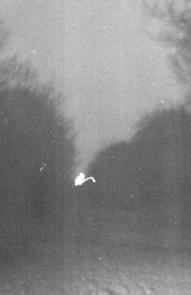
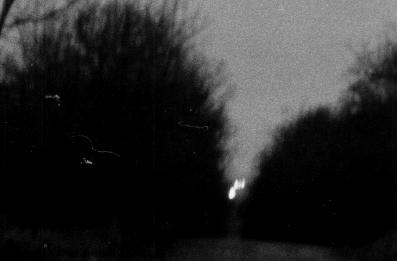
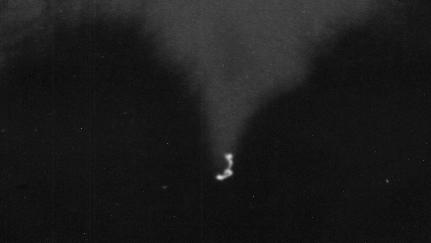
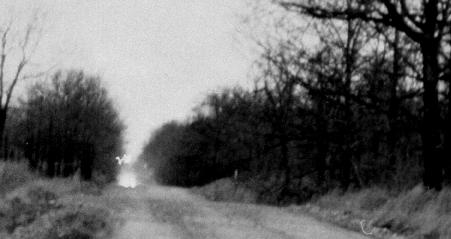
Whatever the source of the light, or origin of the legend, the light is still there. I know because I have seen it. It appeared on each of the nights I was there, showing up about dusk and flashing around the sky until we left four or five hours later. Given what I know, I suspect it stayed until dawn and then gradually faded into the brightness of the day.
I spent a week in Joplin with Monty Skelton who, at one time, was the president of the North American UFO Organization. That first night, in the mid-1970s, as we pulled up near the somewhat dilapidated Spooklight Museum, about dusk, the light twinkled into existence hovering down the road. As Skelton stopped the car, I pulled my camera from the back, set up the tripod, and began to shoot. I hadn’t expected to see anything and hadn’t been fully prepared. I had only part of a roll of film.

Garland Middleton, who owned the museum in the 1970s, told me later that night, "I’ve seen a lot of people try to take pictures, but none of them got anything."

I finished the roll of film and the Spooklight was still there. Using binoculars, I watched it bob and weave, seeming to be about a hundred feet above the ground. It broke into three parts, and then five, and finally vanished for several seconds. Moments later it burst out again, outshining everything around it.

When it was totally dark, the outside lights of the museum had been turned on and I could see Middleton’s car, the door labeled "Spooklight," sitting close to it. While others stood on the road watching the light, and other cars arrived and left, I walked over to the museum.

Middleton was sitting on a couch by an old wood burning stove. He had worked with the original owner, Meadows, had run the museum for him, opening it in morning and sometimes closing it at night.
Meadows had been estranged from his own family telling Ron Bogue of the Joplin Globe, "I’ve got three sons. One of them I haven’t seen in twenty years. I don’t know where he is. My other two boys live in Kansas but they never come to see me... I don’t know them." Middleton, who shared a love of the Spooklight became, to some extent, Meadows’s heir, replacing the family who had no time for him.

When Meadows died, Middleton took over the museum, living out on what Meadows had called "Spooklight Corner." In the mid-seventies, there were two pool tables and three pinball machines in the museum. On one wall there were dozens of clippings about the light, several photographs of it and a short story about the museum. I read the clippings which told me little about the light and a lot about the legends including one that said river boat passengers had sometimes reported the light. Today I’m not sure what river boats the writer meant, or even what river the boats would have been traveling.

I studied the photographs which suggested that Middleton might have been exaggerating when he said that no one had much luck taking pictures. He was even selling post cards that had picture of the light on the front. It was apparently one of many taken by Meadows who had been a photographer in his younger years.

In the mid-1970s, Middleton was an old man, fairly tall and very thin. He was friendly and eager to talk about the light. He told me, "I first seen the light forty-years ago. It looks the same today as it did then. Now it usually stays away but it used to come right down the road, almost to the corner."

Middleton, like so many of the others I talked to, told of friends who had been within twenty feet of the light. He said that he had once gotten to within fifteen feet, but that was years ago. "Nowadays it seems to stay away more. It doesn’t come very close but it’s always out there."

There were a couple of teenagers in the museum. I asked these young men, who were playing pool, if they had seen the light. The taller of the two, who had slightly reddish hair and couldn’t have been more than eighteen said that he hadn’t really seen it and didn’t care to. He was just there to play pool. The other, shorter, stockier kid said that he had seen it but he wasn’t all that interested in it now. Pinball and pool had drawn him, and his friend, out to the museum. They could play uninterrupted because rarely anyone else came in to play pool.

Back outside, I traveled up the road where the Spooklight floated but when I reached the top of the last hill, the light vanished. Below me, stretched for miles, was part of Oklahoma. In the distance I could see lights flickering along a stretch of highway and some of them looked remarkably like the Spooklight but everyone said they weren’t.

"Besides," said James Smith of Joplin, "the light was here long before the town or cars or electricity."

Well, maybe.

We turned around and started back to the museum. In the rearview mirror we could catch glimpses of the light still hovering over the hilltops, seeming to pulsate and change color.

Although we tried to drive up on it several times, we always failed. One man volunteered that he sometimes came in from another direction, using some of the back roads and that way he could "fool it." Once, as he turned onto "Spooklight Road" it had passed over his car. At least that is what he said.

He wasn’t alone in making such a claim. Others said that they had friends, family, cousins, or had just heard that the light sometimes came down the road. One man said that his brother reported that the Spooklight had touched the hood of his car, sitting on it for several seconds before disappearing. When I traced the brother, he said, no, that had been a friend. But then the friend related that he had heard it from someone else. The story had evolved into the old "friend of a friend" routine. I could never get to the original source.

I returned on a couple of other nights. Once I was there with Marta Poyner, a reporter for the Joplin Globe. She said that she had been out several times but had never seen the Spooklight. Just as we pulled up, it flared once and seemed to split into pieces. I pointed it out and she said, "Oh, I’ve seen that before. I always thought it was car headlights."

One of those who had driven out that night overheard her comment and said, "It’s been here since 1811, long before there were any cars."

Well, maybe.

We both took pictures, and just like the batch I had taken the first night, these too, came out, contrary to the legend. Once we had finished, we tried walking down the road to the light, but after a mile or so, we gave up. The light wasn’t any closer, and I had already tried to approach it in a car.

Back at the museum, I ran into John Wysong, a long time Joplin resident. He was with his wife and son, and though he had first seen the light in 1955, he returned two or three times a year to look at it.

James Wysong, the son, had also seen the light before, but his wife, from Arizona had not. She hadn’t even heard of the light until after she was married into the Wysong clan.

I asked her what she thought of it. She said, "I didn’t know what they were talking about. I really didn’t believe that I would see it but there it is. I don’t know what to make of it but I know there must be some kind of explanation for it."

The younger Wysong said that he had tried to find out exactly what it was. One night he had tried to stalk it, but after only a few minutes had given up. He didn’t say it, but seemed to imply he didn’t really want to get too close to it. He didn’t know what he might discover and that had concerned him.

The older Mrs. Wysong leaned across the front seat of the van and said, "After studying it all these years, you would think that someone would be able to figure it out what it is. It’s a real mystery to me."

Well, she was right. You would think that after all the studies someone would have a logical explanation for the Spooklight.

During the Second World War, the Army Corps of Engineers spent some time studying the Spooklight. Colonel Dennis E. McCunniff was interviewed in his headquarters at Camp Crowder and said, "I know that no one is going to like this, or even believe this, but we found a few interesting things about the Spooklight. We discovered that it is seen more frequently in the winter but I believe that is due to the lack of foliage. Leaves off the trees and that kind of thing. After looking at it, we’ve determined that it’s a refraction of light. An optical illusion."

Well, maybe.

In 1960, William K. Underwood, a high school student from Carthage, Missouri, spent 400 hours studying the light for his high school science project. He claimed that the lights were from a section of highway going east out of Quapaw, Oklahoma, and directly west of the road where the Spooklight is seen. Underwood, with the help of his friends and family, designed a number of experiments to prove his theory. Using a spectroscopic photograph, Underwood discovered that the light was from an incandescent source. In other words, the light came from car headlights. This seems to corroborate the theory given by Colonel McCunniff.

He also had friends drive down the stretch of highway, some with colored filters on their headlights. He watched as they flashed signals at him that were reflected in the Spooklight, verifying, to some degree his theory.

Others, equipped with mirrors, binoculars and cameras made similar experiments. Given that the signals were flashed in random patterns so that those at the museum didn’t know exactly when they were coming or what the signals would be, it provided some dynamic evidence.

A Joplin resident, who didn’t want to be named, said that he believed the Spooklight to be some kind of magnetic aberration that caused an ionization of the atmosphere near it. That caused the gases to glow and could account for the reports that the light had been attracted to cars. The gases would have one electrical charge and the car would have the opposite. The problem was that the glow lasted for hours and that suggested it wasn’t an ionization. Besides, there was no real mechanism in the explanation to cause the glow. The air might be ionized, but that, in and of itself, does not cause it to glow.
Spooky Meadows, in 1969, told Bogue of the Globe that he had formed his own opinion of what, according to Bogue, "has baffled everyone from Army Engineers down to amateur scientists." Meadows said, "It’s a light, of course. But the mystery is - what causes it?"

Most of those who live in Joplin will tell those who ask that there is no good explanation for the Spooklight. They will tell you that the Army studied it, as have scientists and investigators, but no one has explained it. They will tell you that it is probably some kind of a natural phenomenon, but they will refuse to identify exactly what that phenomenon is, preferring to sound somewhat skeptical while denying any and all explanations.

They will also mention, whenever an explanation is offered, that the light was there long before cars and electricity arrived on the scene. I could find no documentation to support that. The first of the newspaper articles and other documents are from the beginning of the twentieth century.

Those who live in Joplin are going to believe what they want to believe and they won’t listen to an outsider with an explanation. That attitude was typified on a call-in radio program originating in Joplin. One woman heard that we were there and wondered why we didn’t just stay home. The light wasn’t ours to study, but it was theirs. It belonged to Joplin. "If they want to study something, why don’t they do it at home and leave us alone," she said.

Friday, September 15, 2006

Faked? Who Knows?


A number of years ago, more than I like to think about, I used to visit newspaper morgues and ask about UFO stories. Sometimes I got lucky and found information on cases that hadn’t been reported outside the local area. In Cedar Rapids I was given a photograph of two objects (seen at the left) as they flew over town. I deduced the date as late August or early September based on evidence in the picture and was told that it had been taken by Fay Clark, one time the mayor of little Hiawatha, Iowa.

Later I learned that the picture had been taken on September 3, 1955, and was pleased that I had figured the time of year properly. I learned that Sam Stochl had been commissioned by the mayor, Clark, to take aerial photographs of Hiawatha but hadn’t seen the objects in the picture. Clark said that "knowing the airplane was flying at 1,200 feet... we can triangulate the objects as approximately 33 feet in diameter... at an altitude of 800 feet."

All well and good, but the picture always struck me as looking as if the objects had been drawn on the photographic paper and then the picture printed. You might remember how you could put designs on Easter eggs using wax to protect the shell from the dye. I always thought the objects had that sort of a quality too them. I especially thought this after learning that no one had seen the objects in broad daylight.

Now I learn a little more about Fay Clark. He is credited with founding Hiawatha. He was a rock hound, a flying saucer enthusiast and had an interest in photography. He wrote about book in 1958, Beyond the Light, about astral projection and parapsychology.

Given this information, especially about his interests in UFOs and photography, given the look of the photograph, and given that the actual photographer, Sam Stochl didn’t see the objects, I think we can conclude that Clark created the photograph. It was undoubtedly meant as a local oddity and nothing more, though it has appeared in one book published for a national audience some years later.

This is just another in a long list of UFO photographs that doesn’t deserve much more than a casual glance. And even if we called the photograph authentic (meaning of real UFOs) there isn’t much more we can do. There are no eyewitnesses and the evidence offered is of little value without additional information. It is an oddity, it is interesting, and it does nothing to increase our knowledge.

Disappearing Aircraft - Part 3 The Bermuda Triangle


The Bermuda Triangle is a place out in the Atlantic that supposedly swallows ships and aircraft with frightening regularity. These aircraft, according to legend, are often in radio contact with some kind of flight following agency, or in sight of land or airfields, and are said to disappear without a trace. The mystery deepens because there is never any wreckage suggesting to many that something supernatural or other worldly had occurred.

Such is the case of a C-119 Flying Boxcar that vanished in June 1965 while on enroute to Grand Turk Island from Homestead Air Force Base in Florida. The crew made a badly garbled radio transmission only minutes out and were never heard from again. It was suggested, by those who write about such things, that some kind of desperate last message had been sent, possibly about UFOs.

The International UFO Bureau, in 1973, took the idea of UFOs even further when they suggested that the UFO allegedly seen by James McDivitt and Ed White on a Gemini space mission was somehow tied into the disappearance of the C-119. McDivitt reported a strange object while over the Carribean and the International UFO Bureau thought that the UFO seen by the astronauts might have "captured" the cargo plane.

The real story, although as tragic, is not as dramatic. According to members of the Air Force Reserve and the 440th Tactical Airlift Wing at Milwaukee’s Billy Mitchell Field, the unit to which the aircraft and crew were assigned, the disappearance wasn’t nearly as total, nor as strange.

"We know," one officer told me, "that everything was fine about thirty minutes before landing. Major Louis Giuntoli [the pilot] had made a position report about 11 p.m."

A search was launched when the aircraft failed to arrive. Nearly 100,000 square miles of ocean were covered by boats and planes. By June 8, the Miami newspapers were calling attention to the Bermuda Triangle, recounting that dozens of planes had disappeared without a trace in the area.

The search was abandoned on June 10 when searchers failed to find any sign of the missing plane. But just two days later debris, stenciled with serial numbers and the tail number of the aircraft, was found. Although none of the wreckage was from the structure of the aircraft, the debris was from inside it.

About a month later, in early July, a wheel chock stenciled with the tail number turned up near Ackins Island. This was in the general area where the rest of the debris had been found.

The intelligence officer of the 928th Tactical Airlift Group, a subordinate unit to the 440th, said that he had talked to a number of officers in the wing and their belief was that the C-119 lost an engine just after the pilot had made his position report. He said, "If there was a corresponding electrical failure, which wouldn’t have been all that uncommon in those circumstances, they would have had no lights and no radio. Since this was at night when a light haze forms that makes it nearly impossible to see the horizon, the deck was stacked against them."

It means, simply, that the sky would have combined with the water surface giving the pilots the look of flying at a wall. With the instruments out because of the electrical failure, the pilots would have had nothing to use to keep the aircraft flying straight and level. The eventual outcome would be they would have flown into the ocean. It is not unlike what happened to JFK Jr. when he, his wife, and their female companion were killed in an aircraft accident.

Given the full story, the interviews with members of the missing aircraft’s unit members, the discovery of debris, and the circumstances, it is not difficult to understand how the aircraft might have crashed. Unlike the chroniclers of the Bermuda Triangle legend claim, wreckage was found, though not very much. The reasons for the crash are understood. It seems that this is one mystery that has been solved.

Friday, September 01, 2006

Disappearing Aircraft Part 2 - Kinross


When I had the chance, back in 1976, to look at the then recently declassified Project Blue Book files, one of the first cases I asked to see was that on the disappearance of an F-89 over Lake Superior on November 23, 1953. This was the story of a jet, scrambled into a stormy night to identify a UFO detected by radar. Those watching the intercept on radar saw the blip of the fighter merge with that of the UFO and then the single blip disappear from the scope. The fighter was never seen again and the two officers on board, Felix Moncla, Jr., and Robert R. Wilson were gone.

No one was sure what happened. By coincidence, earlier in the day, an F-89 from the same squadron had crashed near Madison Wisconsin, killing both pilots. They had been testing the afterburners and the test seemed to go fine. Not long after that witnesses reported they heard an explosion and the jet crashed into a swamp. It was a bad day for a unit that wasn’t involved in combat operations. No one is quite sure what happened there either, though both Donald Keyhoe and Frank Edwards speculated that flying saucers might have been involved (which makes for a great tale but doesn’t appear to be true).

But the case that I wanted to see when I had the first chance was that of Moncla and Wilson. When I was given the file, I was surprised. It contained two sheets of paper. One was a note explaining that the case was not a UFO sighting but an aircraft accident and the other was the page proof from a debunking book on UFOs. Neither was much help but they certainly provided a glimpse into the Air Force mind set in 1953.

What we know is this. On the evening of November 23, about six hours after the crash near Madison, radar at Truax Air Force Base picked up an unidentified blip over the Soo Locks in restricted airspace. Since it was unidentified, an interceptor was scrambled. Ground radar vectored the jet toward the UFO. Wilson said that he was unable to find the object on his radar, so the ground radars continued to vector the jet toward the object that had seemed to be hovering but was beginning to accelerate as it headed out over the lake.

For nine minutes the chase continued with Moncla able to gain slightly on the UFO and Wilson finally able to get a fix on it. The gap between the jet and the UFO narrowed, closed and then merged as Moncla caught the UFO.

At first no one was concerned because the ground radar had no high-finding capability and it was possible the jet had flown over or under the object but the blips didn’t separate. They hung together and then the lone blip flashed off the screen. The jet, apparently, was gone.

Attempts to reach Moncla failed. Radar operators called for Search and Rescue, providing the last known position of the jet. Through the night they continued to search, later joined by the Canadians. They found nothing. They found no clue about the fate of the jet or the crew. No wreckage and no sign that the crew had bailed out.

An early edition of the Chicago Tribune carried a story about the accident with the radar operator’s opinion that the jet had hit something. While the search continued, the Air Force moved to suppress the idea that the jet had hit anything.
Although a well-coordinated search was conducted, and everyone thought they knew where the jet had been because of the radar tracking, they never found anything. There was no wreckage, no oil slick, no bodies, nothing. The last trace of the jet had been when the two radar blips merged.

In the years that followed the Air Force offered a variety of answers for the accident. They claimed the radar operators had misread the scope and that Moncla had actually been chasing a Canadian DC-3. After Moncla had caught and identified it, he turned, only to have something happen then. Something so swift that he had time to neither report the identity of the unidentified blip or suggest the nature of the his sudden problem.

The Canadians quickly denied the jet had hit one of their aircraft, but the Air Force, for about a year, stuck to the DC-3 story until, finally, changing it to an RCAF jet. The Canadians, quite naturally, denied this, too. The Air Force later suggested that Moncla’s jet exploded at high altitude (which given what had happened earlier in the day wasn’t all that far out of line). That sort of an accident should have left wreckage scattered over the surface of the lake, but nothing was found.

The Air Force officers who were stationed at Truax in 1953 had their own theories. I talked to a lieutenant colonel (yes, I know exactly who the lieutenant colonel is, but given the way things operate in today’s environment, I’m not inclined to publish his name... I will reveal it to researchers who have a genuine interest in the case) who verified that the jet disappeared and that the search failed to find anything. He told me there were two schools of thought about what happened. "One group thought the plane had gone straight into the lake. If it didn’t break up, there would have been no oil slick or wreckage. That’s entirely possible. The other school thought that Moncla had been ‘taken’ by the UFO."

Not long after Moncla and Wilson disappeared, according to the lieutenant colonel, two jets found themselves paced by a large, bright UFO. They went through a series of turns and banks to make sure the UFO was not some bizarre reflection on the canopy or other optical illusion. Then, knowing what had happened to Moncla and Wilson, the flight leader called the break and both aircraft turned into the UFO. It hesitated for an instant and then flashed from sight. The lieutenant colonel, who had been there, told me that the pilots had, as regulations demanded, made a report to Project Blue Book. When I searched the Blue Book files, I could find no indication of this report. The lieutenant colonel said that he was surprised that no report could be found.

Some fifteen years after the disappearance, according to the Sault Daily Star two prospectors found aircraft parts, including a tail section, on the eastern shore of Lake Superior. The paper quoted Air Force sources saying the parts belonged to "a high performance military jet aircraft." Speculation was that the wreckage as from the missing F-89.

So that’s where the mystery stood for more than fifty years. What became known as the Kinross Incident puzzled researchers and while it didn’t prove UFOs were hostile, it certainly suggested they were dangerous. Neither the jet nor the missing airmen had been found.

Now, an outfit known as Great Lake Dive Company claims they have found the wreckage of the aircraft sitting on the bottom of Lake Superior in about 500 feet of water. On their website, www.greatlakesdive.com is a photograph of an aircraft that could be the missing jet. It is in surprisingly good shape considering having crashed into the lake.

If this is the missing jet, then one question has been answered. We will know what happened to the aircraft. If Great Lake Dive succeeds in getting down to the aircraft and can verify that it is the missing jet, then they might be able to suggest something about the fate of the two men on board.

There are some, inside the UFO community, who caution that we should wait for more information. Finding the wreckage of an aircraft that could be an F-89 doesn’t automatically mean that it was the one flown by Moncla and Wilson, though the wreckage on the bottom seems to be missing the same pieces that were found in 1968. Even that doesn’t prove it was the jet flown by Moncla and Wilson. What we have here is the possible solution to a mystery. All we need is a little patience, along with a little more information.