Showing posts with label Herbert Dick. Show all posts

Friday, April 16, 2021

X-Zone Broadcast Network - John Greenewald vs Tony Bragalia


This week we had a special edition of A Different Perspective with guests Tony Bragalia and John Greenewald. The idea to discuss Tony’s claim that the Pentagon had confirmed they were in possession of alien debris and that they were conducting reverse engineering on it. We began with Tony describing what he had discovered through his FOIA campaign directed at various government agencies. You can listen to the first part of the program here.

https://www.spreaker.com/episode/44336683

John did present his side of this conversation as well, explaining, again how the FOIA worked and that sometimes the material sent was not necessarily what had been requested. He was of the opinion that what was addressed in the email didn’t necessarily relate to the specific request. The FOIA officers attempted to fulfill the request in compliance with the law.

John Greenewald
Tony mentioned a connection between his investigation into Nitinol metal and Titanium. He mentioned that General Exon had talked about the ultra-high purity of Titanium. I said that I didn’t remember General Exon saying anything about Titanium in my interviews with him and I asked for the citation. Tony didn’t have it at his figure tips but promised to send it to me later.

You can listen to the exchange on the first part of the program. It begins at 24:32 minutes in the show. Tony said, “…he told you, on tape, that he understood that some of the [Roswell] wreckage being tested was comprised in part by special processed Titanium, so we begin to examine specially processed Titanium in these documents…”

I said, “I do not remember Exon saying anything about the Titanium.”

Tony said, “It’s in your book and I will cite and send it to you…It’s in your books… you certainly did talk about Titanium and Arthur Exon and his mention of specially processed Titanium.”

Tony did send a citation. The reference came from my book Roswell UFO Crash Update and Tom Carey and Don Schmitt’s Witness to Roswell. The information originated in Don’s interview with Exon in June 1990. It said:

I don’t know, at that time, if it was Titanium or some other metal… or if it was something they knew about and the processing was something different.

Tony has taken that single, rather unimportant reference to Titanium as the possible metal recovered and turned it into a positive identification of the metal from Roswell being Titanium. So, in one way, Tony was right. Exon did mention Titanium but in the long haul, it is not as important as Tony has made it out to be. It wasn’t a positive identification of Titanium, and there was no mention of any sort of processing related to the Titanium. Exon did talk about special handling of the debris but it wasn’t necessarily related to Titanium as Tony suggested.
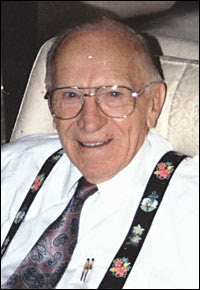
Arthur Exon. Photo by
Tom Carey.

Lewis Rickett, who had been the NCOIC of the Counterintelligence Corps (CIC) office in Roswell, handled some of the debris and said it reminded him of Cold Rolled Steel. He also pointed out that it was very light weight and very strong. I mention this only to point out that those who actually handed the metal had different opinions of it. General Exon never handled the debris, a point that Tony has overlooked. This sort of thing will become important in the second hour of the show.

It was in the second hour that things became somewhat acrimonious. You can listen to that portion of the show here:

https://www.spreaker.com/episode/44336808

I brought up the problem with Tony’s analysis of the Dr. Herbert Dick interviews that dealt with the situation on the Plains of San Agustin in July 1947. You can read about that in detail in the following posting. I believed it had some relevance in the way Tony had described the situation and as the one who actually interviewed Dr. Dick, I believed that I had a better handle on it. The discussion related to Tony’s misunderstanding of what Dr. Dick had said and his, Tony’s, somewhat over the top description of what he believed had happened.

It was here, as I was attempting to explain the significance of Tony’s analysis of Dr. Dick’s statements that Tony kept interrupting me. I told him he would understand if he would just let me finish. Finally, annoyed with his constant interruptions, I told him to “Shut up.” Not exactly the most professional way to handle this, but I had sent him what I thought of as the rules for this discussion. One of them those rules was not to interrupt because I would provide an opportunity to respond later. He just hung up.

In our email exchange that followed, I provided additional information about Dr. Dick and my interview with him. Dr. Dick told me that he arrived on the Plains in July 1947. He didn’t think it was in the first week, which was the critical time. Later, Art Campbell found documents that put him on the Plains on July 1. Tony had written that Dr. Dick had categorically denied he had been there in July and Campbell’s discovery proved that he had. Of course, Dick never denied he had been there, only that he wasn’t there at the very beginning of the month.

Tony later wrote in an email that he had been right about Dr. Dick and that I knew it. I was the one who talked to Dr. Dick, I knew what he had said, and there was never any question about him being on the Plains in July 1947. The question was about when he arrived. Putting him there on July 1, was a blow to those who accepted the Plains San Agustin crash.

Don Schmitt on the Plains of San Agustin. Photo by Kevin Randle.

With Tony gone, John and I completed the show. In the last segment of the show, I mentioned that John had just written about a Pentagon release of more video. We discussed the implications there, along with what it meant to the UFO report due to Congress in July, and the possibility that some of these sightings were drones.

We also, briefly, touched on the Roswell Slides. Tony had been a vocal advocate of the validity of the slides. Once the slides were available to the public, the image on the slides was quickly identified. It is just another example of Tony’s advocacy for a position that isn’t as solid as it could be.

Next week is the second part of the show, which is available now through the embedded audio player or by using the links above.

Wednesday, April 14, 2021

Did Herbert Dick Lie about Being on the Plains of San Agustin?


A fellow identifying himself as Lemurian is often commenting here but most of those comments don’t see the light of day. That’s because they’re just nasty and often appended to the wrong posting. It’s as if he just clicks on one and then writes whatever moves him regardless of the topic. I delete them because they are nasty and inappropriate. Recently, however, he did provide a comment that wasn’t nasty, only inappropriate. He suggested that we all access a website that contained information about the Barney Barnett aspect of the Roswell case. You can access that story here:

https://www.ufoexplorations.com/other-roswell-crash-secret-of-plain

While the story is interesting, it is also somewhat misleading, and it is filled with misinformation. Please note here that I said “Misinformation,” rather than “Disinformation.” There is a difference.

Rather than go through this one segment at a time, I’ll just make a few general comments. First, there are no other first-hand witnesses to the Barnett tale. The archaeologists have never been found and the Gerald Anderson story, sometimes used to bolster the case, is a hoax. Anderson is little more than a footnote in the overall picture. He destroyed his own credibility by lying about his Naval career and forging a number of documents. For those interested you can read about it here (You’ll need to scroll down a bit to find the relevant segment:

http://kevinrandle.blogspot.com/2020/08/stan-friedman-vs-philip-klass-whats.html

I spoke with Fleck Danley, who was instrumental in providing a date for the Plains of San Agustin crash that Barnett had discussed. It was clear to me, that Danley had no real idea of when the alleged discussion with Barnett took place. Danley was pushed into agreeing with the July 1947 date by Bill Moore so that there would be a tale of alien bodies for his book, The Roswell Incident. Without Barnett, they had only stories of strange metal and the Army’s efforts to recover the debris and change the narrative.

Barnett’s wife, Ruth, kept a diary for 1947. It was, apparently, the only year in which she did that. I was able to obtain the diary from Alice Knight, Barnett’s niece, so that we might copy it. There is no mention of any event on the Plains that suggest Barnett was involved in anything unusual or strange. In fact, the only date in the diary that works, meaning that Barnett was out of his office and over in the area of the Plains to see the crashed saucer is on July 2, 1947. If we follow the conventional wisdom, that is a day too early because the Roswell crash took place later.

Although the counterargument is that Barnett wouldn’t have shared this startling information with his wife so we wouldn’t read about in the diary, there are no indications of anything unusual happening at the time. Barney didn’t come home upset, didn’t suggest anything out of the ordinary. Just that he’d been out of the office that day. Later, however, we see that Barnett told many people the story of crash including friends and family. You can read about this aspect of the case in Roswell in the 21st Century. I will note here that no one has ever found a document in which any of that was discussed. You would think that someone would have written something that would provide a little corroboration in the proper time frame. Instead, all we have are memories that were decades old when they were finally discussed and Barnett had been dead for those decades.

There is one interesting point here. Although nearly everyone who discusses the story places it on the Plains of San Agustin, in reality, according to Jean Maltais, Barnett’s description was somewhat vague about the location. She only mentioned “the flats,” which could mean any number of places in New Mexico. Most ignore this minor glitch in the tale to focus on the Plains.

But let’s get to the meat of this claim. Tony Bragalia wrote about Dr. Herbert Dick, “While considering various archaeologists, researchers uncovered Harvard-trained Dr Herbert Dick. Dick was a noted archaeologist who passed away in 1992. Some years before his death however, he was located and questioned. Dick categorically denied that he had ever worked around the Plains of San Augustin region in July of 1947 (highlight added). Dick had told researchers he had not been there, telling one of them, "If I knew anything I would have told you." One of his dig party, Jeff Morris, also denied it. These denials were reported in early 1990's issues of the publication IUR – International UFO Reporter and elsewhere.”

Much of this is inaccurate. I did talk to Herbert Dick about this and rather than “categorically [denying] that he had ever worked about the Plains of San Augustin (sic),” the truth is that he wasn’t sure exactly when he arrived there in July 1947. What he denied was that he had seen any sort of a UFO crash retrieval operation on the Plains. This was not reported in the IUR as claimed.

Dick told me (not one of them) that if he knew anything about this, he’d tell me. What is important here that another member of his team denied that “it,” meaning, here, I suppose, that they had seen nothing suggesting a flying saucer crash. This was not reported in the IUR.

Although Bragalia wrote, “It turns out though that Dick had lied [highlight added] to these researchers when he was interviewed by them. In 2006 a revealing letter was uncovered by researcher Art Campbell. Campbell has been active in the UFO field for decades, including with NICAP. He is the author of "UFO Crash at San Augustin" and maintains the UFO Crash Book website. The documents that he discovered confirm that Dick had not told the truth. Dick was in fact at the Plains at the very time that he said that he was not.” As we have seen, Dick had told me he was on the Plains in July 1947, he just wasn’t sure exactly when he arrived.

Bragalia went even further, when he wrote, “A thorough search of records finds that no other group of archaeologists were working on the Plains in early July of 1947 except Herbert Dick and party – and Dick lied that [highlight added] he was even there. Lies are used [highlight added] to cover up the truth by those who wish to evade it. To have ever spoken of the event, Dick may have felt that he could have risked a security breach, his own professional advancement, future professional credibility, award of grant monies or – later in life – damage to his impressive professional legacy.”

But Dick didn’t lie. In an interview I conducted on June 23, 1991, Dick told me that he had worked in the area called Bat Cave on the southeastern edge of the Plains in 1947. He just wasn’t sure exactly when he arrived. The letters and notes found by Art Campbell, showed that he had arrived in time to have seen the crash, had it taken place on July 2, and would have been in a position to see the recovery operation in the days that followed, had there been one.

Don Schmitt at one of the alleged Plains of San Agustin crash sites. The Bat Cave
is across the Plains in the mountains seen behind Don.

I provided this information to Stan Friedman, telling him that Dick had been at the Bat Cave on July 1. Friedman’s response? He said we didn’t know how far back in the cave they were working and we didn’t know which way the cave faced. I told him that it faced to the west and that they wouldn’t be very deep because they were researching human habitation. Humans would have been very close to the mouth of the cave because to move in deeper would have put them in darkness. Besides, according to the information, the only level spot for camping was about a hundred yards from the mouth of the cave. They had a panoramic view of the whole of the Plains and the alleged crash site in the days prior to that alleged crash and of the recovery operation had there been one.

The point is that Bragalia’s speculations about Dick are not borne out in the interview I conducted with the man. According to Bragalia himself, he was using information provided by Campbell and the source mentioned, the International UFO Reporter, does not contain this information. Instead, it comes from Art Campbell’s analysis of the situation which is highly speculative. Campbell mentioned a paper found in The Magdalena Fact Book. This was a document that I created for the single meeting in Chicago to discuss the problems with the Plains of San Agustin tale. The book was created for the meeting, there were only five copies and I have one of them. I’m surprised that Campbell had seen a copy of it and can only guess that it was Friedman who showed it to him.

The real point here is that the information about Dick’s involvement, that he lied repeatedly about what he was doing and where he was, is inaccurate. Dick wasn’t confused. He had forgotten the exact date he arrived. He was quite candid in his conversation with me about where he was and what he was doing. What Dick’s statements do, corroborated by the documentation from by Campbell, is destroy the remaining threads of the Gerald Anderson claims of what he had seen on the Plains, and calls into question that Barnett saw anything there in the summer of 1947.

Dick denied the involvement because there was no involvement. I can say this with confidence because I talked to the man. I don’t have to rely on what others have said or written. I have the first-hand source, that trumps all the second and third-hand reports and all the speculation that permeates Bragalia’s article.

Bragalia’s analysis here is more of the same sort of over-the-top rhetoric we’ve seen before. He has taken some poorly researched information and created a scenario in his mind that fits into his theory. He writes in a fashion that suggests he knows what is going on, but a careful reading and an examination of all the facts, including my interview with Dick, show the flaws in his theory. He even cites a source that doesn’t exist.

One more thing for those of you of a conspiratorial mindset. According to Dick, he knew Winfred Buskirk (Anderson’s archaeologist on the Plains) in the 1940s. Since both were working on their PhDs at the time, and both were in New Mexico (well, Buskirk was working in Arizona in the summer of 1947, he lived in Albuquerque), it is not surprising. I just thought I’d mention it to stir the pot and before someone creates another whole scenario about government secrecy and lying anthropologists.

Wednesday, February 11, 2015

The Plains of San Agustin Crash Revisited


Since it has been brought up here in the last couple of days, and since we might have beaten the Roswell Slides issue to death, at least for the time being, I thought we might look at the Plains of San Agustin crash scenario once again. Remember, to disagree with me doesn’t make you a liar, just someone with a different opinion. When you don’t bother with searching all aspects of an event, then you become an advocate for that event. I have looked into this case for a long time, and given everything that I have found, I simply cannot shoe horn it into a July 1947 time frame.

You might say that this story begins when Stan Friedman met a couple, Vern and Jean Maltais, in Bemidji, Minnesota, on October 24, 1978. They wanted to tell him of Barney Barnett and a UFO crash that Barnett had told them about many years earlier. He related the tale in his book, Top Secret Majic on pages 18 – 19.

According to Friedman, they were told by Barnett he had found a flying saucer crashed with four bodies lying around it. The military arrived and told Barnett and members of an archaeological team to leave the area. Friedman wrote, “They had no date for the Barnett story.” Please note here that Stan is making this claim about the lack of a date when first told this tale.

Later, however, the date was narrowed down when Vern and Jean Maltais told Bill Moore they visited the Barnetts in February, 1950 (See The Roswell Incident, pages 53 – 58). It was during this visit that Barnett said that he had seen the crashed saucer. Jean Maltais, when asked where the craft had crashed, said, “…I don’t exactly, recall. It was somewhere out of Socorro. He may have said exactly, but I don’t recall. I remember he said it was prairie – ‘the Flats’ is the way he put it… Barney traveled all over New Mexico, but did most of his work directly west of Socorro.”

According to what the Maltais told Moore during his interview with them, Barnett was out on assignment near Magdalena, New Mexico, which is west of Socorro. The story was that Barnett thought at first it was a plane crash but when he got closer, crossing a little more than mile of desert, he saw that it was a saucer-shaped craft, twenty-five or thirty feet in diameter. It was a flash of sunlight from the metallic craft that caught his attention.

Maltais said that Barnett saw some bodies. They were dead, according to what Barnett told Maltais. There were bodies both inside and out, and Barnett said that the ones outside had been tossed out by the impact. He described them as being like humans but they weren’t human. The heads were pair shaped, their arms and legs were skinny, the eyes were small and they had no hair. They were smaller than humans and the heads were larger than those on human bodies.

There were other witnesses there, according to what Maltais heard and what he told me during interviews in August, 1989 and July 1990. These were archaeologists who had been working nearby and apparently had seen the object fall the night before. Barnett seemed to think they were from an eastern university, but Moore reported they were from the University of Pennsylvania. These witnesses have never been located though searches for them have been made.

Not long after Barnett arrived, the military turned up, and took over. They condoned the area and escorted everyone off the site after warning them not to talk about it.

Barnett apparently didn’t keep the secret very long according to others interviewed. In 1947, J. F. “Fleck” Danley was Barnett’s boss. Bill Moore asked Danley about the story. Danley said that Barnett had come into the office one day and said that the flying saucers were real. Danley had been in a bad mood on that day, said that the flying saucers weren’t real and he wasn’t interested in discussing it further. But Danley, thinking about it, felt bad, so he asked him about it sometime later. Danley said Barnett mentioned something about the “Flats” but couldn’t remember much else including when this conversation might have taken place.

Moore returned to the topic four months later and again talked to Danley. At that time Danley said that he remembered the date and was sure that it was sometime early in the summer of 1947. In interviews I conducted with Danley in October 1990 and June 1991, he suggested that he didn’t have a clear memory of when Barnett had told him about the crashed saucer, and in fact, didn’t have a clear idea where Barnett had been on the day he told Danley about the saucer.

Danley mentioned that Barnett was a soil conservation engineer who worked out of Socorro and a satellite office in Magdalena. He did mention that Barnett occasionally made it into Lincoln County, New Mexico but that was rare. Please notice that it was Danley that provided the information that Barnett occasionally got into Lincoln County, in which Corona and the Foster ranch are located. Interestingly, Danley remembered Barnett said something about Carrizozo when he mentioned this in a May 14, 1991 interview. He said that Barnett told him about the crash but he didn’t remember him saying anything about bodies or creatures. Please note that Danley said that Barnett didn’t say a thing about bodies… yes that is redundant, but necessary.

To make this even more complicated, Friedman said that he had “reinterviewed Danley and several others who knew Barney in 1990 [clearly Friedman means he interviewed the people in 1990 and not that they knew Barnett in 1990] and again was told ‘in the Plains.’” Of course, many of those people said “the Flats,” which Friedman, with some justification, translated into the Plains.

These were not the conclusions of others. Jaime Shandera, at the UFO Expo West in Los Angeles on May 11, 1991, was lecturing about the Plains of San Agustin. According to information supplied by Antonio Huneeus and Javier Sierra Shandera had this to say:

The people that supposedly found stuff in Socorro did not find stuff in Socorro. The party of archaeological people and the Barney Barnett part of the story; they were at the Corona site, not in Socorro. I know [this is] the way you understand it because it’s the way it’s always been written and even the way it was written in The Roswell Incident. That’s wrong. There is new evidence that it was all in the Corona site. The way it happened was this – there were not two sites that were more than one hundred miles or so apart … and the so-called Roswell site was just outside of Corona. The archaeologists and Barney Barnett part of it, that was over in Corona. There was no person that found anything in San Agustin.
There were others who talked to Barnett about the case. Stan Friedman interviewed a military reserve officer from New York, William Leed who said that in “the early 1960s,” a fellow officer had told him about Barnett. Leed arranged to go to New Mexico soon after to talk to Barnett about the crash.

Leed did hear the story from Barnett, thought that Barnett was sincere and was impressed that Barnett wouldn’t talk to him until Leed showed him a military ID. Leed made it clear that he was there on a personal quest and this had nothing to do with the military or official business.

There is nowhere in the various interviews with Leed that provide a date or a location. It is assumed that the date is early July, often on the second, and the location is out on the Plains, not far south of Highway 60. Friedman wrote of this meeting between Leed and Barnett, “No reason to think it was other than ‘on the Plains,’ but offers no quotes suggesting that Leed believed this.

In the 1990s, Friedman placed an ad in the Socorro newspaper, asking for anyone who had information about the Barnett story to contact him. One of those who did was Harold Baca who in the 1960s lived across the street from Barnett. He said that as he helped Ruth Barnett take care of an ailing Barnett, he heard about the crashed flying saucer from Barney who was convinced that his cancer was the result of breathing contaminated air near the wrecked saucer and the bodies, at least that is what Baca told me in an interview in June 1991. Baca seemed to think that it had happened “out on the plains.”

Friedman found addition witnesses who suggested that Barnett had said that he was on the Plains. These included the late Marvin Ake, who said he had heard the story “many years earlier, but provided no date and an unidentified and retired postmistress from Datil who said the saucer had been trucked through Magdalena at night. 

Others in the area also remembered discussion of a flying saucer crash on the Plains, but some of them couldn’t remember if they had heard about it in the late 1940s, or sometime after the publication of The Roswell Incident. That was what Johnny Foard told me during an interview on February 9, 1992.

The problem with all this is that Barnett died in 1969 before anyone was talking about flying saucer crashes in New Mexico in 1947 other than mentioning the Aztec case. The interviews are all with people attempting to remember what was said decades earlier and give it some sort of time frame. The contamination of the witnesses can be seen in the evolution of their stories. Vern and Jean Maltais, for example, and according to what Friedman has written, had no date for the story. It wasn’t until later that they seemed to narrow it down and that it could be suggested as July 1947.

The same thing is seen with Fleck Danley. He did not have a time frame or a solid location for the crash until after he had talked to researchers. Other witnesses were vague saying that Barnett had said it was twenty years earlier (Baca) who talked to Barnett about it in 1968 so it provides something of a time frame but one that is still vague.

Then there are people who were on the Plains in July 1947 and said nothing happened. Herbert Dick was one of them. He was excavating the Bat Cave beginning on July 1, 1947, according to a letter I believe was uncovered by Art Campbell in a Harvard archive. The Bat Cave is situated on the eastern side of the Plains with a panorama view from Datil to Horse Springs. If something had fallen and then been recovered in early July 1947, Dick was in a position to see it. We know this because they were excavating the human habitation in the Bat Cave, which means they were near the entrance, and their camp site was on the only flat piece of ground near the cave and facing west. But, according to Dick, they saw nothing.

One other interesting point. In a communication I had with Dick he said that he was not a big fan of the government. If he had seen anything, he wouldn’t keep it a secret. He would tell, but unfortunately, he hadn’t seen anything.

It is for these reasons, that is the lack of first-hand corroboration of the Barnett tale, the inability of the first people to talk of what Barnett said to provide a location and date and that the only source of the information is Barnett that I say, with confidence, that nothing happened there in July 1947.