Like
the treasure stories from Oak Island, the exact location of this treasure is
well known. According to the legend, it is hidden deep in a cave in the San
Andres Mountains north of Las Cruces, New Mexico, on what it now part of the
Army’s White Sand Missile range. The exact location is in a mountain known as
Victorio Peak.
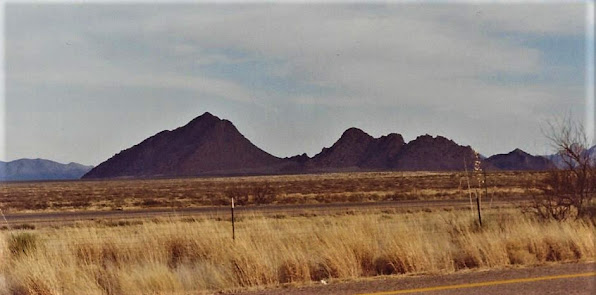 |
| Victorio Peak. Photo copyright by Kevin Randle |
There
had been rumors of a large cache of gold bullion hidden in the San Andres
Mountains for decades. A Jesuit priest, Father La Rue, who was working in the
area around 1800, learned from a sick Spanish soldier that there was a huge
vein of gold some two days from what was then Paso del Norte and now known as
El Paso, Texas. Apparently, La Rue, working with the local indigenous
population, set up a mining operation in the Organ Mountains, which border
White Sands and are just south of Alamogordo, New Mexico, which is north of El
Paso. For two years La Rue mined the gold, stockpiling it nearby.
As
with most such stories there are slight variations to the myth. La Rue discovered
that the Spanish were about to send soldiers to learn what happened to him. Or
the story of the massive wealth that La Rue had acquired found its way back to
the Spanish in Northern Mexico. Nothing stirs the fires of the Spanish conquistadors
in the New World like tales of massive wealth and stacks of treasure. An armed
expedition was sent north to find La Rue and what he considered his gold.
To
prevent the Spanish from taking the treasure, La Rue hid all traces of his
mining activity, hid the gold he had refined into crude bars in a cave and then
sealed the cave’s entrance so that others would not find it. Although there was
talk of his mining the Organ Mountains, it seems more likely that the mine was
in the San Andres Mountains. It was here that the treasure was concealed.
Before
La Rue could escape, the Spanish expedition arrived and attacked. La Rue and
those with him were captured. He was tortured but refused to reveal the
location of the gold. Sometime during the process, La Rue died, and with him,
the exact location of the treasure was lost. All those with him were also
killed without revealing the location of the gold. With La Rue dead, and
without a map to the treasure, the Spanish soldiers returned to Mexico
empty-handed. Although there were those who thought that a proper expedition,
with the resources for a long search would produce results, no one ever
returned to make that search.
Doc
Noss and the Cave of Treasure
Milton
Ernest “Doc” Noss, who claimed he was two-thirds Cheyenne, was born in Oklahoma
and worked throughout the southwest during his life was the man who originally
found La Rue’s lost treasure. Although called “Doc,” he had no medical degree
and was reported to have been arrested in Texas for practicing medicine without
a license. That wasn’t his only trouble with the law or the truth.
Jim
Eckles, who began working for the Public Affairs office at the White Sands
Missile Range, told reporter Carl Knauf, a staff writer for the Albuquerque
Journal, that he had he’d dug into Noss’ background and learned “quite a
bit about Doc Noss.” He had traced Noss from Oklahoma to New Mexico and said that
Noss had been arrested for various crimes. Noss was not exactly the most
reliable of sources.
 |
White Sands Missile Range located near Victorio Peak. Photo
copyright by Kevin Randle |
It
was in 1937, Noss, and his wife, Ova (sometimes called Babe) were living in the
vicinity of Hatch, New Mexico. He spent his time hunting and prospecting in the
area around Victorio Peak, which was not yet part of a government reservation.
During one of those hunting and prospecting trips, Noss was caught in a cold
Spring shower and sought shelter under an outcropping of rock near the summit
of Victorio Peak.
This
was a place that had been used for centuries by other indigenous hunters, not
to mention the Spanish, Mexicans and Americans. Noss saw the evidence of those
earlier hunters but didn’t know if they had lived there long or were just camped
there for the temporary shelter. Sitting there, waiting for the rain to stop,
he noticed a stone that looked as if it had been worked in some fashion. Noss
reached down but at first, couldn’t budge it. He tried digging around the
edges. Given he had nothing better to do, he kept at it until he could work his
fingers under it and lift it.
What
he found was a shaft that descended deep into the darkness of the mountain. Now
he was curious about the shaft, but it was too late in the day to do anything
about it. He was not equipped for a reconnaissance. The next day, he returned
with a flashlight, rope, and a canvas bag. He was unable to probe very deep
into shaft, but he found enough of interest that he wanted to come back.
In
a slightly different version of the story, R.L. Coker told Los Angeles Times
columnist, Robin Abcarian, that he had been with Noss when he made the initial
discovery. He said that he and Noss were at the top of the Victorio Peak
hunting deer. Coker said that Noss knew where there was a spring that the deer
would approach looking for water. Noss said that he felt a breeze that he first
thought might have been a snake, but realized it was coming up from under a
rock. Moving the rock aside, Noss found the entrance into the cave. Apparently,
they didn’t explore it then and I must mention that Coker’s name didn’t come up
in the original tale told by Noss.
In
the days and weeks that followed, Noss returned to the shaft whenever possible.
He did reach the bottom, but his flashlight was inadequate for the task of
lighting the way once he was deep inside the mountain. Eventually, he found an
underground stream but couldn’t see the other side and was initially afraid to
cross it without proper preparation.
On
another trip into the mountain not long after that, he did cross the stream while
Ova waited for him above him. She kept herself busy making coffee and
sandwiches as he searched the cave far below her. Hours later, when he emerged
from the shaft, he had his canvas bag with something heavy in it. He tossed a
black bar on the ground near her, but like Noss, she thought it was nothing
more than lead brick.
Years
later there would be another minor controversy about that bar. Ova, giving a deposition
about the first entry into the cave, said that she was the one who scraped at
it, discovering it was gold. Noss said that he discovered it was gold while
sitting around the fire after having brought it to the surface. Although it
makes no difference today who first found that it was gold, you have to wonder
why he would have carried a lead brick out with him given the descriptions of
the various types of treasure he had found in the cave.
Noss
told Ova there were stacks of the bars in the cave eventually suggesting there
might be as many as 16,000. He said that he had also found uncut gems including
rubies, Spanish coins, and religious artifacts such as a gold Virgin Mary.
There were other manufactured artifacts including swords. He found chests that
held clothes and Wells Fargo strong boxes. He was telling Ova that he had found
a huge treasure, much of it, though not all of it, gold bullion, which is an
interesting point that has often been overlooked.
Noss
was smart enough to know that any news about the find would fill the area with
other treasure hunters, prospectors, con artists and government officials who
would claim the treasure for the United States. There would also be trouble
with the law. In 1937, it was illegal for a private citizen to own gold
bullion. If the word got out about the gold bars, Noss might find himself in
jail on federal charges. He cautioned Ova that they could tell no one about the
treasure because of the real consequences.
But
he didn’t bother to heed how own advice. He showed a gold bar to a friend in what
is now known as Truth or Consequences, New Mexico. When asked if he had found
it in the Caballos Mountains, Noss said, “That’s right.” It wasn’t long before
those mountains were filled with the people Noss had feared would arrive, but
he didn’t care. The Caballos were far from the true site in Victorio Peak.
Noss
was convinced that he had found a huge treasure that would make him one of the
richest men in America. It was difficult to get at the gold and even harder to drag
it out. Some of the bars weighed eighty pounds according to the legend. Still,
he, according to the tale, hauled dozens of smaller gold bars out. He hid them
around the area, telling no one where these bars were stashed. He was trying to
think of a way to convert the treasure into money without violating the law or
alerting others to the location of the gold.
Here
was the real dilemma to the Noss story. He found immense wealth that it would
eclipse the fortunes of the richest men in America, according to what Noss told
Ova at the time. There were coins and jewels that would be of great value to
collectors, which could have been sold to those collectors without violating
any federal law. There was silver bullion hidden in there as well. There were
legal means of disposing of the wealth without mentioning the gold, but Noss
avoided all those. He apparently never consulted with anyone who could have
helped him legally, preferring to enlist the aid of outside investors. He was
willing to spread the wealth around, if he could get his hands on it with their
help.
He
complained that one passage into the treasure cave was so narrow that he had to
crawl forward carefully, his shoulders scraping on the rough stone walls. In 1939,
he hired an explosives expert named Montgomery to widen the passage.
Montgomery, of course, used too much explosive and collapsed the tunnel,
filling it with debris. Access to the treasure room was now impossible by the
original route, but who cared? Noss had already removed enough of the gold to
make him wealthy, if he could just figure out a legal way to convert the gold
into cash.
More
coming in the next installment… “Gold Bars and Tales of Treasure.”


