 |
| Kingman, Arizona. Photo by Kevin Randle |
Like so
many of the crashed UFO tales, this one was originally told by a single witness
without much in the way of corroboration. Or rather, a single identified
witness, and then some testimony from another source that suggests
corroboration. That second witness is second hand, allegedly having heard the
story from her late husband. And then a hint of additional witnesses that
seemed to have leaped on the Kingman bandwagon later. In other words, in the
final analysis, it is not a strong case but seemed to have the potential to become
one.
When first
reported by Raymond Fowler in the April 1976 issue of Official UFO, it
seemed that it might be one of those reports that went nowhere. Without some
corroboration and some documentation, it would be impossible to accept, and it
is next to impossible to verify. Remember, this was 1976 when virtually no one
had heard of Roswell and crashed saucer tales were rejected out of hand.
Fowler,
however, accepted the report because he had interviewed the witness, had a
signed affidavit and a few documents that seemed to support the tale. The man
had an impressive resume and was a respected engineer. The evidence was flimsy,
but it did exist. And that put Fowler, at least in the minds of some, ahead of
most who had found other single witness UFO crash cases.
The first
interview of the witness was conducted on February 3, 1971, by Jeff Young and
Paul Chetham, two young men with an interest in UFOs. In fact, in a newspaper
article published in the Framingham, Massachusetts, edition of the Middlesex
News, Young was identified as a boy writing a book about UFOs for
juveniles. The article mentioned that Young had interviewed a man who had
claimed he worked with Project Blue Book and had even contacted an alien spaceship.
That was a point that was ignored by nearly everyone who investigated the case.
Most failed to mention the paranormal part of the story.
According
to Young, the witness, later given the pseudonym “Fritz Werner” by Fowler to
protect his identity (but known to us in today’s world as Arthur Stansel... I
will use the Werner name throughout to avoid later confusion), had been at the
site of a flying saucer crash about twenty years earlier. Werner, according to
the information provided, was a graduate engineer who had degrees in
mathematics and physics and a master’s degree in engineering. He graduated from
Ohio University in 1949 and was first employed by the Air Materiel Command,
which, according to UFO history, was responsible for the reverse engineering of
the Roswell craft. There seems to be little evidence to tie Werner to any of
that, though he was tied to Dr. Eric Wang, who has been identified in UFO
circles as leading the team reverse engineering UFOs.
During the
Young and Chetham interview Werner first told of just seeing a UFO during one
of the atomic tests in Nevada. Werner and his colleagues had been drinking beer
when they heard a humming and whistling noise and ran outside. The object,
coming toward them, hovered for a while, but they couldn’t tell much about it
because it was night.
During the
initial interview Werner told Young that he had worked for Project Blue Book.
He speculated that Blue Book was created because the Air Force “was getting too
much publicity and there were too many people, other than official people
seeing these things and reporting them.” This observation is untrue. The Army
had created the first official investigation under the code name Project Sign. There
is evidence that an unofficial investigation was started by General Nathan
Twining in December 1946. That investigation evolved into Project Sign which eventually
evolved into Project Grudge and then Blue Book. It was closed in 1969. It would
seem that someone who had worked in that arena would by unaware of the history
of official investigations.
Anyway,
Young and Chetham finally asked specifically about the UFO crash in Arizona and
Werner said, “The object was not built by anything, obviously, that we know
about on Earth. This was in 1954 [actually, according to other information,
1953]. At that time, I was out of the atomic testing, but I was still with the
Air Force and this was the time I was on Blue Book. There was a report that
there was a crash of an unexplained vehicle in the west, and they organized a
team of about forty of us. I was one of the forty.”
According
to Werner, he had been alerted “through official channels and on a private
phone line from the base commander at Wright Field [later Wright-Patterson AFB]
saying that you’re a member of Blue Book and we would like for you tomorrow to
get on a plane, go to Chicago and from there to Phoenix.” According to Werner,
the object had crashed about twenty-five miles from Phoenix. He provided no
explanation for being ordered to Chicago which would take him a thousand miles
out of his way.
The object
was twelve feet long and intact, according to Werner. “It was more like a
teardrop-shaped cigar... it was like a streamlined cigar.” It was made of material
that Werner said he’d never seen before, and it was dull.
Young
mentioned that there had been stories of an object crashing in Arizona and that
one person had claimed to have photographed an occupant in a silver spacesuit.
Werner responded, saying, “I saw the creature you’re talking about. It was real
and I would guess about four feet tall.”
Werner
described the creature as being dark brown and speculated that the skin might
have darkened because of exposure to chemicals in the atmosphere. He saw two
eyes, nostrils and ears. The mouth looked as if it was used “strictly for
feeding,” though Werner didn’t explain how he knew this. He hadn’t gotten a
good look at the body because, at the time he saw it, the military had already
moved it into a tent. He glimpsed it as he walked by the open flap on the tent.
Once he
left the crash site, Werner wasn’t through with UFOs. According to the second
part of the interview, Werner claimed to have contacted other beings from the
saucers. It seemed that Werner had not only seen the body in Arizona but later
conversed with living aliens as he projected himself into one of the flying
saucers. Werner told Young, “Now we’re getting into things where you’ll just
have to take my word for it because I can’t... prove it.”
In
subsequent interviews, Werner didn’t mention his “contact” with UFO occupants.
He would provide those later investigators with an excuse for this, but one
that seems to hurt his credibility rather than help it.
Raymond
Fowler, who later learned of the report though the newspaper, had figured it
was just another tall UFO tale. He received a couple of telephone calls from
friends interested in the case and then decided to investigate it. Fowler
contacted the witness and set up his own interview.
Werner told
a slightly different version of the story to Fowler. None of the changes seemed
significant at the time, and most could be explained as the normal shifts in
the retelling of a tale. However, Werner also made some disturbing claims that
harmed his credibility.
According
to Werner, he was working in the Frenchman Flats area of Nevada when he was
called by his boss, Dr. Ed Doll, and told he had a special assignment. Werner
boarded an aircraft at Indian Springs Air Force Base, north of Las Vegas,
Nevada, and was flown to Phoenix. Once there, he was put on a bus with others
who had already gathered. They were warned not to talk among themselves and
then were driven into the desert to the northwest.
The windows
of the bus were blacked out so that the passengers couldn’t see where they were
going. Werner believed they drove about four hours until they reached an area
near Kingman, Arizona. Night had fallen before they reached their destination.
This is the
first of the problems. Anyone who looks at a map realizes that it would have
been quicker to take them from the Indian Springs Air Force Base to the Kingman
area rather than travel first to Phoenix. I suppose you could suggest that
they, meaning those running the operation, did that to hide the real location.
Or it could mean that Werner’s guess about the location is in error. It might
mean that the real site is somewhere in the Phoenix area rather than in the
northwestern corner of the state.
When the
bus stopped, they climbed out, one at a time, as their names were called.
Although they had been told not to talk to one another, here was an officer
supplying the names of all those on the bus by calling them out. It would
provide those involved with a way of learning more about the assignment after
they were returned to their regular duties because they had the names of the
others on the bus. That seemed to be a curious way to maintain security. It was
a major breach. It also suggests the second of the problems with the Kingman
report.
Werner was
escorted from the bus by military police. Two spotlights illuminated an object
that looked like two deep saucers pressed together at the rims. It was about
thirty feet in diameter and had a dark band running around the center. The
craft was dull, looking as if it was made of brushed aluminum. Werner estimated
that the craft weight about five tons.
There was
no landing gear visible on the underside of the object and no sign of damage to
the craft, although it had slammed into the ground. Werner could see no dents,
scratches, or marks on the surface.
The only
sign of impact was the evidence from the desert floor and the fact that a small
hatch seemed to have sprung open. Werner said the hatch was curved and the
interior of the ship was bright.
Werner made
his examinations, including measurements of the trench the ship had gouged out
of the sand, the compassion factors involved and estimated the weight of the
ship. He believed that the craft had been traveling about twelve hundred miles
an hour when it struck the ground.
According
to Werner, as each specialist finished his examination of the craft, he was
interviewed in front of a tape recorder and then escorted back to the bus. None
of the others was allowed to listen to his debriefing and he was not allowed to
listen to any of theirs.
Before he
got to the bus, Werner saw a tent that had been erected on the site, guarded by
armed military police. Inside the tent was a single body of a four-foot-tall
humanlike being. Werner said it was wearing a silver suit that had a “skullcap”
that covered the back of the head but left the face visible and unprotected.
The skin of the face was dark brown, but again Werner thought the coloration
might be a result of exposure to the Earth’s atmosphere or the effects of the
crash. Allowing Werner to see the alien being is another breach of the alleged tight
security around the site.
It is
interesting to note here that in the descriptions of the aliens, that one theme
is mentioned again and again. The skin is dark brown, and it is believed that
the color is the result of either something to do with the crash, or exposure
to the atmosphere. I’m not sure if this detail is significant. It might be a
coincidence born of thoughts of fire during the crash.
At any
rate, on the way to the bus, Werner had the chance to talk to one of the
others. The man had looked inside the craft. He’d seen two swivel-like seats
and instruments and displays, but that was about all. And here is still another
breakdown of the security measures.
Before
Werner learned much more from the man, one of the guards saw them talking and
separated them, warning them not to compare notes. He did nothing else, such as
getting their names and reporting the security breach to his superiors.
On the bus,
everyone was required to take an oath of secrecy. They were not to talk about
what they had seen or done to anyone at any time. They were then returned to
Phoenix and released to their regular assignments.
Werner
supplied a long professional resume that listed not only his engineering
status, but his educational background and a list of his professional
publications. It suggests that Werner is a highly trained engineer, and it
doesn’t seem likely that he would jeopardize his professional standing with a
hoax about a wrecked flying saucer. However, he didn’t want his name used in
connection with the tale, so it could be argued that he was not jeopardizing his
career and professional standing unless someone learned his real name. His name
didn’t leak for years.
Fowler, in
his report to NICAP, documented several contradictions between what Werner had
told him and what he had said to Young during that first interview. The major
problem was that Werner originally reported that the object was twelve feet
long and five feet high and looked like a teardrop with a flat bottom, not like
two deep saucers fastened together at the rims.
Fowler
pointed out that Werner told him that the object was disk-shaped, thirty feet
in diameter and about twenty feet from top to bottom. Fowler wrote:
When confronted with this
contradiction, the witness appeared flustered for the first time and said that
he had described the object he had seen over Thule, Greenland, to the boys
[Young and Chetham]. I reminded him that he had described the Thule sighting to
me as having been a black disc seen at a distance. He started to insist until I
produced the copy of the transcript, which clearly indicated that he had
described the crashed object, not the Thule object, to the boys. At this point,
he backed down and admitted that he had lied to the boys [emphasis
added]. He said that the description given to me was accurate because I was
really conducting a serious investigation into the matter. In my opinion, this
is the most significant and damaging contradiction without a completely
adequate explanation.
There were
a series of other discrepancies between what Werner told Fowler and Young and
Chetham. Most of them could be attributed to memory lapses, or, as Werner
suggested, his exaggerations to the boys. It wasn’t that he was intentionally
trying to mislead them, he just wanted to tell them a good story. This, he suggested,
was a result of the martinis he had consumed before the interview with the boys
began.
For Fowler,
he produced a page from his daily calendar dated May 20 and 21, 1953. It seemed
to corroborate part of the story. The entries said, “May 20 – Well, pen’s out
of ink. Spent most of the day on Frenchman’s Flat surveying cubicles and
supervising welding of plate girder bridge sensor which cracked after last
shot. Drank brew in eve. Read. Got funny call from Dr. Doll at 1000. I’m to go
on a special job tomorrow.”
The only
interesting point was the reference to the special job given to him by Dr.
Doll. But it doesn’t tell us much and it could refer to practically anything at
all that is slightly out of the ordinary.
“May 21 –
Up at 7:00. Worked most of the day on Frenchman with cubicles. Letter from Bet.
She’s feeling better now – thank goodness. Got picked up at Indian Springs AFB
at 4:30 p.m. for a job I can’t talk about.”
Again,
nothing to suggest that Werner was involved in a crash retrieval, only that he
had some kind of special assignment. And yes, it does seem strange that he
would note in his unclassified desk calendar that he was involved in a special
project that he couldn’t talk about.
Fowler, to
his credit, tried to verify as much of the story as he could. He tried to
verify Werner’s claim that he had worked with Blue Book. Fowler, in his report
to NICAP, explained that he had spoken to Dewey Fournet, a former Pentagon
monitor for Project Blue Book and Fournet had said that he didn’t recognize the
witnesses’ name, but then, he didn’t know all the consultants assigned to Blue
Book over the years.
Since that
proved nothing one way or the other, Fowler talked to Max Futch, who had been a
temporary chief of Blue Book. Futch said that he thought he had known all the
consultants and didn’t remember Werner, under his real name, begin among them.
Importantly, Futch was assigned to Blue Book during 1953, the time frame
suggested by Werner.
On the
other hand, Fowler called three friends of Werner’s as character witnesses.
Each of them said essentially the same thing. Werner was a good engineer and a
trusted friend and never lied or exaggerated. Of course, Werner had
contradicted that himself as he attempted to explain some of the discrepancies
that had developed.
However,
noticing the differences between this interview and that conducted by Young and
Chetham, Fowler had his doubts. Fowler said that he met Werner at his office on
May 25, 1973, to discuss the problems with him. Werner claimed that the
discrepancies were the result of mixing up dates, which he later corrected by
checking his diary.
Werner also
said that he had been under the influence of four martinis when he talked to
the boys. He claimed that when he drank, he exaggerated and stretched the
truth. Fowler checked with Young and was told that Werner had only had one beer
on the day that he was interviewed. Of course, Werner could have his four
martinis before the boys arrived, which is, of course, what he said to Fowler.
While the boys were conducting their interview, he only consumed that one beer.
But what
Werner had done was shoot down his own credibility. His friends said that they
had never known him to exaggerate, but he had said he did, after he had been
drinking. Werner’s explanations for the failure of the corroboration left a
great deal to be desired.
William
Moore, co-author of The Roswell Incident, in his 1982 presentation at
the MUFON Symposium, reported:
Fowler’s source, the pseudonymous
“Fritz Werner” (whose real first name and some of his background are known to
me) claimed that on the evening of May 20, 1953, he received “a phone call from
[his superior] Dr. Ed. Doll, informing [him] that [he] was to go on a special
job the next day.” When I asked Fowler if he had checked this part of the story
with Dr. Doll, he responded that his efforts to locate Doll had been
unsuccessful.
In fact, in
his report, Fowler said that he had confirmed that Doll existed, that Doll had
been an employee of the Atomic Energy Commission and had been at the Stanford
Research Institute. It seems unlikely that Werner would name a man for
corroboration who could, if found, tear his story apart quickly, but that was
what Gerald Anderson had done with his Dr. Buskirk during Anderson’s claim or
having seen a wrecked UFO on the Plains of San Augustin. The inconveniently
alive Buskirk told me that he had not been part of a UFO crash/retrieval in New
Mexico and that Anderson had taken his anthropology class at the Albuquerque
High School.
But I
digress.
Moore said
that it took him just four days to locate Doll, and that he met with him on
October 9, 1981. Moore asked him what he knew about the incident near Kingman,
and Doll said that he knew nothing about it. Moore then asked him about Werner
using his real name and wrote, “I was somewhat taken aback by his flat
statement that no one of such a distinctive name and rather distinguished
technological background had ever worked at the Nevada Test Site.”
Moore then
dismissed the Kingman story, writing, “I don’t know quite what to make of this
case... since my own investigations into the matter have produced nothing but
dead ends... I am inclined to spend my time pursuing more productive matters.”
The single
glaring error in Moore’s analysis is the claim that Fowler’s source has a
distinctive first name. In the past year I have located a signed copy of the
affidavit, along with the professional resume, and a full analysis of the case
by Fowler. In other words, I have Fowler’s source’s name, Arthur Stansel, and
there is nothing distinctive about it. Of course, knowing how Moore operates,
it might be he said first name and actually meant last name, which is
distinctive. It seems that Moore’s claims about the case might be without
foundation, which complicates the matter.
In fact, I
have learned quite a bit about Moore in recent years, and without something
more definitive than his uncorroborated statements, I am inclined to reject
Moore’s analysis. It might be nothing more than an attempt to reject other
tales of crashed saucers to keep the Roswell case as the most important UFO
crash case. In fact, it might be an attempt to return it to its unique status.
Remember
too, that in 1989 Moore claimed to have operated as an unpaid agent of
disinformation. He told researchers that in his role, he had spied on fellow
researchers, supplying information about them to the Air Force. He engaged in a
deception directed at another researcher to discredit him. And he said that he
had supplied disinformation to researchers to divert them into areas that would
provide nothing useful. MJ-12 anyone?
It doesn’t
really matter if Moore was telling the truth about these activities because no
matter how you slice it, he has killed his own credibility. If what he says is
true, then we can’t believe much of what he says because we don’t know what is
tainted by his association with these other agents of disinformation. And, if
he is not telling the truth about this, then what else has he been less than
candid about. It is the classic lose-lose situation. And the point is that
Moore is the one who created it the mess.
Len
Stringfield, however, found another witness who corroborates part of the
Kingman story. According to Stringfield’s monograph, Retrievals of the Third
Kind, Cincinnati researcher Charles Wilhelm said that a man identified only
as Major Daly had told Wilhelm’s father that in April 1953, he had been flown
to an unknown destination to examine the remains of a crashed flying saucer. He
had been blindfolded and driven to a point out in the desert where it was hot
and sandy. Inside a tent the blindfold was removed, and he was taken to another
location where he saw a metallic ship, twenty-five to thirty feet in diameter.
He saw no signs of damage. He spent two days analyzing the metal from the ship,
which he claimed was not native to Earth.
 |
| Len Stringfield |
Daly was
not allowed to enter the ship, though he did note that the entrance, or hatch,
was about four or five feet high and two to three feet wide and was open. When
he finished his analysis, he was escorted from the area.
Daly’s
information didn’t agree exactly with that given by Werner, but it was close
enough to raise some questions. The discrepancies can be explained by the point
of view of the teller. He saw things from a different angle and his experiences
were slightly different. It does seem to provide some corroboration for the
Kingman crash story. The real problem is that it is second hand, at best, and
that moves us right back into the realm of Gerald Anderson. His story seemed to
be corroborated by a series of second-hand sources, all of whom were
unavailable for independent review. In fact, no one knows if Daly exists, or
existed at all though I will note that Len Stringfield was a careful investigator.
Stringfield
also reported on a man who was in the National Guard (though I wonder if it
wasn’t the Air Guard, a distinction that those who haven’t served in either
might not make) claimed that he saw the delivery of three bodies from a crash
site in Arizona in 1953. He mentioned that the creatures had been packed in dry
ice, were about four feet tall with large heads and brownish skin, which does
corroborate Werner to a limited extent.
Stringfield,
in his 1994 self-published monograph UFO Crash/Retrievals: A Search for
Proof in a Hall of Mirrors, reported still another claim of the Kingman
crash.
According
to him, “My new source JLD, a resident of Ohio, north of Cincinnati, in a
surprising disclosure claimed that a close relative, the late Mr. Holly, who
had served in a top command (in a defense department capacity [whatever that
might mean]) at Wright-Patterson in 1953, told him about one of two crashes in
Arizona. He also told him three bodies, one severely burned, and parts of the
wrecked craft, were delivered to the base.”
Those two
reports, Major Daly and JLD are the classic friend of a friend stories. The
information doesn’t come from the source, but from someone else who heard it
from someone else and when you are that far removed, the chances for mistakes,
misunderstandings and confabulation increase. Yes, the information is interesting,
and it does provide some corroboration, but the fact is, such reports are quite
dubious.
There is
more second-hand information about Kingman. A woman, June Kaba, who worked in
the Parachute Branch (WCEEH-1) at Wright-Patterson Air Force Base, reported
that a sergeant, who she didn’t identify, and who had a special clearance
needed to enter the office, claimed that he had just come in on a flight from
the Southwest. Thinking about it years later, she had believed he was talking
about the Roswell crash, but an examination of her work history documents,
supplied to me, showed that she had not been working at Wright-Patterson until
the early 1950s.
Further
checking suggested that the incident she remembered took place in late 1952 or
early 1953. The sergeant told all the people in that small office about
bringing alien bodies to Wright Field. Naturally, the people in the office
didn’t believe the story because it was so outrageous.
Within an
hour, however, the base commander, Colonel (later Brigadier General) C. Pratt
Brown, arrived at the office. He explained the story the sergeant told was just
rumor and speculation and that no one was to repeat these wild rumors anywhere.
In fact, he brought an official form for them to sign, explaining that they
were not to report what they had heard under penalty of a $20,000 fine and
twenty years in jail.
The problem
is clearly that the secretary did not remember the exact time frame, location
or the name of the sergeant. To suggest this was part of the Kingman case, we
must resort to speculation based on the limited documentation of her employment
experience at Wright-Patterson. The only crash that fits is the Kingman event,
and the connection to it is extremely weak.
And the
colonel coming around to tell them to forget it, the story is just a rumor and
then demanding they sign statements, is another problem. The only thing the
colonel did was tell them the story is true. He hadn’t come around to stop other
rumors, only this one. Then he underscored the importance of it by demanding
they take an oath of secrecy.
The Kingman
case has been blundering along on the periphery of legitimacy for several
years. It would be easy to write it off, especially with the problems of the
Werner account, if not for another source, this one discovered by Don Schmitt.
During
research into the abduction phenomenon, he learned of a woman, Judie Woolcott,
whose husband had written her a strange letter from Vietnam in 1965, believing
that he wouldn’t be coming back from overseas.
According
to her memory of the letter, he had seen something strange twelve years
earlier. Judie Woolcott thought that it had been August 1953, and although she
might be mistaken about the month, she was sure that it happened near Kingman.
Her husband, a professional military officer, was on duty in an air base
control tower. They were tracking something on radar. It began to lose
altitude, disappeared from the screen, and then in the distance there was a
bright flash of white light.
Woolcott
wrote that the MPs began talking about something “being down” in the desert.
Woolcott and most of the men in the tower left the base in jeeps. They drove in
the general direction of the flash, searching. Eventually they came upon a
domed disk that had struck the ground with some force, embedding itself in the
sand. There didn’t seem to be any exterior damage to the craft, and there was
no wreckage scattered on the ground.
Before they
had a chance to advance, a military convoy appeared. Woolcott and those with
him were stopped before they could get close to the disk. They were ordered
away from it and then escorted from the site. They were taken back to their
base, where they were told that the event had never happened, and they had not
seen anything strange. Just as others have been in the past, they were sworn to
secrecy under severe penalties if they revealed what they knew.
Woolcott
didn’t write much more in the way of detail. There didn’t seem to be any
external reason for the craft to have crashed, and he didn’t see any bodies.
But there was talk about them. Some of the military police said that there were
casualties that were not human. Woolcott made it clear that he hadn’t seen
them, he’d just heard talk.
The letter
indicated that he knew more but didn’t want to write it down. According to Judie
Woolcott, about a week later she learned that he had been killed in action.
Here was a
source who allegedly knew nothing about the Kingman case who was able to
provide a little more information about it. Although the time frame is off
slightly, it is interesting that she was sure of the location. During his
interview with her, Schmitt said that she brought up Kingman, and that stuck
because he thought about calling Ray Fowler when the interview ended.
I need to
note here something that I find curious about this end of the report and that
is that Judie Woolcott doesn’t have the letter. It would seem to me that one of
the last communications with her husband would be of significant sentimental
value. It would be something that she would want to keep, even if it took a
trip into the unusual by mentioning a flying saucer crash. That document, dated
in the mid-1960s, would be of value to researchers.
But nothing
is ever easy in this search for corroboration.
On June 1,
2010, I heard from the daughter Judie Woolcott, Kathyn Baez. It was at that
point that the entire tale told by Woolcott blew up. Baez said that her stepfather William
Woolcott was not only still alive, but he had not served in Vietnam. And, he
had not married Judie Woolcott until 1980, so he hadn’t written to her about
his involvement in the Kingman UFO crash.
Baez said
that her father was Elmer E. Fingal who was born in 1938 and had been in his
mid-teens in 1953. He hadn’t been working in an air traffic control tower in
1953, so he could not have been the man who wrote the, what I now think of as
the “nonexistent,” letter. According to Baez, her father had served in the
Navy. He died in 2006, which took him out of the running as well.
But because
nothing is ever simple in the world of UFO crashes, especially those in
Arizona, there is another man involved in this. According to a man who calls
himself “The Wanderling,” this man wasn’t married to Woolcott, but was a
soldier and close friend who killed in Vietnam in 1965.
According
to the research conducted by Rudiak and which takes us to a website hosted by
The Wanderling, we learn that Woolcott’s Vietnam correspondent was not her
husband but a friend she met when she lived in Wisconsin. This man, an Army
captain named Charles Alan Roberts, was killed in Vietnam and was old enough to
have been in a control tower, which suggests he was the source of Woolcott’s
tale. She lied about him being her husband because they had a thing going on.
The alleged letter was not released by Woolcott because there was some personal
information in it that she didn’t want out in the public arena. She was hiding
it from her then current husband or her family because of those personal
comments.
Roberts’
military career is well known. There is nothing in his background that would
have put him in a control tower near Kingman in 1953. His military assignments
do not put him in that area and while there is a gap for 1953, there is nothing
to suggest he had any training as an air traffic controller, that he was an Air
Force officer at the time or that would provide a reason for him to be in a
control tower. This is just another of those rabbit holes that lead away from
any relevant information
Baez said
that her mother liked to embellish stories and that her tale of a mysterious
letter from a husband killed in Vietnam was another of those tales. In fact, Baez
told me that “I often felt that my mother sensationalized her life for which I
didn’t agree, and we would often butt heads.”
This meant
we were back to one witness for the Kingman crash, and by his own words, he
liked to embellish his stories, especially after he had been drinking. While I
had once thought there was something to the Kingman UFO crash, there simply
wasn’t any corroboration for it.
So, why
bring all this up now? Well, Christopher Mellon, who is described as a former
Deputy Assistant Secretary of Defense for Intelligence, released an email
exchange that was partially redacted. We don’t know who the recipient was other
than a senior member of the government but given what we have seen of senior
government officials in the last decade or so, I’m not sure that it is
particularly impressive.
In the
email he wrote, “Right now we haven’t gone that far back. We’re dealing with
the recovered UAP that landed in Kingman, Arizona in the 50s… We now know the
management structure and security control systems and ownership of the C/R.”
He
continued, “We also know who recovers landed or crashed UAPs under what
authorities. We also know that a still highly classified memo by a Secretary of
the Air Force in the 1950s is still in effect to main the cover on UAPs. We
also know the SES-2 who’s the Air Force gatekeeper.”
 |
| The Mellon email. |
That email
tells us nothing that we didn’t already know or what we suspected, and it does
not provide names or organizations. We could, of course, learn the names of all
the Secretaries of the Air Force in the 1950s, but I suspect all of them are
dead by now. We can’t verify much of anything, and it provides us with no real
corroboration.
I’ll note
here that Mellon is associated with others who have been identified with
current UAP research including crash/retrievals. This means that Mellon heard
about Kingman from those others. We’re still left with no first-hand witnesses
other than the unreliable Arthur Stansel. We have a former official suggesting
that there was a UFO crash near Kingman.
It did, however,
send me and later David Rudiak down several additional rabbit holes that do not
confirm the crash but do supply several strange incidents. We both were trying
to learn more about the Kingman crash and in the search from that information,
we came up with two names of proponents of that claim, Preston Dennett and
Harry Drew. I reached out to both.
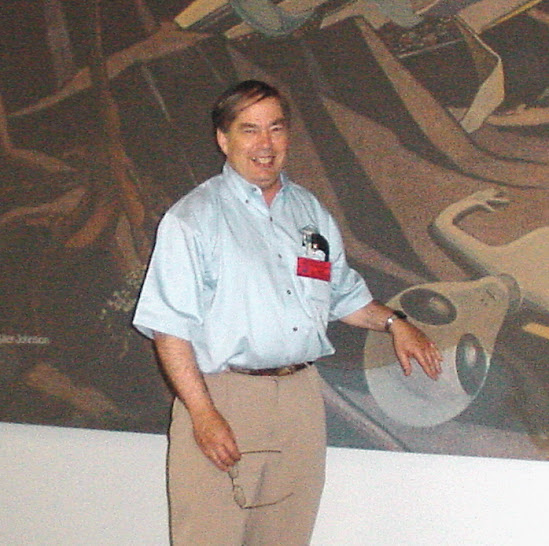 |
| David Rudiak. Photo by Kevin Randle |
Drew, who
had been researching the Kingman crash for years, suggested that not one, but
three UFOs had crashed in Arizona in a short period of time. Drew wrote that
one of those craft had been destroyed when it flew into a mountain, a second
had hit a rocky butte and fell into a reservoir and the third had found embedded
in the sand intact. The military had recovered one of them and took it to
Nevada, which I suspect is an oblique reference to Area 51.
The second
man, Dennett, is still alive and posting to Facebook. I have attempted to
contact him several times through Facebook and his website but have not
received a reply. In interviews conducted by the media, Dennett was clear in
his belief there had been the crash of an alien spacecraft. But there was no
clear evidence that such was the case.
David
Rudiak made a detailed search of the newspaper files for the time, beginning in
1950 and working toward 1953. He found no hints of a crash in any of those
newspapers though he did find some strange events recorded in them. None of
these strange events, some of which hinted at an alien presence, related to the
crash/retrieval stories.
What he did
find was Harry Drew’s claim of three crashes in six days in May 1953. There was
another crash in the area, in June 1950 in which the UFO crashed into Hualapai
Peak. Drew seemed to claim that the first of the “Kingman crashes” happened on
May 18 southeast of Kingman. Drew thought this wasn’t so much a crash as a
landing. An Air Force recovery team arrived within two hours of landing.
The second
crash was north of Kingman on May 21, 1953. This is the tale told by Arthur
Stansel. According to Drew, those involved in the recovery only spent a short
time on the crash site and were told this was a secret Air Force project. That
didn’t show up in the early interviews with Stansel.
The third
crash took place on May 24. This is another craft that was alleged to have been
brought down by a high-powered radar that was being tested in the area. Where
have we heard this claim before? According to those who believe the 1948 Aztec
crash was real talked about how radar brought down that craft.
What Rudiak
didn’t find was any newspaper references to a crash in the Kingman area in May
1953. Roswell, on the other hand, was announced in newspapers around the world
at the time of the event. There are pictures of some of the primary players in
the Roswell case that were published then. Kingman, not so much.
For those
who wish to chase this down the rabbit hole, Rudiak sent me a link to a website
that discusses some of this. While it tries to make a case for the Kingman
crash, it just finds additional rabbit holes to explore.
The research
that David Rudiak and I began after Mellon’s leaked email, which, as I noted, inspired
this investigation, provided no new evidence for the Kingman crash. I’ll
provide additional links for information at the end of this post. They’ll
provide a range of opinions. You’ll have to decide which information you find
reliable.
David, I
believe, believes there might be something valuable in continuing the Kingman
investigation. I fear that there was no crash simply because the main source,
while an accomplished man, admitted to inventing exciting tales while he was
drinking. I also worry that, without additional testimony, if it exists, we’ll
never be able to learn the truth about this case.
The
following links will provide some of the latest information about the Kingman
case.
https://the-wanderling.com/woolcott.html
https://army.togetherweserved.com/army/servlet/tws.webapp.WebApp?cmd=ShadowBoxProfile&type=Person&ID=66286
https://kevinrandle.blogspot.com/2024/09/kingman-ufo-crash-and-michael-schratt.html
https://kevinrandle.blogspot.com/2024/08/kingman-skeptics-and-uap.html
https://kevinrandle.blogspot.com/2024/09/david-rudiak-kingman-ufo-crash-and.html
https://kevinrandle.blogspot.com/2024/08/the-kingman-ufo-crash-connumdrum.html
https://kevinrandle.blogspot.com/2010/05/kingman-ufo-crash.html
https://kevinrandle.blogspot.com/2021/03/kingman-rises-from-dead.html
https://kevinrandle.blogspot.com/2011/05/kingman-ufo-crash-really.html
https://kevinrandle.blogspot.com/2010/06/kingman-ufo-crash-revisited.html
I will note
here that embedded in these links are additional links to relevant postings and
links to interviews conducted on my radio show/podcast that dealt with some
aspects of the Kingman case.
I am
interested in the opinions of others on this case. David and I disagree on some
aspects of it, but we can work together to learn more. Let me know what you
find and where you disagree… Of for that matter where we agree.


