Showing posts with label Jesse Marcel Jr.. Show all posts

Thursday, February 03, 2022

'X' Zone Broadcast Network - William Puckett


This week I invited William Puckett on the program to talk about what was happening in the world of UFOs.  He hosts a website, www.ufosnw.com, on which he posts sighting reports made to him. Many of them include pictures and videos of those sightings that allows the reader to decide if the object is something strange or something that has a terrestrial explanation. You can listen to the show here:

https://www.spreaker.com/episode/48569631

Before I brought on William, I mentioned something that bothers me. I have been

William Puckett

working on a book Understanding Roswell, which is a deeper look into the backgrounds of some of the witnesses. The dilemma is what to say about someone’s background in this world of cancel culture. I’m thinking specifically of Jesse Marcel, Sr., because it seems, based on everything that we have seen, read and heard that Jesse tended to spin a tale or two.

I mentioned specifically, the tale about preforming an appendectomy on a soldier while being given the instructions by a surgeon using the radio. In Linda Corley’s book, For the Sake of My Country, she mentioned Jesse beginning to tell the story and his wife, Viaud, saying something about it, suggesting she didn’t believe it.

There are other areas of embellishment that can’t be proved and, in some cases, have been disproved. I hesitate to mention all this because of the family. Jesse

Jesse Marcel, Jr.

Marcel, Jr., was a man of great integrity. I know of no embellishments he made to his testimony about the UFO recovery.

The other side of this is that Jesse Marcel Sr. telling of his involvement in the retrieval isn’t stand along. There are many others who talked about those events, corroborating what Marcel, Sr. said. If we didn’t have that additional testimony, we could easily reject all that Marcel, Sr. said. There doesn’t seem to be much in the way of embellishment to that tale.

My hesitation is what good does it do to mention all this? It doesn’t alter the case, which, if it was stand alone, it certainly would. Take Marcel out of the picture and we still have every member of Colonel Blanchard’s senior staff that we were able to interview suggested it was something extraterrestrial other than a single officer.

William mentioned that he had the opportunity to interview Jesse, Jr. a number of times found him, as did I, an honest man. Jesse, Jr. was a good man, and if he was still alive, I probably would have kept some of the trouble with Jesse, Sr. to myself. As it is, in the upcoming book, Understanding Roswell, I look at this a little more deeply.

When we finally got around to talking about William’s website and experiences, I asked about the Star Link Satellites because it seemed they were responsible for a number of UFO sightings. Such reports had become so common, that William stopped noting them at his website. There are some pictures of those satellites on his website.

We talked about the number of pictures that have been reported over the last few years. William explained that there was a way to determine if a picture had been manipulated by looking at the meta data available. If there had been an alteration, that could be determined and the photo could be rejected. He also said that he doesn’t post pictures that are obvious fakes.

One of the interesting things he mentioned was that in many cell phone pictures of anomalous green objects might be an artifact from the camera. When the camera was pointed, more or less, in the direction of the sun, the “lens flares” tended to manifest as something green.

I also asked if the upswing in triangular-shaped objects might be the result of some sort of evolution in terrestrial aviation technology. It seemed to me that with so many sightings of them in the world today, it might be a new technology that is Earth-based, rather than something interstellar. He had noticed a similar trend.

He did provide information on a couple of interesting cases that suggested EM Effects as well. It was a wide-ranging conversation. There is a link to EM cases on his website, and, of course, my book, Levelland, is all about EM Effects for those interested in pursuing that line of investigation.

Next week, I’ll be talking with Dr. James Horan, who has done some scientific research into the Roswell case in general and the Ramey Memo in particular. He is also the editor of the Journal of Scientific Exploration. We’ll delve into the Ramey Memo and some of his other UFO investigations. If you have questions, put them in the comments section of the blog. I won’t post them, but will try to get them answered.

Sunday, July 08, 2018

Jesse Marcel's Journal

Jesse Marcel, Sr.
As you all know, one of the problems with the Roswell case is that we have been unable to find any letters, diaries, journals, or notes that were written in 1947 that would tell us about the crash. There have been hints about this, but to this point, none of those hints produced anything that is conclusive. Inez Wilcox, wife of the Roswell sheriff, had written a story about her “four years in the county jail,” talking about what it was like to be the wife of the sheriff. Although the original article contained nothing about the crash, she added a page later that talked about that. Unfortunately, the document was undated, so didn’t help us at all. She could have written her story sometime after 1978 when Jesse Marcel, Sr. told Stan Friedman and Len Stringfield about picking up pieces of a flying saucer in New Mexico.

Jesse Marcel, Sr. Photo
copyright by Kevin
Randle.
Now I learn, through emails sent to me by several colleagues, that we might have some of those documents. Christina Stock reported in the Roswell Daily Record, that Marcel Sr. might just have left that sort of documentation. Jesse Marcel III, the grandson of Jesse Sr. and son of Jesse Sr., announced that they had found a “treasure trove” of documents relating to his grandfather’s military service, including a journal kept by the senior Marcel. If such a journal contains references to what he saw on the Brazel ranch that day in July 1947, and if it contains descriptions of the find, and if it makes any reference to alien beings, that would be huge. Here would be a document that contains information written in 1947 while still fresh in the mind and that would not be contaminated by everything that followed when the Roswell case exploded into the mainstream in the late 1970s.


As I say, this could be the sort of documentation that we all have been waiting for. True, it’s not something official from the US government, but it would be something written in the proper time frame and that would make it a very important document. The lack of any thing like that, written at the time in the form of letters, diaries or journals, has always been a worry for all of us. If this pans out, it might be the key to unlocking the mystery.

Saturday, May 14, 2016

Lt. John (Jack) Trowbridge and Roswell

In the early 1990s, we, meaning Don Schmitt, Stan Friedman and I were having a debate with John Keel about what had fallen in Roswell. He was suggesting it was a Fugo Balloon, that is, a Japanese Balloon Bomb. Research quickly disproved this, though Keel did hang onto the answer longer than I thought necessary. He did write one thing that was important. In the January 1991 issue of Fate, on page 67, Keel wrote, “I suppose by 1999 there will be thousands of Roswell witnesses from that long-gone era.”

Turns out that Keel was right about this. You might ask yourself, “But why bring it up now, some twenty-five years later?”

It is because, as many of you know, I have just completed a book about the Roswell case as it exists in the 21st century, and though I tried to get to everything, there is just so much that I missed a few things. One of those was the testimony of
Lt. John P. Trowbridge
the late First Lieutenant (later Lieutenant Colonel) John P. “Jack” Trowbridge. He had been assigned to the 509th Bomb Group in 1947 and in 2007 he said that he was one of the intelligence officers working with Major Jesse Marcel. He claimed that he had handled the “memory metal” debris that some have mentioned in the past.

He also claimed that he had been over at the Marcel’s to play bridge that night in July 1947 but Jesse wasn’t there at the time. It was fairly late in the evening when they broke up the game because Marcel finally had returned. They apparently went outside to see what Marcel had brought home.

He told Greg Bishop and Nick Redfern at their UFO Mystic blog, “It was aluminum in appearance, there were fragments of aircraft-skin or whatever the thing was, and also some girders, with pictures of… hieroglyphic-like things on it. I took them to be… you know… who knows?... [I]t was interesting. I could get my hand on the material. And the material had some peculiar properties… For example they looked like [Hershey bar] wrappings [very thin foil]… But you squeezed it up in your hands as hard as you could, you let it go, and it returned… to the original shape. Instantly!”

He went on to claim that Marcel brought in some of the debris the next day and they all played with it and then went back to work. Later in the day they were told that nothing had happened and they should not talk about it.

According to that article and then to his obituary, he had been the last known survivor to personally have inspected the debris. This was “a secret he kept for 50 years.”

And I say nonsense. It is the proof of Keel’s theory that more and more people would come forward to tell their tales of seeing the alien debris or the bodies of the alien creatures as time passed.

We know, based on the testimony of Jesse Marcel, Sr., Jesse Marcel, Jr., and Viaud Marcel that this bridge game didn’t happen because none of them ever mentioned it. Jesse Jr. told me, as he did many others, that his father woke him up to show him the debris. He never mentioned other people being there that night or seeing the memory metal that Trowbridge mentioned. His mother didn’t report that either and when Jesse Sr. was interviewed by Linda Corley, there was no mention of any of this.

I have searched through the 509th Unit Histories for the summer of 1947 and I could find no reference to Trowbridge as part of the intelligence section. To be fair, few names were mentioned in those various reports, so it is possible that he was assigned to intelligence but simply not mentioned. I do know that he was assigned to the Headquarters, but then those who had jobs at the group level or in the supporting organizations such as the JAG, or Finance were assigned there for purposes of accounting, pay and the like.


Given the lack of mention of many of the things that Trowbridge claimed, that no one suggested a bridge party on that night, that his account varies from those given by the Marcels, and that he has some of the other facts wrong, I find this account to be unreliable. It is as John Keel said so long ago. There are many people coming forward with their tales of seeing the bodies, seeing the craft or handling the debris, and unless there is some form of corroboration, these stories should be rejected.

Saturday, May 03, 2014

The Last of the Roswell Witnesses


Just the other day I saw or read something that suggested that the Roswell investigation has transitioned into a new phase with the recent and untimely death of Jesse Marcel, Jr. It was suggested that he was the last of the first-hand witnesses, having held the metallic debris and having heard about the find on the Brazel (Foster) ranch from his Army Air Forces intelligence officer father.

But I realized that this isn’t true. While I know that this will generate discussions that have little to do with the posting (I mean look how far afield some of the others have roamed), I would suggest that there are still some first-hand witnesses alive.

The first one who springs to mind first is Frankie Rowe. As a twelve-year-old girl during that July of 1947, she had the opportunity to handle a piece of metallic debris found by a state police officer. She also heard the story of the crash from her father who had driven out to the crash site on his own… which explains why there was no record of the Roswell Fire Department involvement. And please remember that this was confirmed by a member of the Fire Department in interviews conducted by both Tony Bragalia and me (and no, we really don’t have to go through all that again, this simply means that whatever you think of the tale, Frankie didn’t invent it, which also doesn’t mean it was grounded in reality… I’m just trying to prevent the round robin arguments that this can generate.)

I also think of Sally Tadolini, daughter of Marian Strickland, who handled a bit of material recovered by Bill Brazel. Brazel had brought it by and showed it to a number of people. Tadolini signed an affidavit about this, including a description of the debris that when fully read doesn’t suggest something of an earthly manufacture. And yes, I know that signing an affidavit doesn’t make it true, but it does provide us with a concise description of the event. There really should be little dispute about this. There is no indication that Tadolini is not telling the truth… the dispute is about the origin of the material that she saw.

Both of these women were shown bits of metallic debris and both are still living. True, they didn’t see anything quite as dramatic as that suggested by Jesse Marcel, but they did see something that was different enough and exciting enough that they remember the event. We can argue about the reliability of now more than sixty-year-old memories later.

I will note that in the last year or so Tony, Tom Carey and I have talked with a number of the men who were stationed at Roswell in 1947 and who were lower ranking which, in many cases simply meant younger. One of them, who was 87 when I talked to him told me that everything was, “Hush hush. They told us to keep our mouths shut.”

He also said, “Everything was highly classified.”

Which, of course, could mean many things and he provided no new information. We were talking about the crash and the like, so I can say with some confidence that his comments were related to that. But learning only that something was highly classified, especially at the only atomic strike force in the world at the time, doesn’t move us any closer to learning what happened.

Other interviews have contained the same sort of information. We can conclude that something happened and the soldiers were warned about talking too freely. Others said they remembered nothing or heard nothing and weren’t involved.

The point is simply that with the loss of Jesse Marcel, we see the end of the road. The numbers of witnesses to the events are slipping away and we are left with the descendants who heard the stories from those first-hand witnesses. We haven’t reached the end of that road yet, but time is not on our side. I just wanted to correct that statement that we have no one left. 

Wednesday, January 22, 2014

Philip Corso and The Day After Roswell, Again


(Blogger’s Note: In the last few days I have been asked about Philip Corso and his tales of seeing the Roswell bodies and of seeding alien technology into American industry. I have updated the information to reflect what we now know. This is my take on the stories Corso told, and once again, I find myself attempting to explain why I don’t accept what he said as real.)

As everyone now knows, Philip Corso burst on the Roswell UFO scene in the summer of 1997 with the publication of his book, The Day After Roswell. It was Corso’s story of his involvement with the flying saucer crash at Roswell, first as an officer at Fort Riley, Kansas, and later as a staff officer in the Pentagon, the Eisenhower White House, and finally on the staff of Lieutenant General Arthur Trudeau. Corso claimed that he had been responsible, under orders from Trudeau, for leaking bits and pieces of alien technology to American industry for reverse engineering, duplication and replication.
There is no doubt that Corso had served as a military officer and rose to the rank of lieutenant colonel. He served in World War II and stayed on active duty until he retired and did work for Trudeau. Although he did say that he had retired as a full colonel, there is no evidence to back up this claim.
It was during his assignment at Fort Riley that Corso was introduced, according to him, to the alien crash at Roswell. Corso, again according to him, was an above average bowler and because of his skill was invited to participate on a Fort Riley team by then Master Sergeant Bill Brown (which is a name nearly as common as John Smith for those who wish to attempt to learn more about this guy). Corso was surprised because enlisted men weren’t supposed to fraternize with officers at that time, but apparently Corso’s skill was such that the master sergeant took a chance and breached military protocol.
The friendship that developed between Corso and the master sergeant, who he now called by the nickname Brownie, would play an important role in what would happen on the evening of July 6, 1947, after the arrival of a “secret” convoy. Corso was assigned as the post duty officer, in charge of security and as he described it, the “human firewall between emergency and disaster.” As he walked his post, checking the security, he failed to find Sergeant Brown where he was supposed to be. Instead, Brown was in the doorway of the veterinary clinic. There was something inside that Corso just had to see.
Forget for the moment that Brown would have had no reason to enter the building unless there was some sort of a disturbance inside, or that the secret convoy of five “deuce and half” (two and a half ton trucks) with its accompanying “Low boy” side by side trailers would have been guarded by the men who brought them to Fort Riley to ensure that the contents were not compromised. Forget also that the best evidence suggests that the material from the crash was shipped by air to its various destinations because it was the quickest and safest way to move it and the 509th Bomb Group had access to a wide range of military aircraft. Corso, in his first-hand account, claimed that the convoy stopped at Fort Riley, and the Military Police assigned to it as guards were all armed, which, of course, they would be so that wasn’t unusual. These guards, once the material was secured in the veterinary clinic, apparently abandoned their posts to leave the guarding of the crates to the local soldiers. These guards would have been no reason to unload the cargo, so there is no reason that it would have been in the veterinary clinic but without this wrinkle Corso’s story collapses.
Those local soldiers, being curious men, began to search the material from the top-secret convoy. What they found so upset them that they risked the wrath of the post duty officer and court martial by telling him that there was something he had to see. Brown told Corso that he had to take a look at what the convoy was transporting. Corso warned Brown that he wasn’t supposed to be there and had better leave. Brown, apparently ignoring this advice, which would actually have the force of a lawful order, said that he would watch the door while Corso snooped.
Inside the building, Corso found the crates but hesitated at prying open any of them, which would have been closed with a seal to expose any tampering. He searched among them until he found one that had apparently already been opened by the Fort Riley soldiers so that the nails were loose. He opened that crate and then looked down inside. In a glass tube containing a blue fluid, floating, suspended, was what Corso thought, at first, was a small child. Then he knew it wasn’t a child, but a human-looking creature with “bizarre-looking four-fingered hands... thin legs and feet, and an oversized incandescent light bulb-shaped head...”
Rifling the crate, Corso found an Army Intelligence document detailing that the creature was from a craft that had crashed outside of Roswell, which also doesn’t make sense. The documents wouldn’t have been stashed in a crate carrying the body. The paperwork appeared to manifest the remains, first to the Air Materiel Command at Wright Field, and then to Walter Reed Hospital for what Corso believed would be autopsy (which is in conflict with data provided by the late and former Brigadier General Arthur Exon). Of course, such a manifest would have been in the hands of the convoy commander rather than stuck in a crate where he wouldn’t have easy access to it. Corso, realizing that he was not supposed to have read the document, seen the creature, opened the crate, or penetrated the security around the cargo, put everything back the way he found it, and hurried outside. He told Brown that he had seen nothing and that he Brown, was to tell no one.
That wasn’t, of course, Corso’s last brush with the Roswell case. It was however, more than a decade before he again saw anything dealing with Roswell. Instead he had a number of military assignments, moving him to Washington, D.C., and then to Fort Bliss, Texas. At Bliss he was trained in anti-aircraft artillery, then assigned as an inspector of training and finally assigned as battalion commander for several weeks before he was reassigned to Europe. While at Bliss, according to Corso, he was assigned as the commander of the White Sands Missile Range. At least that is what he told reporters in the summer of 1997 as he was describing his background for them.
In Germany, in 1957, he was a commander of a Nike battalion. In March, 1959, he became the Special Assistant to the Chief of Staff at the Seventh Army Headquarters. In May 1959, he became an Inspector General at Seventh Army HQ, and continued in that assignment for about a year. In 1960 he returned to the United States. In 1961, he was assigned as a staff officer of the Plans Division in Washington, D.C. and then as a staff officer of the Army’s Foreign Technology Division until April 1961 when he became the Chief of Foreign Technology. Three months later he was reassigned as a staff officer at Plans and less than a year later he retired.
It was during the tour in 1961 that he became involved, once again, with the Roswell case. According to an affidavit prepared by Peter Gersten, and according to Corso, “...In 1961, I came into possession of what I refer to as the ‘Roswell File.’ This file contained field reports, medical autopsy reports and technological debris from the crash of an extraterrestrial vehicle in Roswell, New Mexico in 1947.”
Corso’s job, in 1961, was to parcel the debris into American industry hands for research and development which doesn’t explain why he was exposed to information that was irrelevant to his assignment and in violation of the “Need to Know” rule. The idea here was to suggest to various companies that the small artifact or metal had come from an unknown source, which of course shows that there was no need to provide Corso with the background of a UFO crash. The expertise of the scientists at the companies was supposed to unlock the secrets of the debris. This led, according to Corso, to the creation of the transistor, night vision equipment, fiber optics, lasers, microwave ovens and a host of other recent developments though the scientific papers and history of the times suggests that this is not accurate.
All of this was outlined in Corso’s book which became news in July 1997. He appeared on NBC’s Dateline for an exclusive interview. About a week later he appeared in Roswell for a press conference, a lecture, and a book signing. For three weeks in August, his book appeared on the New York Times bestseller list.
Corso was, in 1997, the highest-ranking officer to write a book about Roswell and to make public claims about the case of what he had seen and done (Colonel Jesse Marcel, Jr. now holds that distinction). According to him, he had been a member of NSC, had worked inside Eisenhower’s White House, and had served with the Army’s Foreign Technology Division. If he could be believed, then here was the truth about the Roswell crash. Finally a witness with impressive credentials had gone on the record.
The stories told by Corso to friends and family are even more impressive than those detailed in his book. In a proposed chapter that was edited out of his book, Corso claimed that in 1957 he had taken command of missiles at Red Canyon, where he trained specialists in the management of sophisticated radar and range finding equipment. It was here that Corso saw a series of radar contacts showing objects that could outperform the best Air Force interceptors.
Corso, according to the details of the missing chapter, had been told to report all unidentifiable sightings and then, finally, was told to forget them. He also claimed that at “times of intense UFO activity during his tenure as commander... he is ordered to turn his targeting radars completely off because, he believes, the craft themselves are in danger from our missiles as well as from our high-energy radars.”
Naturally the claims of Corso were subjected to intense scrutiny. Problems with his book began to arise almost immediately. For example, Corso had claimed to be a member of the NSC in the Eisenhower White House. Herbert L. Pankratz, an archivist at the Eisenhower Library, reported Corso was not a member of the National Security Council or its ancillary agency known as the Operations Coordinating Board. There was nothing to link Corso to the NSC.
Corso, in his book, told of how he had intimidated the CIA director of covert operations after Corso learned the CIA was following him. He told Frank “Wiesner” that he was going to start carrying a gun and if he ever spotted a CIA agent following him, they would find the agent’s body with bullet holes in the head. Corso then noted that Wiesner was found dead in his London hotel room in 1961. Wiesner had killed himself by hanging, which is not to say that Corso’s threat so unhinged Wiesner that he committed suicide.
The problem is that most of the facts used by Corso to support this story, from the claim that he had charged into the Langley Headquarters of the CIA, to the facts surrounding the death of Frank Wisner (note correct spelling) are wrong. Corso couldn’t have charged into the Langley headquarters because they weren’t opened when Corso supposedly entered the building. Corso couldn’t have driven to Wisner’s office as he claimed because, in April 1961, Wisner was, in fact, assigned to the CIA’s London office. Wisner did, eventually commit suicide, but it was with a shotgun, at the family farm, and on October 29, 1965.
In what may be the most telling of the events surrounding the publication of Corso’s book is the Foreword written by Senator Strom Thurmond. Here seems to be an endorsement for Corso’s book from a man who has served in the United States Senate longer than almost anyone. When the book was published, Thurmond, objected, claiming that the Foreword he had written had been for a different book. The publisher, Simon and Schuster issued an apology and pulled the Foreword from future printings of the book.
Corso tried to explain it away, saying that Thurmond’s staff had written the Foreword and that “the old man knew it” and that they hadn’t really known the nature of the book. The whole flap, according to Corso, was a misunderstanding about the nature of the book and who actually authored the Foreword. As a matter of courtesy, given the controversy, Simon and Schuster decided to pull the Foreword.
Karl Pflock, who had been around Washington, D.C. in various capacities, decided to look into the matter himself, believing that his friends and sources inside the Beltway would give him a unique perspective on the matter. Pflock, it turned out, knew the senator’s press secretary, and learned that “Yes, it’s true the foreword was drafted by one of the senator’s staff... It was done at the senator’s direction on the understanding he had from Corso that it was to be for Corso’s memoirs, for which he and his staff were supplied an outline, a document which made no mention of UFOs.” Pflock added, “I know of my own certain knowledge the senator was and is mad as hell about the cheap trick that Corso pulled on him...”
Pflock continued, pointing out that Deputy General Counsel Eric Raymond demanded, “Recall all copies of the first printing - failing that, remove all dust jackets with the senator’s name on them; stop using any reference to the foreword by the senator in promoting the book; do not use the foreword in any subsequent printings of the book; issue a statement acknowledging the truth, ‘to establish for the public record’ that the senator ‘had no intention or desire to write the foreword to The Day After Roswell,’ a ‘project I completely disavow.’”
The apology issued by Simon and Schuster was not as bland as Corso had characterized it but was, in fact, damning in its wording. It was clear that Thurmond did not know the nature of the book and that the outline he had read was for a completely different book. The publisher did remove the foreword from all subsequent editions of the book.
This might seem as if it is an argument over trivia, but it does speak to the general attitude of Corso in constructing his book. If he was willing to mislead a United States Senator, one who Corso considered a friend, why believe that he wouldn’t want to mislead the rest of the country? The evidence is that he played fast and loose with the truth.
For example, it was Corso who said that he had been the commander at the White Sands Missile Range but a check of the Range’s website revealed that, with two exceptions, the Range had been commanded by a general officer. The first exception was Colonel Turner who had been the first commander, and the second was when a full colonel took over temporarily when the commanding general died. Corso’s name did not surface as a commander.
However, as noted, his records indicated that he had been a battalion commander at Fort Bliss in El Paso, Texas. The two organizations, Fort Bliss and White Sands Missile Range, share some facilities. So, it might be said Corso was a commander at White Sands but not the commander. Clearly Corso was inflating his record when speaking to members of the press.
During those same press conferences, Corso made other statements that were quite revealing. He mentioned the Philadelphia Experiment, a hoax that began in 1956 when a man claimed he had witnessed, during the Second World War, Navy efforts to teleport a destroyer. The story is an admitted hoax, but Corso began telling reporters about the event, claiming that he had read the top-secret files about it.
Research into Corso’s claims showed that they were firmly grounded in the UFO community. Corso had read and reviewed everything that had been printed, published on the Internet, or shown in television documentaries over the last five or six years as it related to the Roswell case. There was nothing new in Corso’s book, except for his claim that he had seen one of the bodies at Fort Riley and then that he was the conduit for the alien technology to American industry. For evidence, he offered nothing more than his claim it happened and documentation offered as some sort of evidence had nothing to do with his claims.
In fact, when Corso came into conflict with other witnesses, or information that was contrary to his point of view, he retreated. He appeared on a radio program with Frank Kaufmann but at every point of disagreement, Corso deferred to Kaufman as if Kaufman was the real authority. Kaufmann’s tales have since been shown to be untrue, a fact which Corso should have known if he had the inside knowledge that he claimed he had.
He was quick to suggest that his information might not have been the best. In other cases, it seemed to have been the worst. The caption over a photograph in his book read, “Lt. Col. Corso was never able to confirm the veracity of the following purported UFO surveillance photos which were in Army Intelligence files as support for material for the R&D project to harvest the Roswell alien technology for military purposes.”
The first of the pictures is of a well-known hoax. The photographer, Guy B. Marquand, Jr. told various UFO researchers, as well as the editors of Look, that he was sorry, but it was a hoax. He had been young and foolish and thought it a great joke. It would seem that if Corso was on the inside as he claimed, he would have been aware that this particular UFO photograph was faked.
Given the information available, given the mistakes in Corso’s book, and given his inflation of his own importance during his military career, it seems that the logical conclusion is that Corso’s claims are of little value. They added nothing to what was already known, and certainly have detracted from the whole of the Roswell case. When his claims break apart, those who know little about Roswell become convinced that the whole case is built on structures similar to those built by Corso.
Sunday, August 25, 2013

Jesse Marcel Has Died

Just minutes ago I received some very sad news. Jesse Marcel, Jr. died of a heart attack on August 24. He was alone, at home, apparently reading a UFO book when he died.

I have known Jesse for more than a quarter century. I first met him while we both
Jesse Marcel in 1994.
were in Roswell to film a segment for the old Unsolved Mysteries that aired on NBC. We had gone out to dinner with a number of those in town for the program and since we shared a military background, including that of Army Aviation, we connected immediately. As medical doctor, he was trained as a flight surgeon and I, of course, had been a helicopter pilot.

From that point I met him quite a few times as we both explored the Roswell UFO crash case. He, as a young man, boy really, of eleven was exposed to metallic debris that his father had brought home late that July night. He told the story to all who would listen with little in the way of variation.

I learned of the special bond he’d had with his father. He told me that that one day, he had asked his father what the atomic bomb looked like and Jesse, Sr. had drawn a picture of “Fat Man.” He then shredded it and burned the pieces. Although reluctant to share they story outside a small circle of friends, he did mention it at the Citizen Hearing in Washington this last May.

Over the years, I had the opportunity to interact with Jesse and never had reason to doubt his sincerity. He truly believed that he had handled material made on
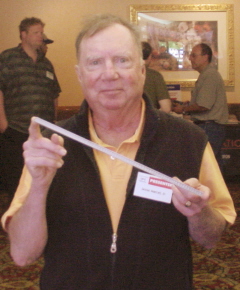
Jesse with I-beam replica.
another planet and might have the first person in modern history to have seen writing created on another world. He had small, replica I-beams made with those symbols on it, and while it is just a replica, it is a very interesting one.

But what I think of mostly, these days is his military service. He had retired from the Montana National Guard as a colonel but was recalled to active duty for service in Iraq. Before he deployed, he asked me if he should take a personal computer with him and I said it had been the best investment I had made, if only for the DVD player in it.

His service there seems to have affected him more deeply than did mine. He spent a year there treating those who needed his help, but came back suffering from PTSD. The deployment cost him his medical practice because he could no longer trust his hands. Loud, sudden noises caused him to jump. He was more on edge, nervous, than he had been before going to Iraq. It was something that the government failed to recognize in the way they should have. He was a patriot who served without complaint, did what was asked of him and made the sacrifices he had to make.

I last saw Jesse in Washington, D.C. in May. He was there with several family
Jesse with daughter Denise.
members and offered his story to the former representatives and senators. They all seemed captivated by what he said, probably because he was one of the few first-hand witnesses to some of the Roswell events present. While many of us could talk of what we had been told by witnesses over the years, Jesse could talk about what he had seen and done personally in July 1947. He handled the debris.

He did call the International UFO Museum in Roswell this year telling them that this would probably be the last year he could attend. His health, while seeming not all that bad, did limit what he could do and how far he could travel. I suspect that he thought his health would deteriorate making a trip to Roswell extremely difficult if not impossible in the near future.
Jesse was a friend and a fellow warrior. I always believed that he understood more about my service in foreign lands because he shared those experiences. We connected on a level that others could not because of that military experience. Though we were never in the war zones at the same time, we did see many of the same places under similar circumstances. He served when he was needed, helped those who needed it, and contributed to our knowledge. I know that I will miss him, though not as much as his family

Tuesday, May 14, 2013

Citizen Hearing and Alien Bodies

At the Citizen Hearing on Disclosure, Merrill Cook asked a question that, at the time was confusing for those of us facing him and his former congressional buddies. He wanted to know, as near as I can figure now, if anyone who claimed to have seen the bodies of the alien creatures had mentioned it in 1947. We all struggled with this as he kept talking about it and we thought of military men who had seen the bodies but who had said nothing until years later. We didn’t think of anyone who had talked about it in 1947, or how we could expect to find anything about that now?
The committee listening to testimony at the Citizen Hearing on Disclosure in Washington, D.C., May 2013.
Of course, a letter or diary that was written at the time would be one way, but the only diary I have ever found that was reliable was that of Ruth Barnett. There was nothing in it to suggest that Barney Barnett had seen anything unusual in 1947. Stan didn’t mention Gerald Anderson, I suspect because he was flanked by Don and me and he believed we would challenge that. Besides, Anderson had admitted to faking one document when confronted with the evidence of that forgery.
I looked at Don and he looked at me. We both thought of Edwin Easley, the provost marshal, but I had nothing from him to suggest he had talked about the bodies in 1947 to anyone. Sitting beside me was Jesse Marcel, Jr., but according to him, his father had never said anything to him about bodies.
The one person we didn’t think of at the time was Frankie Rowe. For this discussion, it doesn’t matter what you think of her tale, and I don’t really want to hear about Karl Pflock’s “evidence” that she wasn’t telling the truth. We know that some of his evidence has been debunked.
 
Frankie Rowe
Anyway, according to Rowe, her father, a fire fighter with the Roswell Fire Department, told her, and the family, that he had gone out to the crash site, and that he had seen the bodies of the alien creatures. Rowe said that her father described creatures as small and hairless.
 
This would have answered the question for Cook. Someone who, in 1947, talked about the alien creatures. One of the fire fighters, when interviewed several years ago, also mentioned that Dwyer, Rowe’s father, had told him, in 1947, some of what he had seen.
Granted, this is testimony gathered years after the event. Granted, it is all second hand. It does, however, answer the question as posed. Was there anyone who talked of the alien creatures at the time, meaning in 1947? The answer is, “Yes.”
Sometimes, we all get lost in the weeds. Neither Don nor I thought of Frankie Rowe in front of that committee. It would have been nice to have her sitting at the table to say, “Yes, my father told me about them that very night.” It would have been a powerful moment.
One that we lost.